Donor capacity: the limit every hair transplant has
The donor area is a limited resource. Understanding its limits is the key to realistic expectations.
A finite resource
The donor area at the back and sides contains the DHT-resistant follicles that hereditary hair loss largely spares. But the number is finite, and typically something in the order of 6 000-8 000 grafts can be harvested over a whole lifetime without the donor area becoming visibly thin.
The central point is that the pool does not grow back. Every graft that is moved is gone from the donor zone for good. A hair transplant moves hair; it does not create new hair.
Why the donor zone is limited
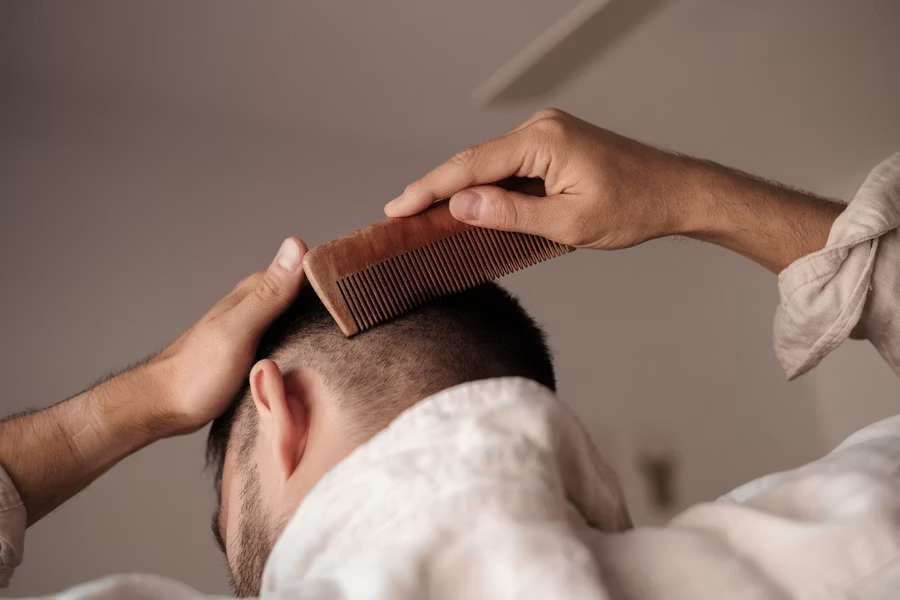
Although it looks as though there is plenty of hair at the back of the head, you cannot harvest all of it. If too many grafts are taken from one area, the donor zone itself becomes visibly thin, what is known as donor depletion. The result is a see-through back of the head, which is often impossible to hide.
Skilled surgeons therefore work with a safe harvesting density: they remove grafts in a spread out pattern and preserve enough hair for the donor zone still to look dense. That sets a natural limit on how much can be moved.
The danger of over-harvesting
One of the most serious, and unfortunately most common, mistakes at unscrupulous clinics is over-harvesting. In order to deliver a high graft count (and an impressive bill), the donor zone is emptied too aggressively. The damage is often permanent: there is no more DHT-resistant hair to draw on, and the thinned back of the head can rarely be repaired.
It is one of the main reasons why the choice of clinic matters more than the price. See the warning signs in choosing a clinic.
Get a free hair analysis
- 1Start
- 2Info
- 3Done
Plan for the future
Because the resource is finite, you have to plan for the long term, especially as a younger patient whose hair loss is still developing. If you use the whole donor pool on a low, youthful hairline at 25, there is nothing left when the crown fails at 40.
A skilled clinic therefore deliberately keeps grafts in reserve and designs with future loss in mind. See why in can future hair loss be predicted.
Protect the pool with medication
The best way to stretch the donor resource is to preserve the hair you already have. Medical treatment such as Finasteride and Minoxidil slows the loss of your original hair, so that you need fewer grafts, both now and later.
The combination of surgery and medication is therefore rarely an either/or. See the documented options in Slowing hair loss without surgery, and get a realistic assessment of your donor capacity before you decide.
Can the donor area be extended?
Some clinics offer to harvest from the beard or body hair (BHT) to supplement a limited scalp donor area. In certain cases that can provide extra grafts, but beard and body hair have a different structure, texture and growth cycle from scalp hair and are rarely suited to the hairline and are better used for filling in at the crown.
It is therefore a supplement with limitations, not an unlimited extra resource. The basic rule stands: the scalp donor pool is finite, and the best strategy is to protect it by preserving existing hair medically. See the options in Slowing hair loss without surgery.
© IdealofMeD Research Academy. Republished with permission.
Get a no-obligation assessment against fixed criteria, directly on WhatsApp.