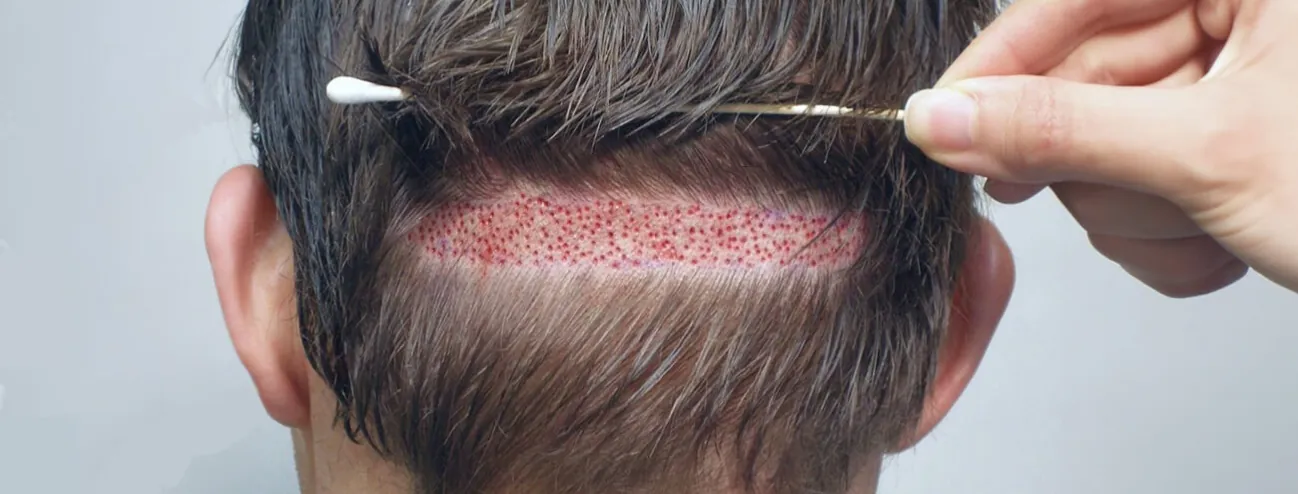
FUT (Follicular Unit Transplantation), also called strip surgery, is a hair-transplant technique that removes a single strip of donor scalp, dissects it into individual follicular units under microscopes, and places those grafts into the recipient area exactly as FUE would. It is the older of the two main donor-harvesting techniques, and although FUE now dominates the market, FUT remains a legitimate, actively used option for specific cases, not an outdated one.
This guide goes through what actually changes with FUT and what does not: how the procedure works, what the resulting scar genuinely looks like at different hair lengths, why some surgeons still choose it in 2026, who it actually suits compared with FUE, how it fits into a longer-term plan that also uses FUE, what recovery involves, what it costs, and how to vet a surgeon specifically for it. It sits alongside our broader guide to hair transplant methods, which compares FUT, FUE, DHI and Sapphire FUE side by side, and our guide to whether you're a candidate overall; this page goes deep on FUT alone.
- FUT changes only how donor hair is harvested, a single dissected strip instead of individual punches, not how grafts are placed, how they survive, or how long they last.
- The trade-off is a single linear donor scar, well hidden at a moderate hair length or longer, visible if that hair is ever cut very short or shaved.
- FUT persists because it can extract a very large number of grafts in one session and leaves the rest of the donor band undisturbed for a later FUE session.
- FUT is typically cheaper per graft than FUE, because dissecting a strip generally takes less individual operator time per graft than one-by-one extraction.
- Results depend more heavily on the individual surgeon and dissection team with FUT than with FUE, so verifying their specific track record matters more.
What is FUT (strip) hair transplantation?
FUT (Follicular Unit Transplantation), also called strip surgery, removes a single thin strip of scalp from the dense, DHT-resistant donor band at the back of the head and closes the wound with sutures. A dedicated team then dissects that strip into individual follicular units, the natural 1-to-4-hair grafts used in any modern technique, under stereo-microscopes. Those grafts are placed into the recipient area exactly as they would be after FUE; the two techniques differ only in how the donor hair is harvested, not in how it is placed or how it grows afterward.
FUT stands for Follicular Unit Transplantation. Almost everyone, patients and clinics alike, just calls it the strip method or strip surgery, because the step that defines it is removing one continuous strip of donor scalp rather than extracting follicles one at a time, which is what FUE (Follicular Unit Excision) does instead. FUT is the older of the two main harvesting techniques, developed as the direct successor to the old multi-hair "plug" era, and it is still a legitimate, actively performed technique in 2026, not a relic clinics quietly avoid mentioning.
A FUT procedure runs in three distinct stages. First, the surgeon marks and removes a single strip of scalp, typically running the width of the safe donor zone at the back of the head, then closes the wound directly with sutures or staples. Second, a dedicated team, often several technicians working in parallel under stereo-microscopes, dissects that strip into individual follicular units: the natural groupings of one to four hairs that are the basic building block of any hair transplant, FUT or FUE alike. Third, those grafts are placed into the recipient area using exactly the same judgment and instruments a surgeon would use after an FUE extraction, whether that means opening channels first or using a DHI implanter pen.
Where FUT and FUE actually diverge
FUT changes only the harvesting step. It does not change what a graft is, how it is placed, how it survives being moved, or how long the transplanted hair lasts once it is growing. A patient treated with FUT and a patient treated with FUE end up with grafts that behave identically in the recipient area, because both are the same thing: the patient's own follicular units, taken from the donor-dominant band at the back and sides of the scalp that stays largely resistant to the DHT responsible for pattern loss.
Why work from a strip at all
Removing a strip gives the dissection team a stationary, well-lit piece of tissue to work through under magnification, rather than following each follicle blind through the skin with a punch. That is the mechanical reason FUT can, in the right hands, extract a very large number of grafts from a single procedure with comparatively little handling damage, covered in depth further down this guide, at the cost of the one linear scar the strip leaves behind, covered next.
What does the FUT scar actually look like, and will it ever fully disappear?
A well-closed FUT scar is a single thin, horizontal line at the back of the head, usually finished with a trichophytic closure that lets hair grow through the healed edge itself, which helps it blend into the surrounding hair. Worn at a moderate length or longer, that hair genuinely hides the line completely for most people; cut to a buzz cut or shaved close, the scar shows as a pale band across the back of the head. Being honest about it: the incision itself is permanent tissue, it does not vanish with time, it just becomes easier to camouflage.
The scar is the single most-asked-about part of FUT, and it deserves a straight answer rather than marketing language in either direction. A strip of scalp is removed, and closing that wound leaves a genuine, permanent incision line at the back of the head, generally somewhere within the safe donor zone above the nape. What varies enormously is how fine that line ends up, and that depends heavily on closure technique and surgeon skill, not chance.
Trichophytic closure, in plain terms
Most experienced FUT surgeons now use a trichophytic closure: one edge of the wound is trimmed at an angle before the two sides are brought together, so that hair follicles sitting right at that edge are able to grow directly through the healed scar tissue rather than stopping abruptly at a bare line. The effect is a scar with fine hairs growing through it, which breaks up the pale, hairless look of an older-style closure and lets it blend into the surrounding donor hair far more convincingly.
Short hair versus longer hair
At a moderate length or longer, meaning the hair simply lies over the area the way it grows naturally, a well-executed FUT scar is genuinely difficult to find, even for someone looking for it in a mirror. The honest limit is length: a buzz cut, a fade that runs short over the donor area, or a fully shaved head at a very short guard length will reveal the line as a pale horizontal band, because there is not enough surrounding hair left to cover it. Anyone who wants the option of shaving their head at any point in the future, not just now, should treat this as a real, permanent constraint rather than a minor cosmetic detail.
What actually widens or worsens a scar
- Too wide a strip for the scalp's laxity. Closing a strip under too much tension is the single biggest cause of a scar that stretches and widens over the following months.
- Repeat FUT sessions. A second or third strip procedure often removes a new strip adjacent to, or including, the healed scar, which can widen the overall band if not planned carefully.
- A genuine keloid or hypertrophic scarring tendency. This is a real, if less common, factor worth flagging to a surgeon before choosing FUT specifically.
- Poor closure technique. A rushed or non-trichophytic closure heals as a harder, more visible line even in a patient with otherwise favourable healing.
Being honest about the word "permanent" here
The scar itself is a permanent feature of a FUT donor area. It typically softens, flattens and lightens in colour over the following year, and a good trichophytic closure camouflages it very well, but it does not disappear the way a course of medication wears off. This is the trade-off at the centre of the entire FUT-versus-FUE decision, covered in full a little further down, and it is worth weighing seriously before surgery, not discovering afterward.
Why does FUT still exist in 2026, when most clinics promote FUE?
FUT persists because, in specific cases, it still does two things better than FUE: it can extract a very large number of grafts in a single session with comparatively low handling damage, and because it draws from one concentrated strip rather than thinning hair across the entire donor area, it leaves the rest of that area undisturbed for a future FUE session. Industry-wide, FUT is now a minority technique, the ISHRS's 2025 global Practice Census found FUE used in roughly 85.4% of male procedures against roughly 12.5% for strip/linear (FUT) harvesting, but that is a meaningful minority still being chosen deliberately, not a leftover habit.
FUE became the default technique for good, legitimate reasons: most patients strongly prefer not to have a linear scar, and want the freedom to wear their hair very short at any point in the future. That shift in patient preference is real and has genuinely reshaped the market. But "most people prefer FUE" is not the same statement as "FUT no longer has a purpose," and surgeons who maintain FUT capability generally keep it for identifiable clinical reasons rather than out of habit.
What the data actually shows
According to the International Society of Hair Restoration Surgery's (ISHRS) 2025 global Practice Census, FUE harvesting was used in roughly 85.4% of male hair-restoration procedures, against roughly 12.5% for strip or linear (FUT) harvesting, with the remainder covering combined or other approaches. That confirms FUT is now clearly a minority technique, but a meaningful one: something close to one in eight male procedures worldwide still uses it, a considerably higher share than "a handful of old-school holdouts."
Reason one: maximum graft yield in a single session
A trained dissection team working in parallel on a stationary strip under microscopes can often process a very large number of grafts in one sitting more efficiently than extracting the same count one follicle at a time. For a patient with extensive loss who wants as much addressed as possible in a single operation, rather than staged across two or more sessions, that throughput is a genuine, practical advantage.
Reason two: preserving the rest of the donor band
Because a strip is taken from one concentrated band rather than spread thinly across the whole donor area, FUT can often leave the overall visual density of the surrounding donor hair looking less disturbed than an equally large FUE session would. That matters most for anyone who may need a second procedure years later, which is exactly the donor-budget strategy covered in the next section.
Reason three: consistency at scale
Because the dissection work happens on a stationary strip rather than requiring the extraction itself to be done one graft at a time by hand or motorised punch across an entire session, a well-staffed clinic can plan very large sessions with a predictable division of labour between the surgeon and the dissection team. Our blog covers a shorter, more practical take on when FUT specifically makes sense alongside this guide.
FUE or FUT: who actually benefits from choosing strip surgery?
Strip surgery tends to genuinely suit a fairly specific patient: someone with extensive hair loss who wants the maximum realistic graft count from a single session, someone who is comfortable keeping their hair at a moderate length or longer indefinitely, and someone whose scalp laxity and donor density make a strip realistic to close without excess tension. FUE suits nearly everyone else, especially anyone who wants to keep the option of ever shaving their head. Neither technique is objectively superior; the right one depends on your hair-length plans and the scale of your case, not on whichever method a particular clinic happens to prefer.
The honest framing here is not "FUT versus FUE, pick the winner," it is "which trade-offs matter more to you." A few concrete factors shift the calculation genuinely toward FUT rather than the default of FUE.
Factors that point toward FUT
- Extensive loss needing a large single-session graft count. Advanced Norwood stages, where addressing as much as possible in one operation matters more than avoiding a scar.
- A firm, long-term commitment to hair of moderate length or longer. Not "probably won't shave," genuinely won't, since the scar is the whole trade-off.
- Favourable scalp laxity and donor density. A surgeon needs enough looseness to close a useful strip width without excess tension.
- A donor area not yet touched by FUE. Someone starting fresh has intact tissue for a clean strip closure; someone already extensively FUE-harvested may have less ideal tissue for it.
- Cost sensitivity, alongside the other factors above. Covered in full later in this guide, but it rarely stands alone as the only reason to choose FUT.
An honest comparison
| Factor | FUT (strip) | FUE |
|---|---|---|
| Donor scarring | One linear scar, permanent, hidden by hair of moderate length or longer | Scattered tiny dot marks, far less visible even when cut short |
| Future hair-length freedom | Limited; a shaved or buzzed back and sides shows the line | High; most people can go very short without it showing |
| Graft yield in one sitting | Can be very high; a genuine strength of the technique | Also high, but more time- and staff-intensive per graft at very large counts |
| Typical price per graft | Usually lower | Usually higher |
| Early donor-area recovery | More wound tension and soreness for the first days | Faster, generally less donor-area discomfort |
| Effect on the rest of the donor band | Leaves it undisturbed for a possible later FUE session | Spreads extraction, and thinning, across the whole donor band |
For the complete picture across every technique, including DHI and Sapphire FUE, not just FUT and FUE, see our full guide to hair transplant methods. A rough sense of your own graft need is also worth having before this conversation with a surgeon, which our graft calculator can give you as a starting estimate.
Can FUT and FUE be combined across several hair transplants?
Yes, and it is a common, deliberate long-term strategy rather than a sign the first procedure fell short. A typical sequence uses FUT for an early session that needs the largest realistic graft count, then FUE later, from the area around the healed scar or elsewhere in the donor band, for smaller top-up sessions. Planning this way, rather than choosing a technique session by session, is what lets a surgeon get the most usable grafts out of a donor supply that realistically supports somewhere in the region of 6 000 to 8 000 grafts over a lifetime.
Donor hair is not a resource you can replenish; it is closer to a lifetime budget that a first procedure either spends carefully or spends carelessly. Because FUT and FUE harvest from the same finite donor band in different ways, a considered long-term plan often uses both, at different points, rather than treating the choice as a one-time, permanent decision. This is exactly the territory our dedicated guide to donor hair supply covers in full; this section focuses specifically on how FUT fits into that lifetime picture.
A common sequence, and why it works
One frequently used pattern starts with FUT for the largest session, often when loss is more extensive and a high graft count matters most, then moves to FUE later, sometimes years later, for smaller refinements drawn from the areas around the healed strip scar or from elsewhere in the donor band. Because FUT concentrates its harvesting into one band rather than spreading it across the whole donor area, it tends to leave more of that wider area untouched and available for a later FUE session, which is precisely the mechanism covered in the previous section.
Why the order isn't a fixed rule
The reverse order is also entirely legitimate. Someone who starts with FUE, then later needs more grafts than a further FUE session can comfortably provide without over-thinning the donor area, may reasonably add FUT at that later stage instead, accepting the scar trade-off only once it is genuinely necessary. Neither sequence is objectively correct; the right one depends on how much you need now, how much you're likely to need later, and how strongly you feel about keeping the option to shave your head at each stage.
What a surgeon actually plans around
A responsible plan treats every session, FUT or FUE, as a withdrawal from the same account: today's realistic graft need, the size and quality of the safe donor zone, and a conservative estimate of how much further loss might still occur. Spending the entire lifetime budget on a single early session, with either technique, is the classic mistake that leaves nothing in reserve if more loss follows.
How is recovery different after FUT compared with FUE?
The donor-area recovery genuinely differs: FUT leaves a sutured or stapled wound under tension for the first couple of weeks, so the back of the head is typically sorer, stiffer and more restricted in movement than after FUE's scattered puncture marks, and strenuous activity is usually restricted for longer. The recipient-area healing and hair-growth timeline, however, is identical for both techniques: shedding around weeks 2 to 3, new growth from roughly month 3 to 4, and the final result judged at around 12 months, because that stage depends on the graft and the recipient site, not on how the donor hair was harvested.
It helps to separate two things people often lump together: how the donor wound heals, which genuinely differs between FUT and FUE, and how the transplanted hair itself grows, which does not.
The donor wound: where FUT recovery is genuinely harder
A sutured or stapled strip wound is under some tension from the moment it is closed, and that tension is what makes the first week or two feel noticeably different from FUE's donor area: more soreness at the back of the head, a stiffer, more restricted range of neck movement, and a wound that needs a follow-up visit to check healing and, if non-dissolving sutures or staples were used, remove them, typically somewhere around one to two weeks afterward. Strenuous exercise, heavy lifting, swimming and contact sport are generally restricted for longer than the equivalent FUE guidance, since anything that stretches the scalp puts direct tension on a healing incision in a way it does not on scattered puncture marks.
FUE's donor area, by comparison
FUE's many small, individual puncture sites close and scab over largely independently of each other, with no single wound under tension holding the whole area together, which is generally why people report noticeably less donor-area soreness and a faster return to normal head movement and light activity after FUE than after FUT.
The recipient area and the growth timeline: identical either way
None of the difference above touches the recipient area or the growth timeline, because both are determined by the graft and the site it is placed into, not by how it was extracted. Whichever technique harvested the donor hair, the transplanted hairs typically shed around weeks 2 to 3, which is normal and expected rather than a sign anything has gone wrong, new growth begins from roughly month 3 to 4, and the final, full result is judged at around 12 months. Our full aftercare guide covers this general routine, sleeping position, washing, sun exposure, in depth; this section covers only what is specifically different about the FUT donor area on top of it.
Recovery differences at a glance
- Soreness and tension. More noticeable at the donor area with FUT for the first week or two; FUE's donor area is generally more comfortable, sooner.
- Follow-up visit. FUT typically needs a check, and possibly suture or staple removal, roughly one to two weeks after surgery; FUE generally does not.
- Activity restrictions. Strenuous exercise, heavy lifting and contact sport are usually restricted for longer after FUT, since tension on the wound is the specific risk being managed.
- Recipient-area healing and growth. Identical timeline for both: shedding weeks 2 to 3, growth from month 3 to 4, final result around 12 months.
Is FUT cheaper than FUE, and why?
Usually, yes. At clinics that price by technique, FUT is typically the least expensive option per graft, often cheaper than both standard FUE and DHI or Sapphire FUE. The main reason is labour: dissecting an already-removed strip in parallel, with a team working through it under microscopes, generally takes less individual operator time per graft than extracting each follicular unit one at a time directly from the scalp, and that time saving is what tends to show up as a lower per-graft price.
Price differences between techniques mostly come down to one thing across this entire site's pricing guide: how much skilled, hands-on operator time a technique requires for each individual graft. DHI is usually priced above standard FUE for exactly this reason, more time, more precision, often a more specialised team. The same logic applies in reverse to FUT, which is why it tends to sit at the lower end of the per-graft range rather than the higher end.
Why the labour math favours FUT
Removing a strip is a single, relatively quick surgical step. From there, a team of technicians works through the dissection in parallel under microscopes, rather than one practitioner extracting each graft individually and sequentially from the scalp as FUE requires. Spread across a large session, that difference in hands-on time per graft is what generally lets clinics offer FUT at a lower per-graft rate while still covering their costs.
Where a lower price can be misleading
A lower headline price is only a genuine saving if the graft count and the quality of the work are actually equivalent. The same rule that applies to any technique applies here: always ask for the total price and the expected graft count together, in writing, rather than comparing headline numbers alone. A clinic offering FUT at a price that looks unusually low, combined with vague answers about graft numbers or who performs the dissection, is the same warning sign it would be with any other technique, not a special exception because FUT happens to be cheaper on average.
The trade you are actually making
A lower price with FUT is not a discount with no cost elsewhere. You are trading it against the linear scar covered earlier in this guide and the longer, more restricted donor-area recovery covered just before this section. For some patients, extensive loss, a firm commitment to moderate-length hair, that trade is genuinely worth making. For someone who might want to shave their head one day, it usually is not, whatever the price difference looks like on paper.
How do you choose a surgeon for FUT specifically?

FUT is more surgeon-dependent than FUE because two separate skills both have to be excellent at once: the hand closing the strip wound at the right tension with a clean trichophytic edge, and a dissection team's precision working through hundreds or thousands of grafts under a microscope without damaging them. A rushed or inexperienced team can turn the exact same strip into a wide, obvious scar and a disappointing graft yield that a skilled team would have closed into a fine line with a strong result.
Every technique rewards an experienced surgeon, but FUT genuinely widens the gap between a well-run procedure and a poorly run one, because more of the outcome depends on decisions made by hand, not on a standardised extraction tool used the same way case after case. That makes verification before booking more important with FUT than with FUE, not less.
What to verify specifically for FUT
- Donor scar photos at short hair length. Ask to see how this specific surgeon's previous FUT scars look with the surrounding hair cut close, not only grown out, since that is the honest test of closure quality.
- Who performs the closure. A named, qualified surgeon should close the strip wound, and it is reasonable to ask directly whether trichophytic closure is used routinely or only on request.
- Who dissects the strip. A consistent, experienced technician team handling graft dissection matters as much as the surgeon's own skill, since a damaged graft at the dissection stage cannot be transplanted regardless of how well the strip was removed.
- How strip width is decided. It should be assessed against your individual scalp laxity, not applied as a fixed default regardless of the patient.
- Aftercare specifics for the donor wound. What a normal healing pattern looks like, when sutures or staples are checked or removed, and how to reach the clinic if something looks wrong.
These questions sit alongside, not instead of, the general checklist in our guide to clinic red flags, which covers named surgeons, verifiable accreditation and transparent pricing for any technique. See how to choose a clinic step by step, compare options in the clinic ranking, and check the best clinics; then bring the FUT-specific questions above to whichever clinics you shortlist.
"More surgeon-dependent" is not a reason to avoid FUT
In experienced, well-organised hands, FUT still reliably delivers a fine, well-camouflaged scar and a strong graft yield; the point of this section is that the range of possible outcomes is wider with a mediocre team than it would be with FUE, not that the technique itself is inherently risky. That is exactly why the verification above matters more here than almost anywhere else in this guide.
Frequently asked questions
Is FUT the same thing as strip surgery?
Yes. FUT (Follicular Unit Transplantation) and strip surgery are two names for the same procedure; "strip surgery" is simply the plain-language description of how the donor hair is harvested, as a single strip of scalp rather than individual follicles.
Does FUT hurt more than FUE?
During surgery, no, both are performed under local anaesthesia, so you feel pressure and movement rather than pain either way. In the first week or two afterward, the FUT donor area is usually sorer and stiffer than FUE's, because a sutured strip wound under tension heals differently from many small, individually closing puncture marks.
Can you shave your head after a FUT hair transplant?
Not without the scar showing. Hair worn at a moderate length or longer generally hides a well-closed FUT scar completely, but a buzz cut or a fully shaved head at a short guard length will reveal it as a pale horizontal line at the back of the head, which is the main reason to choose FUE instead if you want to keep that option open long-term.
How many grafts can a single FUT session yield?
There is no separate, FUT-specific ceiling; realistic yield depends on your donor density, scalp laxity and how wide a strip can be closed without excess tension, generally within the same broad ranges, often 2 000 to 4 000 grafts or more for a large session, used to plan any large procedure. FUT's real advantage is reaching the higher end of that range efficiently in one sitting, not access to some larger pool of grafts FUE cannot reach.
Is a FUT scar permanent, or does it eventually fade away completely?
The incision line itself is permanent tissue; it does not disappear entirely, even with a well-executed trichophytic closure that lets hair grow through its edge. What it typically does is soften, flatten and lighten in colour over the first year, and become genuinely hard to spot once hair of moderate length or longer grows over it.
Can FUT and FUE be used together in the same overall treatment plan?
Yes, this is a common, deliberate lifetime strategy rather than an unusual choice. A typical pattern uses FUT for an early, larger session, then FUE later for smaller top-ups drawn from the area around the healed scar or elsewhere in the donor band, spending the same finite donor supply through two different harvesting techniques over time.
The only reliable way to know whether your donor area, your hair-length plans and the scale of your loss make FUT genuinely worth its trade-offs is a proper look at your own case, not a general article. Get a free hair analysis and hear back from our #1-ranked clinic with an honest read on your donor area, scalp and options, with no obligation to go further.
General educational guidance, not medical advice. Whether FUT is the right technique for you is confirmed by a qualified surgeon at a personal assessment.
Last updated: August 2026 · Editorial standards