
Perhaps you have noticed more hair in your brush, a wider parting or a crown that shows through. It can feel lonely and a little embarrassing, but you are far from alone, and the first step is not surgery. It is understanding why it is happening.
Hair loss in women usually looks different from hair loss in men, and in many cases it is something that can be treated if the cause is found in time. On this page you get the overview: the typical causes, what you can do yourself, and when a hair transplant is the right path at all.
What causes hair loss in women?
Women typically lose hair because of hormonal shifts, telogen effluvium after childbirth or illness, iron deficiency, stress or hereditary female hair loss. Unlike men, women rarely go completely bald; the hair thins evenly across the crown. Shedding 50 to 100 hairs a day is entirely normal.
There is rarely only one explanation. In women, hormones often play a central role, and the hair can react strongly to major shifts such as pregnancy, the period after childbirth, coming off the contraceptive pill or the menopause. Low iron measured as ferritin and thyroid problems are among the most common, and most overlooked, causes of diffuse hair loss, and fortunately both can be clarified with a simple blood test at your doctor.
Stress and illness can push many hairs into the resting phase at once, so the loss only shows a couple of months later. Finally, there is hereditary female hair loss, where the hair slowly thins across the crown over the years. Because the treatment depends entirely on the cause, it almost never makes sense to guess. You can read more in our thorough review of causes of hair loss.
What causes sudden hair loss in women?
Sudden, diffuse hair loss in women is most often caused by telogen effluvium, where a physical or psychological strain pushes many hairs into the resting phase at once. It typically begins 2 to 3 months after the trigger, for example childbirth, fever, surgery or stress, and usually resolves within 6 to 12 months.
Telogen effluvium sounds serious, but it is usually temporary. Day to day, the vast majority of your hairs are in the growth phase, and only a smaller part is resting. A heavy strain, for example childbirth, a high fever, surgery, a strict diet or a hard period of stress, can send many hairs into rest at the same time. Some months later they fall out, often to a degree that can seem frightening when you see it in the drain or on your pillowcase.
The good news is that the follicles rarely take lasting damage. Once the trigger is over, the hair usually returns gradually by itself. If the loss continues for more than half a year, or comes with other symptoms such as fatigue, weight change or irregular periods, you should have blood tests taken at your doctor, so that an iron deficiency or a thyroid problem is not overlooked.
How does hair loss in women differ from men?

In women, hair loss is most often diffuse: the hair thins evenly across the crown, while the hairline at the forehead is usually preserved, and completely bald patches are rare. In men, it typically starts at the temples and crown. Female hair loss is often described with the three stages of the Ludwig scale, men's with the seven of the Norwood scale.
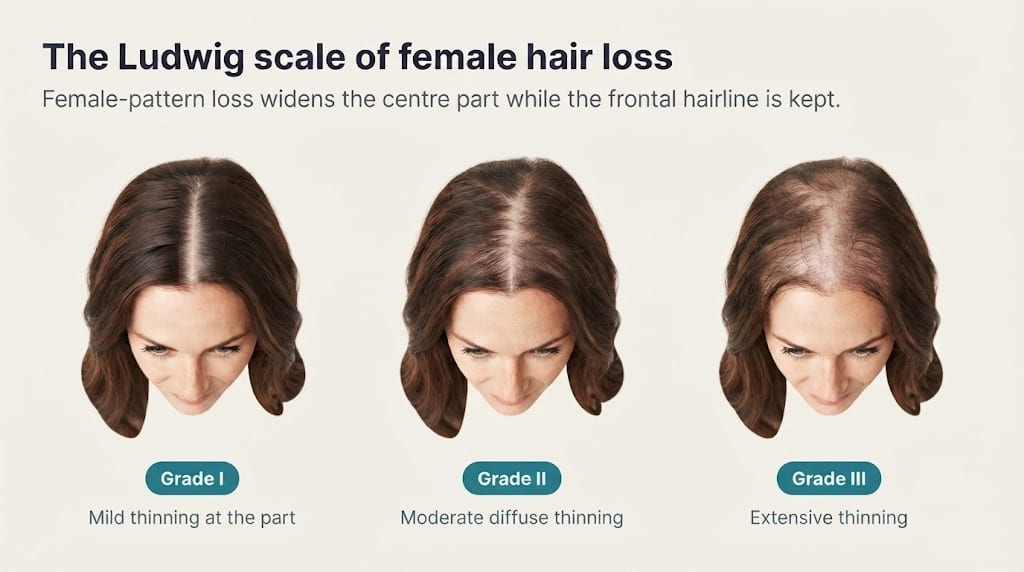
| Women | Men | |
|---|---|---|
| Typical pattern | Diffuse thinning across the whole crown | Receding temples and a thinner crown |
| Hairline at the forehead | Usually preserved | Often recedes |
| Bald patches | Rare | Common over time |
| Assessment scale | Ludwig, three stages | Norwood, seven stages |
The difference matters, because it changes both the assessment and the treatment. When the hair thins evenly rather than in a clear pattern, there is more often an internal cause that can be treated, and that should be found before surgery is even discussed. That is precisely why women often need a more thorough assessment than men. If you want to go deeper, we have a thorough article on hair loss in women.
What can you do about hair loss without surgery?
Hair loss in women can often be slowed without surgery. If you treat an underlying cause such as iron deficiency or thyroid problems, the hair may return by itself. Documented treatments such as Minoxidil require patience and are typically used daily for at least 6 to 12 months before the effect can be judged.
A great deal can be done without surgery, and for most women this is where you start. If the loss is down to an underlying cause such as iron deficiency, thyroid problems or a period of stress, the hair can often return once the cause is corrected. For hereditary female hair loss there are documented treatments that can slow the loss and make the hair denser over time, and some clinics also offer supplementary treatments against thinning. What they all have in common is that they require patience before the effect can be judged.
If your hair loss has come on quickly or comes with other symptoms, get your iron, thyroid and hormones checked at your doctor first, for example. A hair transplant moves hair, it does not treat the cause. We have gathered the whole non-surgical toolbox in the guide stop hair loss without surgery, and you can also read about iron deficiency and hair loss.
When is a hair transplant relevant for women?
Yes, women can also have a hair transplant, but it is not always the right first step. In many women the hair loss is diffuse and caused by something that can be treated without surgery. That is why a good assessment starts with finding the cause, not with booking an operation. A result typically takes 9 to 12 months.
A hair transplant can be a good solution for some women, but it is rarely the first thing you should do. The best results are seen when the hair loss is well defined rather than diffuse, and when the donor area at the back of the head is stable and dense. That applies, for example, to a wide parting, a high or receded hairline, scar tissue or traction alopecia, that is, hair loss from tight hairstyles such as ponytails and braids.
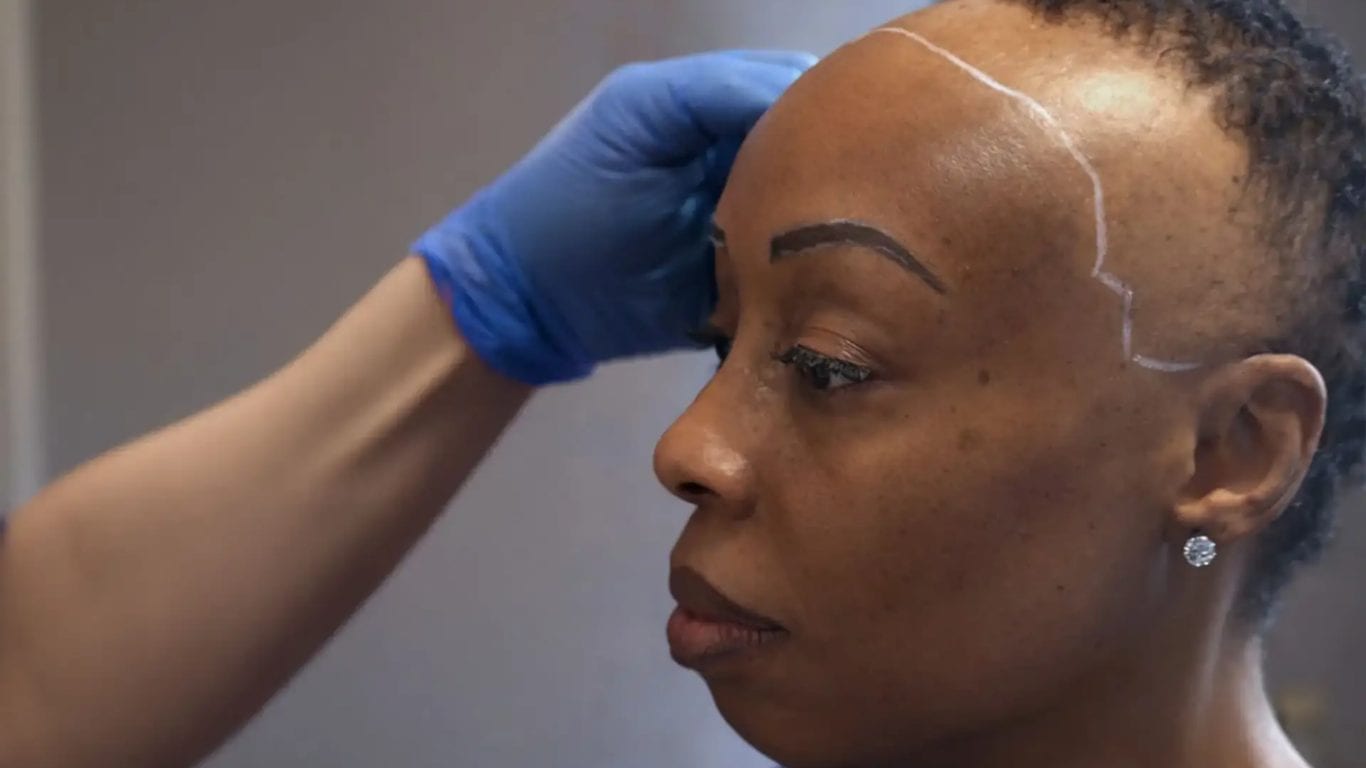
If, on the other hand, the hair loss is diffuse across the whole crown, and the donor hair is itself thinning, a transplant is rarely the right path, because a moved hair can end up shedding along with the rest. A transplant also does not stop ongoing loss, so the underlying cause must be addressed no matter what. A good assessment therefore looks at the cause, the donor area and expectations alike. Read more about the methods, try our graft calculator, and see how you choose a clinic. If you want the surgeon's perspective, we have an article on hair transplants for women.
Frequently asked questions
Does hair loss after childbirth go away by itself?
Yes. It is telogen effluvium and is temporary. It typically starts 2 to 4 months after the birth and usually resolves within 6 to 12 months.
Can women also have a hair transplant?
Yes, but it depends on the type of hair loss you have. A transplant moves your own hair and requires a stable donor area at the back of the head. With diffuse hair loss across the whole crown the result is more uncertain, so the cause should always be investigated first. A free hair analysis can clarify it in a few minutes.
Does my hair have to be shaved off completely for a hair transplant?
No, not necessarily. Often only a small area in the donor zone at the back of the head is trimmed short, and it can be hidden by the hair above. With some techniques you avoid shaving visible hair altogether. The trimmed area typically grows back over a few weeks. Always ask the clinic what your specific method requires.
Is a hair transplant permanent, or do the new hairs also fall out?
The transplanted hairs are taken from the back of the head, which is normally resistant to hereditary hair loss, so they usually last for life. It is entirely normal, though, that the new hairs shed 2 to 3 weeks after the procedure and only begin to grow again after 3 to 4 months. Your remaining hair is not protected, so the cause should still be treated.
Is the hair analysis private and confidential?
Yes. You fill in a short form in a couple of minutes and get an assessment from home, without having to turn up anywhere. The consultation is free and completely without obligation, and you decide for yourself whether and when to go further. No one expects you to book an operation.
Hair loss can weigh on you, and it is entirely understandable if it affects how you feel. But remember that hair loss in women is often something you can act on once you know the cause. The most important first step is not an operation. It is an honest assessment of what is going on.
With a free hair analysis you get exactly that: a confidential assessment from home, entirely without obligation. You find out what is behind your hair loss, and whether a hair transplant is relevant for you at all, or whether something quite different will help you better. You decide every step along the way.
Last updated: July 2026 · Editorial standards