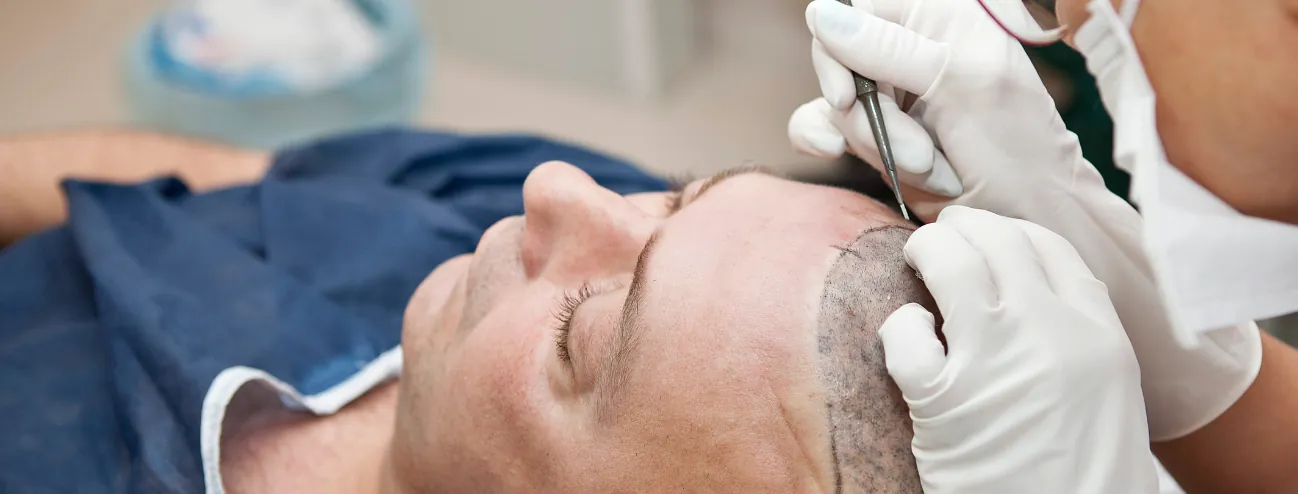
What is Sapphire FUE, and is it actually better than regular FUE? Sapphire FUE is standard Follicular Unit Extraction with one change: the recipient channels, the tiny openings each graft is placed into, are cut with a blade of synthetic sapphire instead of surgical steel. Extraction itself, how follicles are removed from the donor area, is identical to standard FUE. The blade can support narrower, more consistent incisions, a genuine and plausible advantage, but it does not make Sapphire FUE a separate operation, and the surgeon's skill still shapes the result far more than the blade material does.
This guide sets out exactly what the sapphire blade changes, what the evidence actually supports next to what clinics market, how healing compares, who is likely to benefit most, how Sapphire FUE stacks up against DHI, and whether any price premium is worth paying. It sits alongside our broader guide to hair transplant methods, which covers FUE, DHI, FUT and Sapphire FUE together. If you are still working out whether you are a candidate for a transplant at all, start with am I a candidate.
- Sapphire FUE is standard FUE extraction plus a sapphire-blade recipient channel; it is not a different procedure or a different way of removing follicles.
- The claimed advantages, narrower incisions, denser packing, gentler healing, are physically plausible and modest in practice; large-scale independent trial evidence is limited.
- The surgeon's technique, planning and hairline design affect the result far more than whether the blade is sapphire or steel.
- Sapphire FUE and DHI change different steps of the procedure, incision versus implantation, and clinics often combine them rather than choosing one over the other.
- The shedding, regrowth and final-result timeline, weeks 2-3 shed, growth from around month 3-4, final result around 12 months, is unchanged by which blade opened the channels.
What is Sapphire FUE, and how does the procedure work?
Sapphire FUE is standard Follicular Unit Extraction in which the recipient channels are cut with a blade made of synthetic sapphire instead of surgical steel. Follicles are still removed one by one from the donor area exactly as in regular FUE; only the instrument used to open the tiny sites that receive each graft changes. It is a variation on one step of an FUE procedure, not a separate transplant technique.
Every FUE-based hair transplant has two distinct steps, whatever a clinic calls it: extraction, removing individual follicular units from the donor area at the back and sides of the scalp, and placement, opening a recipient site and setting each graft into it. Sapphire FUE only changes a detail within the second step. It leaves extraction, graft handling, and the overall structure of the operation untouched.
Extraction: unchanged
Follicles are still harvested one at a time with a small circular punch, sorted by the number of hairs they contain, and kept in a cooled holding solution until they are placed. None of that differs between "Sapphire FUE" and any other form of FUE; the word only describes what happens at the recipient site.
Placement: where the blade comes in
In classic FUE, the surgeon opens a recipient channel first, and a graft is placed into it afterwards, often by a second team member. Sapphire FUE uses a sapphire blade to make that channel instead of a steel one. The graft is then placed the same way it would be with a steel-blade incision.
Why the name can be misleading
Marketed on its own, "Sapphire FUE" can sound like a distinct, more advanced procedure. It is more accurate to think of it as a component choice inside FUE, comparable to choosing a particular brand of punch: a real variable in the plan, but one part of a larger operation whose outcome still depends mostly on the person performing it.
What does a Sapphire blade actually change compared with steel?
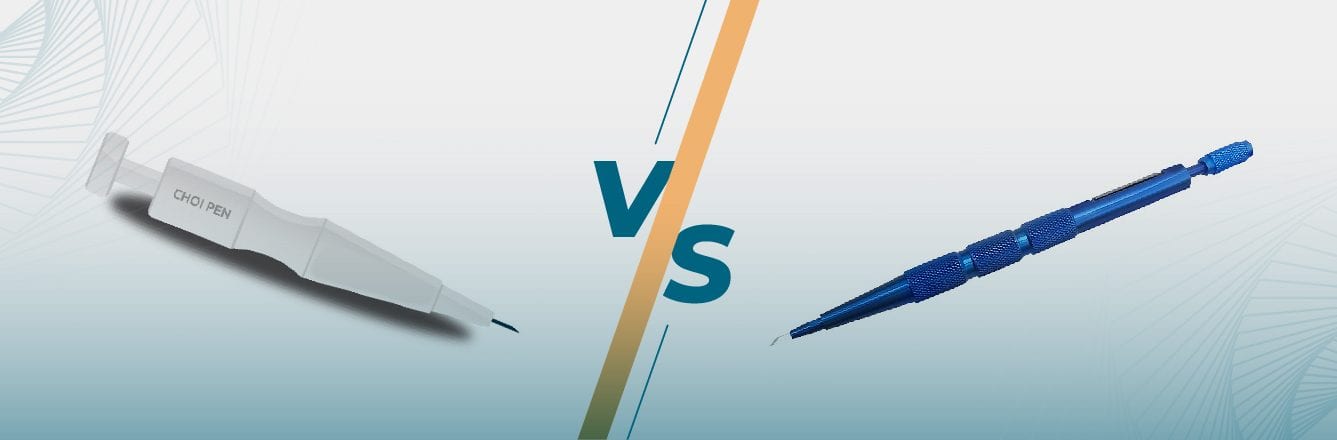
A sapphire blade is harder than surgical steel and can be ground to a finer edge, which lets it cut a narrower, more consistent V-shaped incision with less lateral compression of the surrounding tissue. In principle, that supports tighter graft spacing, steadier incision angles, and slightly less visible trauma around each channel. In practice the difference is one of degree, not a result that is only achievable with one blade material.
The physical difference
Surgical steel blades are strong and reliable but wear down with use and, compared with sapphire, take a comparatively coarser edge over time. A sapphire blade, cut from a hard synthetic crystal, holds a finer, more consistent edge for longer and is typically shaped to create a narrow V-shaped slit rather than a wider incision. A sharper, narrower cut is a real, mechanically sound reason to expect less tissue disruption around each recipient site.
What that is claimed to support
Clinics that use sapphire blades typically point to three claimed benefits: the ability to pack grafts closer together without channels merging into one another, more consistent control over the angle and direction each hair is set at, and less bleeding or crush injury immediately around the incision. Each of these follows logically from a narrower, cleaner cut.
What it does not change
A sapphire blade does not extract follicles, does not decide graft distribution across the scalp, does not design the hairline, and does not determine how many grafts survive long term. Those outcomes are set by the surgeon's planning and hand, not by the incision tool, which is why the blade is one input into the result rather than the result itself.
Does the evidence actually support the marketing claims for Sapphire FUE?
Partly. The physical case for a sapphire blade, harder material, finer edge, less lateral tissue disruption, is sound, and some small studies and clinic-reported case series describe less swelling and cleaner incisions with sapphire compared with steel. What the evidence does not support is the idea that the blade itself determines your outcome: no large, independent trial has shown sapphire incisions produce a meaningfully better long-term result than steel in comparably skilled hands, and technique remains the dominant variable.
What is genuinely plausible
The mechanism behind sapphire's claimed advantages is not marketing fiction. A harder blade that holds a finer edge for longer really does cut with less lateral tissue disruption, and a narrower channel really can allow tighter spacing before adjacent incisions start to compromise each other. This part of the claim is grounded in basic surgical mechanics, not invented.
What the research base actually looks like
Most of the published comparisons between sapphire and steel incisions are small, short-term, and frequently produced or funded by clinics or instrument makers with a direct interest in the result, a genuine limitation, not a reason to dismiss them outright. Independent, large-scale, long-term trials comparing graft survival and final density between sapphire and steel are scarce. That gap is exactly why a responsible source describes the benefit as plausible and modest rather than proven and large.
What professional bodies actually emphasise
Organisations such as the International Society of Hair Restoration Surgery (ISHRS) direct patients toward checking a surgeon's training, certification and documented, verifiable results, not toward any specific blade or instrument brand. That is a telling signal: the field's own professional body puts its weight behind who performs the procedure, not what it is marketed as being done with. See the fuller set of checks in how to choose the right clinic.
The honest summary
Sapphire incisions are very likely a genuine, if modest, technical refinement in experienced hands. They are not independently proven to transform outcomes, and no reputable source should present them that way. Treat "Sapphire" as one detail to note, not as the deciding factor in choosing a clinic.
Does Sapphire FUE heal differently, with fewer crusts?
Some early healing differences are plausible and are reported anecdotally: a narrower, cleaner incision can mean smaller crusts and slightly less pinpoint bleeding in the first days. It does not meaningfully shorten the overall recovery timeline. Crusts still form over the days after surgery and typically clear within one to two weeks, shedding of the transplanted hairs still happens around weeks 2-3, and new growth still starts from around month 3-4, whichever blade opened the channels.
What sapphire may change in the first days
A narrower incision generally means a smaller wound at each recipient site, which is consistent with the modestly reduced early bleeding, redness and crusting sometimes reported with sapphire blades. If this effect is real, it is most visible in the first three to five days, when the recipient area is at its most sensitive.
What stays exactly the same
The biological process of healing does not run on a different clock because of the incision tool. Crusts form, itch, and fall away over roughly the first one to two weeks; a temporary shedding of the transplanted hairs, not the follicles, is normal from around week 2 through week 3; and new, near-permanent growth begins from about month 3-4 and continues toward a final result at around 12 months. None of that changes with blade choice. The full day-by-day course, including washing, sleeping position and what is normal versus what is not, is covered in aftercare after a hair transplant.
Why this is not a reason to choose or avoid Sapphire FUE on its own
Even a genuine, modest reduction in early swelling or crusting is a comfort difference in the first week, not a change to whether or how well your hair grows back. Deciding on Sapphire FUE for faster healing alone overweights a short-term, cosmetic effect against the far larger factors that determine your result at 12 months: planning, execution and aftercare discipline.
Who benefits most from Sapphire FUE?
Sapphire FUE is most often discussed for high-density hairline and frontal work, where tight, consistent graft spacing and precise angling matter most to how natural the result looks. It matters comparatively less for large-area crown or mid-scalp coverage, where spacing between grafts is inherently more forgiving. Whether it is worth seeking out for your case depends far more on the surgeon's hairline design skill than on the blade alone.
Where tighter packing genuinely matters
The hairline is the most visually demanding zone in the entire procedure: single-hair grafts have to sit close enough together to avoid a see-through look, at consistent forward-raked angles, without channels crowding each other to the point of damaging neighbouring grafts. This is the scenario where a narrower incision offers the clearest theoretical advantage, since it creates more physical room to pack grafts densely without compromising blood supply to each one.
Where it matters comparatively less
Across a large crown or mid-scalp area, grafts are typically spaced somewhat more generously to begin with, and the visual standard for "natural" is less exacting than at the hairline. A narrower incision is still a reasonable default there, but it is not the deciding factor in how full or natural a large area will look; graft count, distribution and the surgeon's overall plan carry more weight.
Working out what your own plan needs
How many grafts a hairline or a full plan realistically needs depends on the size of the area, your hair's calibre and curl, and your donor supply, not on the blade type. A rough first estimate is useful before that conversation; try our graft calculator for a starting figure, then confirm it against your own hair at a personal assessment.
How does Sapphire FUE compare with DHI?
They change different steps of the same broad procedure, so they are not direct substitutes. Sapphire FUE changes how the recipient channel is cut, a sapphire blade instead of steel, with the graft placed afterwards, while DHI changes how the graft is placed, a Choi implanter pen opens the channel and inserts the follicle in a single motion, with no separate channel step at all. Many clinics combine the two, using an implanter pen in the hairline and sapphire-opened channels elsewhere.
"Sapphire vs. DHI" is a common framing in marketing, but it compares two things that are not actually opposites; one is an incision tool, the other is a placement method. Seeing exactly where each one sits in the procedure makes the comparison far more useful than the marketing shorthand does.
| Step | Sapphire FUE | DHI |
|---|---|---|
| Extraction | Follicles removed one by one with a fine punch | Same FUE-style extraction |
| Recipient channel | Cut first, with a sapphire blade | No separate channel; the Choi pen creates it and places the graft in one motion |
| Placement | A graft is placed into the pre-cut channel, often by a second team member | Placed by the same instrument, at the same moment the channel is made |
| Where control is strongest | Consistent channel shape and density across an area | Fine, immediate control over angle, depth and direction, hair by hair |
| Can they be combined | Yes; a common approach uses the DHI pen in the hairline for maximum control and sapphire-opened channels for larger, less exacting areas | |
Why "which is better" is the wrong question
Sapphire FUE and DHI solve slightly different problems: one refines how a channel is cut, the other removes the channel step altogether in exchange for tighter, immediate control at the moment of placement. A plan built around your hair, donor supply and goals reasonably uses either, or both, and the full comparison against FUT as well sits in our hair transplant methods guide. For a closer, instrument-by-instrument look at exactly this comparison, see our comparison of the sapphire blade and the Choi pen.
Does Sapphire FUE cost more, and is the premium worth it?
Often, yes, though not universally: some clinics include sapphire blades in their standard FUE price, while others list it as a paid upgrade or bundle it only into a premium package alongside DHI. Because the blade itself is a modest, single-use consumable rather than a different operation, a large price gap says more about how a clinic packages and markets its pricing than about a fundamentally different procedure. Judge the premium against the surgeon and the clinic, not against the word "sapphire" on its own.
Why the underlying cost difference should be small
A sapphire blade is a single-use surgical consumable. It costs more to manufacture than a steel blade, but the difference per patient is a small fraction of what a full hair transplant costs, nowhere near enough to explain a genuinely large price gap between two otherwise comparable packages at the same clinic.
What actually drives a bigger price gap
Method and graft count matter more than the blade. A classic FUE session and a DHI session do not typically cost the same, because DHI is more time- and staff-intensive; a clinic that markets "Sapphire FUE" as a premium tier is often really charging for a longer session, more staff, or a bundled package, with the blade as the headline feature rather than the actual cost driver. Our full pricing guide breaks down what genuinely moves the price of a hair transplant, method, graft count, clinic and country among them.
How to judge whether it is worth paying
Ask for an itemised price so you can see exactly what the sapphire option adds on top of a standard session, and weigh that figure against the clinic's documented results and credentials rather than against the word itself. Comparing clinics on a price-to-value basis, rather than on a single feature, is a more reliable way to judge whether any premium, sapphire included, is actually buying you something.
What should you ask a clinic that offers Sapphire FUE?
Ask who actually performs the extraction and opens the recipient channels, how many sapphire-FUE cases that specific surgeon has done, and whether you can see unretouched before-and-after results in hair and skin similar to yours. Ask for an itemised price so you know exactly what the sapphire option adds, and be cautious of a clinic that leads with the word "sapphire" instead of with its surgeon's credentials and documented results.
A handful of direct questions separate a clinic that genuinely uses sapphire blades as one part of a well-planned procedure from one using the word as a sales hook. Bring these to the consultation rather than accepting the word "Sapphire" as reassurance on its own.
- Who performs the surgery? Ask specifically who extracts the follicles and who opens the recipient channels, and whether a doctor is present throughout, not only at the start.
- How many sapphire-FUE cases has this surgeon done? A general case count across all methods is a weaker signal than experience with this specific technique.
- Can I see unretouched results in hair like mine? A curated portfolio of ideal cases tells you less than recent, unfiltered results in a similar hair colour, calibre and density to your own.
- What does the itemised price include? Ask whether sapphire is bundled into the base price or charged as an upgrade, and get the full package cost in writing.
- What happens if the plan needs to change mid-procedure? A clinic with a clear, honest answer about limited donor supply or a revised graft count is a stronger sign than one promising an exact number in advance.
These questions sit inside a wider set of warning signs worth knowing before you book, and the same checks apply whether or not a clinic charges extra for sapphire. When you are comparing options, compare clinics on documented quality and price-to-value, not on which single instrument they choose to lead with.
Frequently asked questions
Is Sapphire FUE a different hair transplant method from FUE?
No. Sapphire FUE is standard FUE extraction with one change: the recipient channels are cut with a sapphire blade instead of a steel one. The way follicles are removed from the donor area is identical, and the overall procedure, recovery and timeline are the same.
Is Sapphire FUE better than regular steel-blade FUE?
It can offer modestly narrower, more consistent incisions, which may support denser packing and slightly less trauma around each channel. The evidence for a meaningfully better long-term result is limited, and the surgeon's skill and planning affect the outcome far more than the blade material.
Does Sapphire FUE heal faster than standard FUE?
Any difference is modest and mostly cosmetic in the first days, such as smaller crusts. The overall timeline is unchanged: shedding around weeks 2-3, new growth from about month 3-4, and the final result at around 12 months, regardless of which blade opened the channels.
What is the difference between Sapphire FUE and DHI?
Sapphire FUE changes how the recipient channel is cut. DHI changes how the graft is placed, using a Choi implanter pen that opens the channel and inserts the follicle in one motion. They affect different steps of the procedure and are often combined rather than chosen instead of each other.
Does Sapphire FUE cost more than standard FUE?
Often, yes, though pricing varies by clinic. Some clinics include it in their standard FUE price, others charge it as an upgrade or only offer it within a premium package. Because the blade itself is a modest cost, a large price gap says more about how a clinic packages its pricing than about a different operation.
Is Sapphire FUE suitable for curly or Afro-textured hair?
The blade affects the recipient channel, not extraction, so it does not change the transection risk that makes curly and Afro-textured hair more demanding to remove from the donor area. What matters most for that hair type is a surgeon with specific, hands-on experience extracting it, whichever blade is used for the recipient channels.
Whether a sapphire premium is worth paying depends on your hairline plan, your surgeon and the clinic's actual pricing, not on the word itself. Get a free hair analysis and hear back from our #1-ranked clinic with an honest read on your case and whether the technique is relevant to it, with no obligation to go further.
General educational guidance, not medical advice. Which technique actually suits your hair is confirmed by a qualified surgeon at a personal assessment.
Last updated: August 2026 · Editorial standards