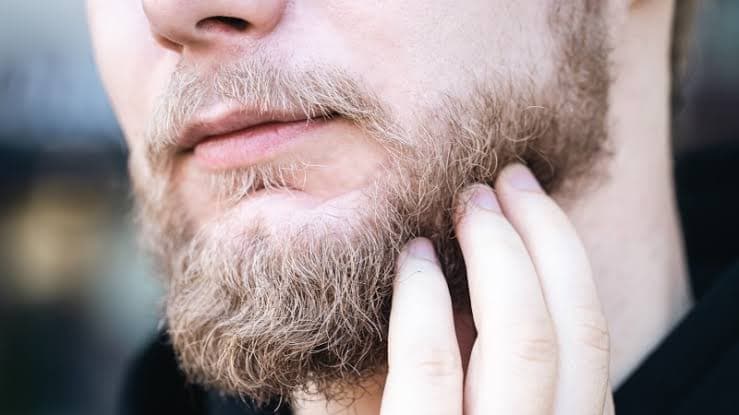
You may have tried oils, supplements and simply letting it grow, but the beard keeps coming in patchy, or it does not grow at all in certain places. A beard transplant fills in the empty areas with your own hair, and the result is near-permanent.
What is a beard transplant?
A beard transplant is a procedure where follicles are moved from your scalp to the beard area with the FUE method, filling patchy or empty areas with your own hair. The result is near-permanent, and after a healing period the hairs grow as a natural part of your beard.
A beard transplant is built on exactly the same principles as an ordinary hair transplant. With the FUE method the surgeon extracts individual follicles, grafts, from the donor area at the back of the head and places them one by one in the beard with care for both angle and direction. There is no scalpel and no long cuts, only the thousands of small, precise extractions and placements that together shape your new beard.
Demand has risen sharply as full beards have become popular. A great many men find that their beard grows unevenly, patchy or not at all in certain places, and this is rarely something you can do anything about yourself. It is genetics. A transplant can give you the dense, even beard your genes did not give you, and the hairs stay put.
Beard hair has some particular qualities that are actually an advantage here: it is often thicker and coarser than scalp hair, so each graft covers well. In return, the coarse hairs and the visible, natural growth patterns of the face demand a high degree of precision, which is why experience with beards specifically matters more than almost anything else. If you want the full picture, you can read the surgeon's in-depth guide or the method guide.
Who is a beard transplant suitable for?
You are suitable if your beard is patchy or thin, does not grow in certain places such as the cheeks, or you want to cover scars or change its shape. The requirement is a sufficient donor area at the back of the head, and a professional assesses whether your wishes are realistic in relation to your donor and your face.
Most people who have a beard transplant belong to one of these groups:
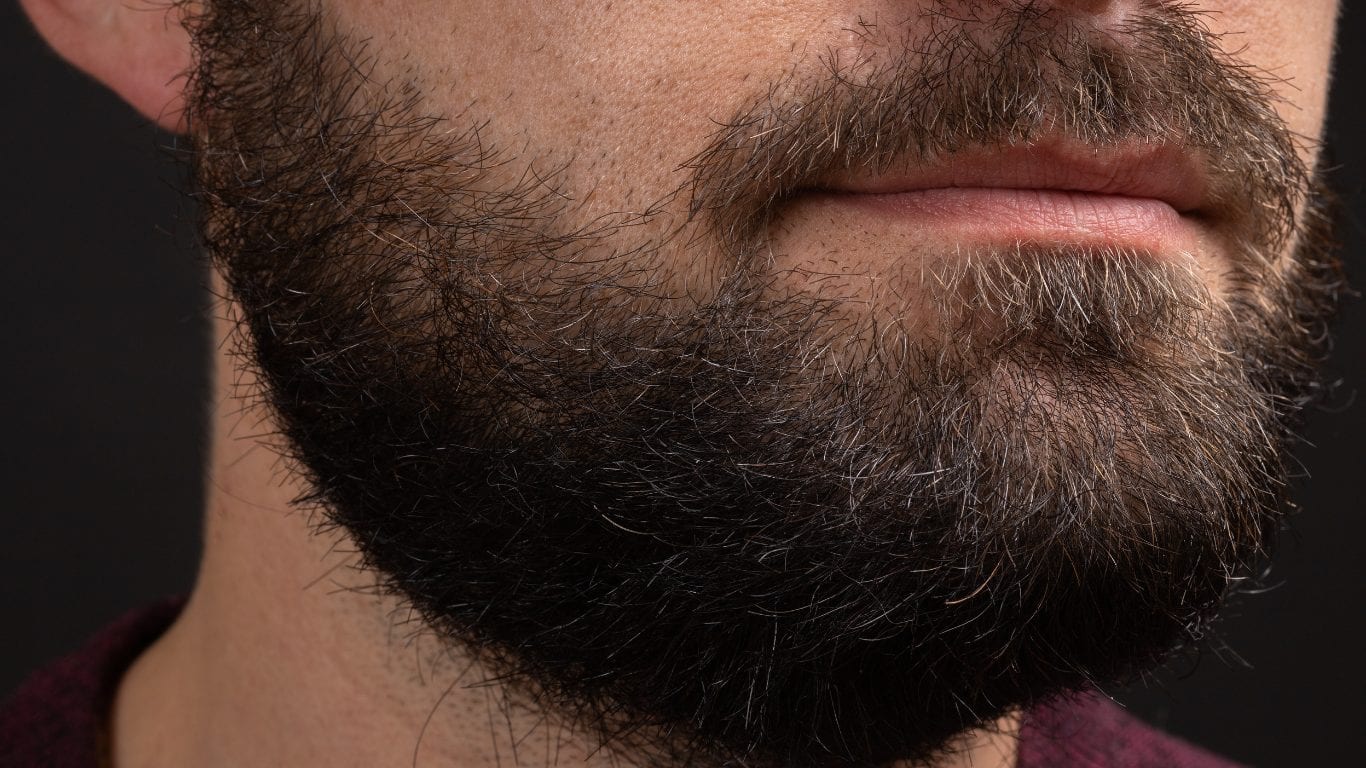
- Men with a patchy or thin beard who would like it denser and more even.
- Men who cannot grow a beard at all in certain places, typically on the cheeks.
- Men who want to cover scars or areas with no growth in the beard.
- Men who want to change the shape, edge or density of the beard.
- Transgender men who want more masculine facial features.
The most important requirement is a sufficient donor area at the back of the head. Because beard grafts are taken from the same place as in a scalp hair transplant, the donor must be managed with the overall need in mind, in case you might also want scalp hair at some point. That is why an honest assessment of the donor, your wishes and your face is always the first step.
Many people worry about whether a transplanted beard looks artificial. The hairs are taken from your scalp and keep their qualities, but in the beard they match your other beard hairs in growth and direction. Because the surgeon places each hair at the correct angle, the result looks natural, even close up. The key is a team with documented experience in the face, and here our guide to choosing a clinic helps.
How many grafts does a beard transplant require?
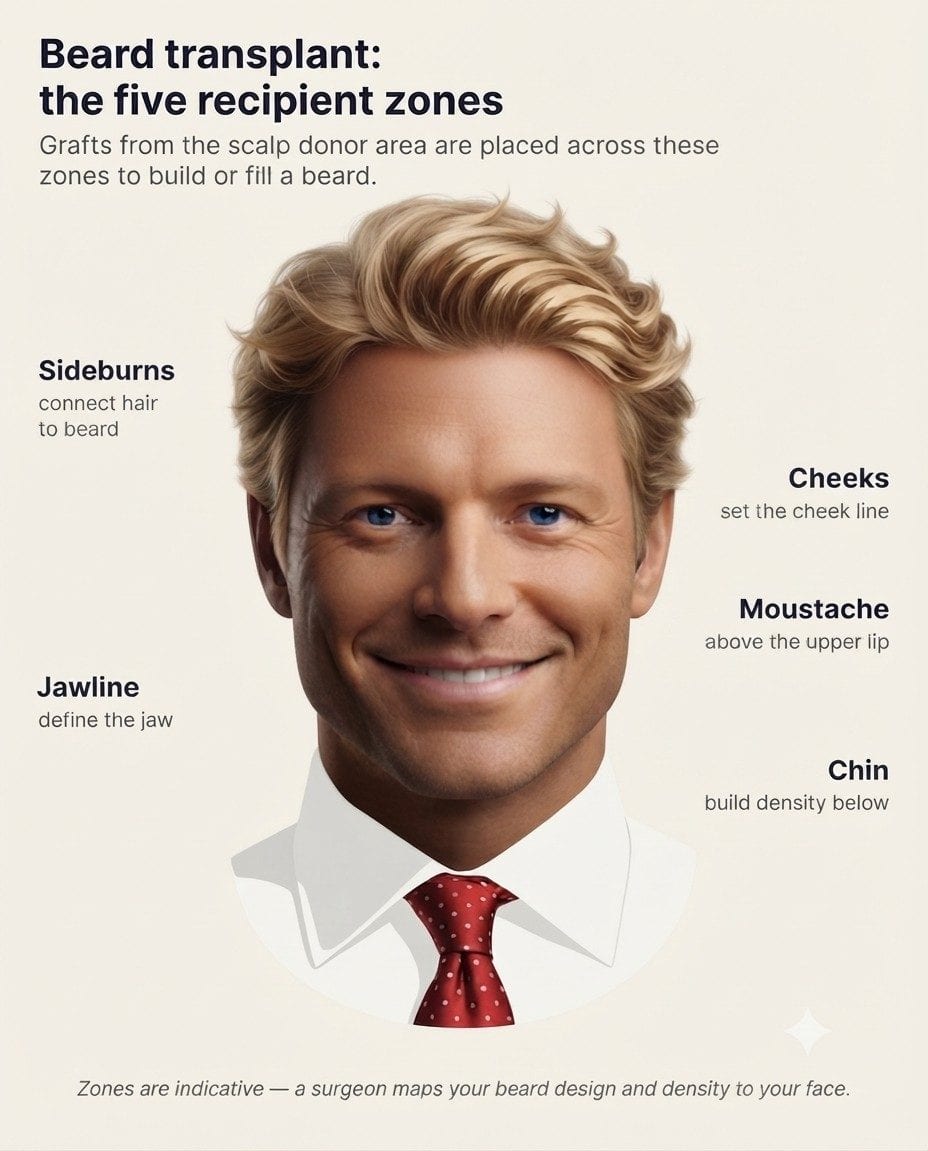
A beard transplant typically requires between 1 000 and 3 000 grafts, depending on whether you want to fill in individual areas or build a complete full beard. Cheek beard and moustache require the fewest, a dense chin the most. The hairs are taken from the donor area at the back of the head, where the growth is near-permanent.
The number depends entirely on how large an area you want to cover, and how dense a beard you dream of. If you only want to fill in a couple of thin patches, you are at the low end. If you want to build a complete full beard from a sparse start, you are at the high end.
The distribution follows a fairly predictable pattern: the moustache and the edges of the cheek beard usually require the fewest grafts, while a dense, defined chin takes the most. The cheeks are typically somewhere in between. Exactly how many grafts you need depends on your current density, the coarseness of the hair and the look you are going for, and it is not something that can be guessed from a distance.
That is why the best starting point is a concrete estimate. You can play with the numbers in our graft calculator and get a feel straight away, or have it properly assessed from photos at a free hair analysis.
How does the process work, and how does it heal?
The procedure is carried out under local anaesthetic and typically takes a few hours depending on the number of grafts. In the first days small crusts form around each transplanted hair, which fall off by themselves over roughly one to two weeks. See the whole process under aftercare, or get a more precise timeline at a free hair analysis.
The procedure itself is carried out under local anaesthetic and typically takes a few hours, depending on how many grafts are to be placed. You are awake throughout and can go home the same day. The grafts are extracted from the back of the head and placed one by one in the beard at the angle and direction that make them fall in naturally.
In the first days small crusts form around each transplanted hair. They fall off entirely by themselves over roughly one to two weeks, and during that period the face should be treated gently: avoid touching, scratching or shaving until the clinic gives the green light. A practical advantage is that the extraction site at the back of the head hides under the hair, so it is not visible to others.
After that comes an entirely normal phase where the new hairs shed again before they grow in. It sounds dramatic, but it is exactly as it should be. See the whole process, week by week, and what you can do yourself, under aftercare.
Is a beard transplant permanent?
Yes. The hairs are moved from the donor area at the back of the head, which is genetically resistant to hair loss, so the result is permanent. The transplanted hairs shed after 2 to 3 weeks and grow back permanently from about 3 to 4 months. Read more about long-term results.
The short answer is yes, and the explanation lies in where the hairs come from. The donor area at the back of the head is genetically resistant to the hormone (DHT) that otherwise thins hair out. When the hairs are moved to the face, they take that quality with them and therefore typically stay put for the rest of your life.
The process does not feel linear, and it is important to know that in advance. The transplanted hairs shed after about 2 to 3 weeks, after which it takes a little time before they return in earnest. From month 3 to 4 they begin to grow in permanently, and the final, full result shows over roughly 8 to 12 months.
Once the beard has grown in, it behaves like your own: you can shave, trim and shape it as you wish. If you want to understand why the result lasts in the long run, you can read more about long-term results.
What does a beard transplant cost, and what does the price depend on?
The price depends first and foremost on how many grafts you need, and thus on how large an area you want to fill in. Method, clinic and country also play a part. Because the need is individual, you get a concrete price level once the number of grafts has been established.
There is no single fixed price for a beard transplant, and that makes good sense, because the procedures are as varied as the beards themselves. The biggest factor is the number of grafts: the larger the area you want to fill in, the more grafts, and so the price rises. A couple of patches cost far less than a complete full beard built up from scratch.
Beyond that, the method plays a part, where clinics predominantly work with FUE, and not least the clinic itself: experience, the team's routine in the face, facilities and which country the procedure takes place in. Many Danes choose clinics in Turkey, where the standard can be high and the price at the same time lower than at home.
Because the need is so individual, it makes no sense to promise a specific amount here. You find the general price levels and market averages on the prices page, and you can turn your own graft need into a concrete estimate with the graft calculator. If you want to compare clinics, our clinic overview helps you further.
Frequently asked questions
Is a beard transplant permanent?
Yes. The hairs come from the genetically resistant donor area at the back of the head and keep that quality in the face. They therefore typically stay put for the rest of your life, and after about 8 to 12 months the beard stands fully in place.
When can I shave and trim the beard again?
Once the beard is fully healed and grown in, typically after about 3 to 4 months, the transplanted hairs behave like your own. Then you can shave, trim and shape the beard entirely normally. In the first couple of weeks, though, the face should be treated gently.
When does the beard really grow in?
The transplanted hairs shed after about 2 to 3 weeks, which is entirely normal. New hairs begin to grow in from month 3 to 4, and you see the final, full result after about 8 to 12 months.
Does a transplanted beard look natural?
Yes, when it is carried out by an experienced team. The surgeon places each of the 1 000 to 3 000 hairs at the correct angle and follows the natural growth patterns of the face, so the beard looks natural, even right up close. That is why experience with beards specifically is important.
Can I have a beard transplant if I have almost no beard growth?
Yes. Even with very little beard growth of your own, a full beard can be built up, as long as you have a sufficient donor area at the back of the head. It usually requires more grafts, often up to 3 000, and a hair analysis shows what is possible for you.
Get a free hair analysis and get a concrete estimate of how many grafts your empty areas specifically need. It is without obligation, takes place from home, and you decide nothing until you can see what a full, near-permanent beard would mean for you. If you want to do the maths yourself first, try our graft calculator.
Last updated: July 2026 · Editorial standards