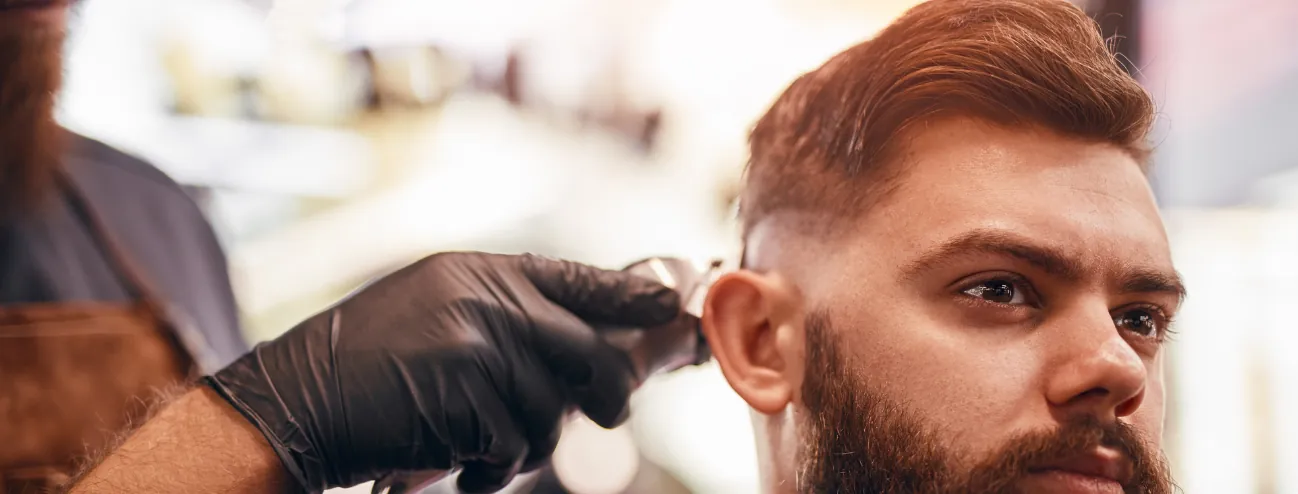
Yes, you can get a hair transplant without a visible shave, but "no-shave" is not one single technique. It covers at least three genuinely different approaches: a partial-shave, where a narrow strip is shaved and then hidden under the hair lying over it; a no-shave donor approach, where only tiny individual windows are trimmed and disappear under the surrounding uncut hair; and true long-hair FUE, where the hair is extracted at its full length and never trimmed at all. The International Society of Hair Restoration Surgery (ISHRS), the field's main professional body, formally distinguishes these approaches for exactly this reason: the term "unshaven" is used loosely in marketing, and what a clinic actually does under that label varies a great deal.
This guide explains what each variant genuinely involves, who realistically qualifies, whether skipping the shave changes the result, what it costs, and how to tell a clinic with real experience in the technique from one that's simply using it as a selling point. It sits alongside our broader guide to whether you're a candidate overall, since a no-shave approach is a planning choice layered on top of ordinary candidacy, not a separate procedure.
- "No-shave" covers three distinct techniques, partial-shave, no-shave donor with trimmed micro-windows, and true long-hair FUE, each with a different trade-off between discretion, session size and technical difficulty.
- Extraction through existing hair is harder to see and control, which raises the risk of damaging (transecting) grafts unless the surgeon has specific, practised experience with the technique.
- No-shave sessions are typically smaller than shaved sessions; a genuine large session usually still needs at least a partial shave.
- The biological healing timeline, shedding, regrowth and the final result, is exactly the same whether or not you shave; no-shave only changes what's externally visible while that happens.
- The clearest sign of a clinic that genuinely offers it is one that names the specific variant, in writing, before you book, rather than using "no-shave" as an unqualified marketing term.
Can you get a hair transplant without shaving your head?
Yes. Three genuinely different techniques let you avoid a visible shave: a partial-shave, where a narrow strip is shaved and hidden under the hair above it; a no-shave donor approach, where only tiny follicle-sized windows are trimmed under surrounding uncut hair; and true long-hair FUE, where the hair is never trimmed and is extracted at full length. They are not interchangeable, and each carries a different trade-off in session size, difficulty and cost.
The honest starting point is that the standard version of a hair transplant shaves the donor area, and often the recipient area too, so the surgical team has full visibility to work quickly and precisely. Every no-shave approach is a workaround to that default, and each one trades some combination of speed, session size or technical ease for discretion, which is exactly why they need to be told apart rather than lumped under one label.
Why "no-shave" needs a real definition, not a marketing checkbox
The International Society of Hair Restoration Surgery (ISHRS) draws a formal line between fully shaved FUE, partially shaved FUE, where hair is lifted, a targeted zone is shaved for harvesting, and the hair is lowered again to cover it, and unshaven FUE, where the hair is left long throughout. The society has gone as far as urging clinics to be explicit on their own websites about exactly what they mean by "unshaven", precisely because the term gets used loosely and inconsistently across the industry. That's the single most useful thing to take from this section: ask a clinic which of the three approaches below it actually performs, and expect a specific answer.
The three variants, side by side
| Approach | What's actually shaved or trimmed | Typical session size | Extraction difficulty |
|---|---|---|---|
| Standard shaved FUE (baseline) | The full donor area, often the recipient zone too | Full range, including large sessions | Lowest, full visibility throughout |
| Partial-shave | A narrow strip, lifted and hidden under the hair above it | Moderate | Moderate |
| No-shave donor, trimmed micro-windows | Only each tiny extraction site, hidden by surrounding uncut hair | Smaller | Higher |
| True long-hair FUE | Nothing, hair is extracted at full length | Smallest, most session-limited | Highest |
What all three have in common
Whichever variant is used, the surgery itself is still ordinary FUE underneath: follicles are still removed one at a time and placed in the recipient area. Nothing about the biology of graft survival or the healing timeline changes. What changes is purely how much of the process is visible to anyone looking at you in the weeks afterwards, which is the actual reason most people ask for it in the first place.
How does no-shave actually work, and what stays visible afterwards?
Each variant conceals the procedure differently: a partial-shave hides a shaved strip under the longer hair lying over it, a no-shave donor approach trims only the follicle itself so surrounding uncut hair falls straight back over each dot, and long-hair FUE never trims anything at all. In every case, the surrounding hair does the concealing, not the absence of a wound; up close, small pink marks are still visible for the same healing window as any FUE procedure.
The mechanics differ enough between the three variants that "no-shave" alone doesn't tell you what your own head will actually look like in the mirror the next morning.
Partial-shave
The surgical team lifts sections of the existing hair, shaves a narrow strip underneath, extracts from that strip, and then lets the longer hair fall back down over it. Several thin strips can be worked through this way across a session, and because each one is covered by hair that was never cut, the donor area looks essentially untouched at a normal distance once the hair is combed back into place.
No-shave donor with trimmed micro-windows
Instead of a strip, each individual follicular unit is trimmed to a very short length immediately before it's extracted, and the hair around it, which stays at its original length, is parted and then falls back to cover the tiny site. This is slower than a partial-shave because it's done unit by unit rather than in a block, but it avoids any visible shaved zone at all, however narrow.
True long-hair FUE
Here nothing is trimmed. The punch is guided down alongside the existing hair shaft, and the graft is extracted at its full length, hair and all. Both the donor site and the newly placed grafts in the recipient area keep their length throughout, which is the only one of the three variants that gives an immediate look at hair length and rough density in the treated area on the day itself.
The honest limit: concealment, not invisibility
None of the three variants makes the procedure undetectable up close. Every extraction site is a genuine wound, however small, and it goes through the same redness, tiny scabbing and healing as a shaved FUE site over the following one to two weeks. What no-shave actually buys you is that a colleague, a stranger, or a camera at normal conversational distance won't see a change in your hairstyle or a shaved patch. That is the whole of the discretion being asked for by someone who can't show up to work with a visibly shaved head, or who hasn't told family or colleagues. It's a cosmetic difference in what's visible, not a difference in how the wound itself heals.
Who actually qualifies for a no-shave hair transplant?
Realistically: people who need a small-to-moderate graft count, typically hairline work, temple points or a limited touch-up rather than full-scalp coverage, and whose existing hair already has enough length for the surrounding strands to fall back over the extraction sites. Large sessions are the main limiting factor, because working around, or through, existing hair is slower, which is why most clinics cap a genuine no-shave session well below what a shaved, large session can deliver.
Candidacy for the procedure itself doesn't change: you still need a stable pattern of loss and a healthy donor supply, exactly as covered in the general candidacy guide. What changes with a no-shave request is a second, practical layer of questions about whether it's realistic for your specific case.
Hair length is the first practical gate
Every no-shave variant depends on hair around the treated sites being long enough to fall back over them. Hair fresh off a buzz cut or a very short crop simply can't cover anything, so most clinics ask for a minimum length, commonly cited as at least a few centimetres, before a no-shave session is even offered.
Session size is the second, and the bigger, limit
Working slowly around or through existing hair reduces how many grafts a team can safely and accurately harvest in a single sitting. No-shave sessions, particularly the fully unshaven variants, are commonly reported well below the 3 000 to 4 000-plus grafts a shaved session can handle in the same time, which makes the approach best suited to hairline restoration, temple recession, or a limited touch-up rather than covering an entire crown or a fully advanced pattern in one visit.
Why large sessions usually still need at least a partial shave
A large session, often defined as 4 000 grafts or more, depends on the surgical team maintaining speed and full visibility for six to eight hours or longer. Extracting through uncut hair slows every single graft down, and doing that across thousands of grafts in one sitting isn't practical without meaningfully extending the day or compromising quality. This is exactly why an experienced, honest clinic will tell a patient who needs a very large session that a full no-shave approach isn't realistic for their case, and will offer a partial-shave as the workable middle ground instead.
Where this is especially relevant
This is one reason no-shave approaches come up particularly often for women having a hair transplant, who are frequently unwilling to shave the scalp at all, and for anyone in a client-facing or on-camera role who needs to return to normal life within days rather than weeks.
Does skipping the shave compromise the result?
It doesn't have to, but it raises the bar for the surgeon. Extracting through existing hair reduces visibility of each follicle's exit angle, which published research on the technique associates with a meaningfully higher transection (graft-damage) rate than standard shaved FUE, particularly with generic instruments. Purpose-built long-hair punches and a surgeon with real, specific practice in the technique narrow that gap substantially, but the skill premium is genuine, not marketing.
This is the honest trade-off at the centre of the whole decision, and it's worth taking seriously rather than dismissing in either direction.
Why the risk is real
A follicle's path under the skin isn't perfectly straight, and a surgeon extracting through a shaved field can see the hair's exit point clearly and adjust the punch angle accordingly. Working around or through existing hair removes some of that visual feedback, so the punch is more likely to be misaligned with the follicle's actual angle. Published studies on unshaven and long-hair extraction have found transection rates running a meaningful amount higher than standard shaved FUE when older, generic instruments and technique are used.
Why experience narrows it, but doesn't erase it
Surgeons who specifically practise no-shave and long-hair techniques use punches designed for the job, flared or texture-modified tips that guide the hair shaft through rather than cutting across it, work more slowly per graft, and rely on tactile feel and careful parting rather than direct sightlines alone. In published work using purpose-built long-hair instruments, transection rates in experienced hands have been reported close to, and in some cases within, the range seen in standard shaved FUE. The gap is real but closeable, and it closes with hands-on experience in this specific technique, not general FUE volume.
The question that actually matters at consultation
Because the difficulty is genuinely technique-specific, the useful question isn't "do you offer no-shave" but "how many no-shave or long-hair cases, specifically, has this surgeon personally performed, and can they show results." A clinic that offers it as a checkbox option without a surgeon who has real, specific repetitions in it is asking you to accept a documented higher-risk technique performed by someone without the practice that closes the gap. See our guide to hair transplant methods for how extraction technique in general affects graft survival.
What is long-hair FUE, specifically?
Long-hair FUE is the most literal version of no-shave: grafts are extracted and implanted at their existing length, with nothing trimmed at all, so the treated area shows real hair length and rough density immediately after surgery instead of just tiny dots. It's genuinely useful as a preview of direction and density, but it's also the most technically demanding of the three variants and is offered by relatively few surgeons with real, practised experience in it.
Long-hair FUE, sometimes marketed as a "long hair transplant" or simply folded into a general "no-shave" claim, deserves its own explanation because it's meaningfully different from the trimmed micro-window approach, even though both leave the surrounding hair uncut.
The genuine advantage: an immediate preview
Because the grafts keep their full length, the recipient area doesn't look like a field of tiny dots the way a freshly shaved session does. You, and your surgeon, can see roughly how the hair will sit, fall and cover the area on the day of surgery, which is a real, practical advantage for judging density and hairline shape before the months-long growth process even starts. For people who found the "it looks strange before it looks better" phase of a normal transplant off-putting in photos, this is the specific thing long-hair FUE addresses.
The honest catch: it still sheds
The preview is not a shortcut past the normal biological process. Transplanted hair, long or short, goes through the same cycle: it typically sheds within the normal shedding window before the follicle produces new, near-permanent growth from around month 3 to 4, with the final result settling at around 12 months, exactly as with any other transplant. A long-hair graft that looks full on day one will still shed that visible hair before the real, lasting result grows in, so the preview is a genuine look at direction and rough density, not a finished result you keep from day one.
Why it's a niche technique, not a mainstream default
Extracting a graft at full length without cutting it is the hardest version of extraction to do without damaging follicles, which is exactly why it's practised by a comparatively small number of surgeons who have specifically trained in it, and why it tends to come with the smallest realistic session size of the three variants. Treat a clinic offering it as a routine, no-extra-consideration option, for any graft count, with real scepticism.
What does a no-shave hair transplant cost?
Expect to pay more than a standard shaved session at the same clinic, because a no-shave approach is slower per graft and needs the clinic's most experienced hands, not its most junior team members. Some clinics add a stated premium or a higher per-graft rate for the technique; others simply price a smaller no-shave session at what a larger shaved session would otherwise cost. Either way, ask for the same breakdown you'd ask for any quote: total price, exact graft count, and which specific no-shave variant is included.
There's no fixed, universal premium for no-shave work, because clinics price it in genuinely different ways, but the underlying cost driver is consistent: time.
Why it costs more
Working slowly around or through existing hair means fewer grafts extracted per hour than a shaved session achieves, and it requires the surgeon or senior technician personally doing more of the extraction rather than delegating it, since the technique leaves less room for a less experienced hand. Both of those, more chair time and more senior time, cost the clinic more to deliver, and that cost is passed on one way or another.
How it typically shows up in a quote
Some clinics quote a flat surcharge on top of their standard package for a no-shave or long-hair session. Others simply charge a higher price per graft across the board when the technique is chosen. And some effectively price it by capping the session smaller for the same total price a larger shaved session would cover, so you're not paying more per graft, you're getting fewer grafts for the same money. All three are legitimate ways to price it; the problem is a quote that doesn't say which one you're getting.
What to actually compare
Treat a no-shave quote exactly like any other: get the total price in writing, get the exact graft count the price covers, and get written confirmation of which specific variant, partial-shave, no-shave donor, or true long-hair, is being performed for that price. See our general price guide for how a normal shaved session is priced by country and by graft, as the baseline to compare a no-shave quote against, and use the graft calculator to sanity-check whether the graft count you're being quoted for a no-shave session matches what your own area of loss realistically needs.
What does recovery and concealment look like, week by week?
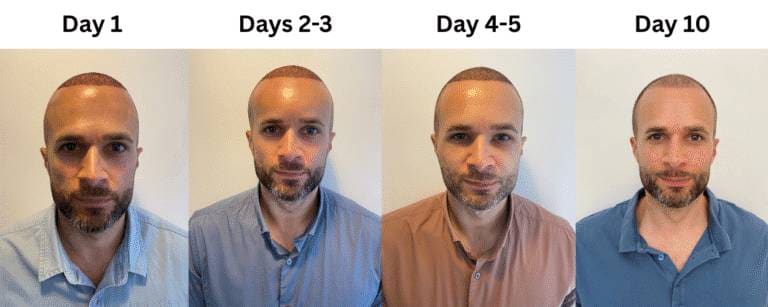
The underlying biology doesn't change: shedding of the transplanted hair typically happens around weeks 2-3, new growth starts from roughly month 3-4, and the final result is visible at around 12 months, identically whether or not you shaved. What differs with a genuine no-shave approach is purely what other people can see while that timeline plays out, since the surrounding uncut hair covers the healing sites throughout.
Two different things get merged together here: the medical healing and growth timeline, which is fixed by biology, and the cosmetic concealment, which is what a no-shave approach actually buys you.
The timeline itself doesn't move
Whichever variant you have, the transplanted hairs typically shed around weeks 2 to 3 after surgery, which is a normal, expected part of the process and not a sign anything has gone wrong. New, near-permanent growth then begins from roughly month 3 to 4, and the final result, in density and texture, is generally judged at around 12 months. None of that changes because you avoided a shave; a no-shave approach affects what's visible, not how quickly the biology works.
What's actually different, week by week
In the earliest days after surgery, both the donor sites and the recipient area are still genuinely healing, some redness and tenderness, regardless of technique. With a real no-shave approach, the surrounding uncut hair covers this from day one at a normal distance, which is the entire point; with a shaved approach, it's visible until hair regrows enough to cover it. As shedding happens around weeks 2 to 3, a no-shave approach means that phase is also largely hidden by surrounding hair, whereas a shaved area shows a visibly patchy scalp during the same weeks. From month 3 to 4 onward, as new growth starts, the concealment advantage of no-shave gradually matters less, because by then a shaved area has regrown enough hair of its own to blend in too.
Aftercare doesn't change either
The basic rules for protecting the grafts while they establish a blood supply, avoiding pressure and rubbing on the treated area, being gentle with the first washes, avoiding heavy sweating and alcohol in the early weeks, apply exactly the same whether or not you shaved. See our full aftercare guide for the complete week-by-week routine.
How do you find a clinic that genuinely offers no-shave, not just upsells it?
Ask the clinic to name, in writing and before you book, which specific variant they mean, then check they can show results from that exact technique, not their general shaved-FUE portfolio. Be wary of a large graft count promised alongside full no-shave discretion in one sitting, since that combination is rarely realistic, and confirm upfront whether a partial shave becomes the fallback plan if visibility becomes a problem on the day.
Because "no-shave" is a genuinely useful thing to ask for, and a genuinely easy thing to claim without delivering, this is one of the areas where a few direct, specific questions do more good than a long checklist.
Ask for the specific variant, in writing
Following the ISHRS's own recommendation, a legitimate clinic will tell you plainly whether it means a partial-shave, a trimmed no-shave donor, or true long-hair extraction, and will put that in the written treatment plan rather than leaving "no-shave" as an unqualified label on a quote. If a clinic can't or won't be specific when asked directly, treat that vagueness as the same warning sign it would be for any other unclear claim, covered more generally in our guide to clinic red flags.
Ask to see results in that exact technique
A gallery full of impressive shaved-FUE results tells you little about whether the same team can genuinely deliver a low-transection no-shave session. Ask specifically for donor-area photos, ideally close-up, from real no-shave or long-hair cases, and ask how many the surgeon has personally performed.
Watch for a mismatch between graft count and technique
Be sceptical of a quote that promises both a large graft count, in the thousands, and full no-shave discretion in a single sitting; the two pull against each other, and a clinic promising both without qualification is either overpromising on the graft count, quietly planning to shave more than disclosed, or both. Ask directly what session size the clinic considers realistic for a genuine no-shave approach in your case, and compare that answer against your own estimate from the graft calculator.
Confirm the fallback plan before the day of surgery
Even a well-planned no-shave session can run into a spot where visibility genuinely requires a small shaved area to work safely. A clinic that discloses this possibility upfront, and explains how it would be handled and covered if it happens, is being honest about a real limitation; one that only mentions it once you're in the chair is not. See our broader guide to choosing a clinic, our clinic ranking, and the clinic overview for how to vet a provider on the fuller set of criteria beyond this specific technique.
Frequently asked questions
Can you get a hair transplant without shaving your head?
Yes, but not as a single technique. A partial-shave hides a shaved strip under longer hair, a no-shave donor approach trims only individual follicle windows under uncut hair, and true long-hair FUE extracts hair at full length without trimming anything. All three keep the visible parts of the process hidden under your existing hair length rather than eliminating the surgery's healing marks altogether.
What's the difference between no-shave FUE and long-hair FUE?
"No-shave" is the broader umbrella term, and it includes a version where the donor hair is trimmed to a very short length unit by unit before extraction, so the individual grafts themselves are short even though the surrounding hair isn't cut. Long-hair FUE is more specific: the hair is never trimmed at all, and both the donor extraction and the transplanted grafts keep their full length, which is also why it's the more technically demanding of the two.
How long does my hair need to be for a no-shave hair transplant?
It needs to be long enough for the surrounding, uncut hair to fall back over each tiny extraction site, commonly cited as at least a few centimetres. Hair that's recently been buzzed or cut very short generally isn't long enough for any no-shave variant to work discreetly, and a clinic should tell you clearly if your current length isn't sufficient.
Does a no-shave hair transplant cost more?
Usually, yes. It's slower per graft and needs more of the surgeon's or senior technician's direct time, so clinics typically charge a stated premium, a higher per-graft rate, or offer a smaller session for the same price rather than a discount. Ask for the total price, the exact graft count, and the specific variant in writing before you compare it against a standard quote.
Does not shaving increase the risk of damaged grafts?
It can, yes. Extracting through existing hair gives the surgeon less visibility of each follicle's angle, and published research on the technique has found meaningfully higher transection (graft-damage) rates than standard shaved FUE when generic instruments and inexperienced technique are used. Purpose-built long-hair punches and a surgeon with genuine, specific practice in the technique narrow that gap substantially, which is why hands-on experience with this exact approach matters more here than for standard FUE.
Will people be able to tell I've had a hair transplant right after a no-shave procedure?
At a normal conversational distance, generally not, since the surrounding uncut hair is what conceals the treated areas, not the absence of a wound. Up close and under bright light, small pink marks and tiny scabs are still visible for the same one-to-two-week healing window as any FUE procedure, so "no-shave" is realistically about hiding a change in your hairstyle, not making the healing invisible to close inspection.
Whether a partial-shave, a no-shave donor approach or true long-hair FUE is realistic for you depends on your own hair length, graft need and donor density, not a general rule that applies to everyone. Get a free hair analysis and hear back from our #1-ranked clinic with an honest read on which approach, if any, genuinely suits your case, with no obligation to go further.
General educational guidance, not medical advice. Whether a no-shave technique is realistic for your case is confirmed by a qualified surgeon at a personal assessment.
Last updated: August 2026 · Editorial standards