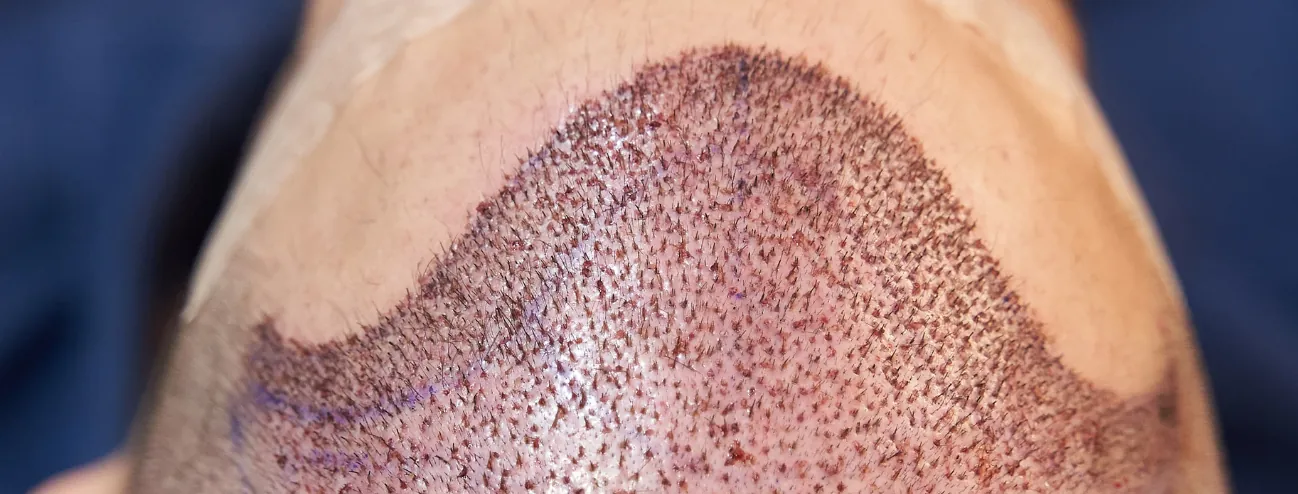
Can a bad hair transplant be repaired? Yes, in most cases. A repair typically combines three things: removing or redistributing badly placed grafts, camouflaging old work with new single-hair grafts, and rebuilding density with a fresh session. The catch is that a repair is harder than a first transplant. It has to work around scar tissue, a partly spent donor area and the mistakes of the first surgeon, which is why repair cases belong at high-volume clinics with documented experience, not at the kind of clinic that caused the problem.
This guide covers why so many transplants need correcting in the first place, the seven problems repair surgeons see most, what a repair actually involves, and how to choose who does it. If you are researching before a first operation instead, start with the warning signs of a bad clinic, the cheapest repair is the one you never need.
Why do so many hair transplants need repair in the first place?
Because for decades the standard technique was crude, and because a large part of today's market still runs the old model, small, low-volume clinics working with older tools and last-generation methods, too little time per patient and too little experience per operation. Old punch grafts produced doll's-hair rows; today's less advanced clinics produce no-growth, wrong angles and pluggy hairlines. What separates a bad result from a good one is not geography but experience, case volume, modern equipment, per-patient time and who actually holds the instrument.
Historically, a lot of hair transplantation was simply done the wrong way. From the 1960s to the 1980s, the standard technique was punch grafts, "plugs" of roughly 15 to 20 hairs moved in one piece, which produced the doll's-hair rows many people still associate with hair transplants. The methods have improved enormously, but the problem did not disappear: it moved.
Today most poor results come from clinics that still operate on the old model, small in scale, low in case volume, working with older equipment and last-generation methods, giving too little time to each patient and gaining too little experience per operation. Where the world's leading centres invest in newer tools, generous per-patient time and named-surgeon oversight, these clinics rush through the operation with technicians rather than surgeons performing the critical steps, several patients on the go at once, and planning reduced to a sales call. The pattern behind a failed transplant is almost always the same: too little time, too little experience, older tools, and nobody senior enough checking the work.
What are the most common problems a repair has to fix?
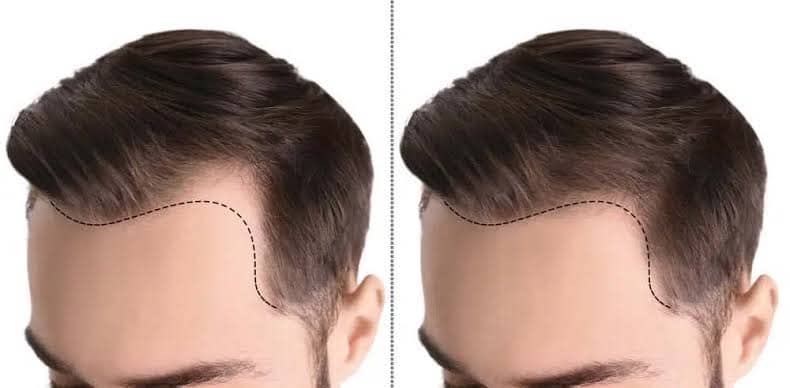
Seven problems account for nearly all repair cases: no growth, patchy growth, hair growing at the wrong angle, multi-hair grafts placed in the hairline, a wrongly shaped or wrongly placed hairline, too little density, and sessions that were simply too small for the area.
- No growth. The grafts never grew, typically because they were handled roughly, stored wrongly or left dehydrated too long between extraction and placement.
- Poor or patchy growth. Some grafts survived, others did not, leaving an uneven, moth-eaten look.
- Wrong direction. Hair grows at unnatural angles because the recipient channels were cut without following the natural flow, most visible in the hairline and the crown's whorl.
- Multi-hair grafts in the hairline. A natural front line consists of single hairs. When double, triple or quadruple grafts are placed in the first rows, the result looks coarse and "pluggy" even at normal speaking distance, the opposite of what makes a transplanted hairline look natural.
- Wrong hairline shape or placement. Too low, too straight, too rounded, or designed with no thought for how the face will age, a design error that no amount of density can hide.
- Too little density. The transplant "took", but the coverage is thin. This is the classic result of clinics with too little volume and too little routine, where the economies of scale needed to invest in the right equipment, staffing and per-patient time simply are not there.
- Sessions that were too small. The operation was undersized for the area, leaving coverage half-finished. The fix is a completion session, in effect, the planning that should have happened the first time.
How is a failed transplant actually repaired?
With three instruments, usually combined: badly placed grafts are removed one by one with FUE punches and re-implanted where they belong, visible old work is camouflaged behind fine single-hair grafts, and missing density is rebuilt with a new session. Scar tissue and the remaining donor supply set the limits of every plan.
Badly placed grafts can be extracted individually with FUE punches and re-implanted where they belong, old plugs can be broken up into follicular units the same way. Visible old work can be camouflaged by placing fine single-hair grafts in front of and between the coarse ones, softening the transition. And missing density is rebuilt with a new session in the thin zones.
Two constraints shape every repair plan. Scar tissue in the recipient area reduces graft survival slightly, so a repair often needs a conservative, staged approach. And the donor area is finite, every graft the first clinic wasted is a graft the repair surgeon no longer has. An honest repair plan therefore starts with a donor audit: how much donor hair is left, and where does it do the most good?
Who should perform a repair?
A surgeon who has seen hundreds of failed transplants and has the case volume to judge, graft by graft, what to remove, camouflage or reinforce. The clinics that cause repair cases and the clinics that fix them are rarely the same.
Repair work is the discipline's masterclass: it demands diagnosis of someone else's mistakes, planning under donor scarcity, and surgical precision inside scar tissue. That is the profile we rank for in our list of the world's best hair transplant clinics, the top of that list handles repair and correction cases routinely.
If you want help assessing whether your result can be improved, get a free hair analysis and receive a donor-and-repair evaluation before anyone touches your scalp again. And whoever you choose: run them through the same warning-sign checklist that would have caught the first clinic.
What is a realistic timeline for a repair?
The biology matches a first transplant, shedding in weeks two to three, new growth from months three to four, final result at about twelve months, plus two repair rules: wait at least twelve months after the failed operation, and expect staged corrections to add months between stages.
The transplanted hairs shed in weeks two to three, new growth starts around months three to four, and the final result is judged at about twelve months, the same curve as any transplant. Two repair-specific rules come on top. First, wait at least twelve months after the failed operation before repairing it: what looks like failure at month six can still partially recover, and operating too early means correcting a result that does not exist yet. Second, staged repairs, removal first, density later, add months between stages by design. A repair is measured in patience as much as in grafts.
Frequently asked questions
Can transplants from the 1980s and 1990s still be fixed?
Yes. Old punch grafts respond well to modern repair: the plugs are divided into follicular units with FUE, redistributed, and the front is softened with single-hair grafts. The age of the bad work is not the limiting factor, donor reserves are.
Does removing grafts leave scars?
FUE removal leaves the same dot scars as FUE extraction, small and generally not visible at normal hair length. Removing large old plugs can leave slightly bigger marks, which the surgeon plans camouflage grafts around.
How many grafts does a repair need?
Everything from a few hundred (softening a harsh hairline) to several thousand (rebuilding density after a botched full-scalp session). The donor audit decides, not a price list.
What if my donor area is already depleted?
Then priorities matter: most repair value sits in the hairline zone people see first. In selected cases beard hair can supplement scalp donor hair. A serious clinic will tell you plainly what is achievable, and what is not.
Is a repair more expensive than a normal transplant?
Per graft, often somewhat, removal and redistribution take more surgical time than straightforward implantation. Get the repair plan itemised: removal, camouflage and density are three different jobs.
A failed transplant feels final. It rarely is, but the second attempt has to be the last, so it belongs with a clinic that repairs for a living. Compare the clinics that meet that bar in our ranking of the world's best hair transplant clinics, or get a free hair analysis with an honest repair assessment.
Last updated: August 2026 · Editorial standards