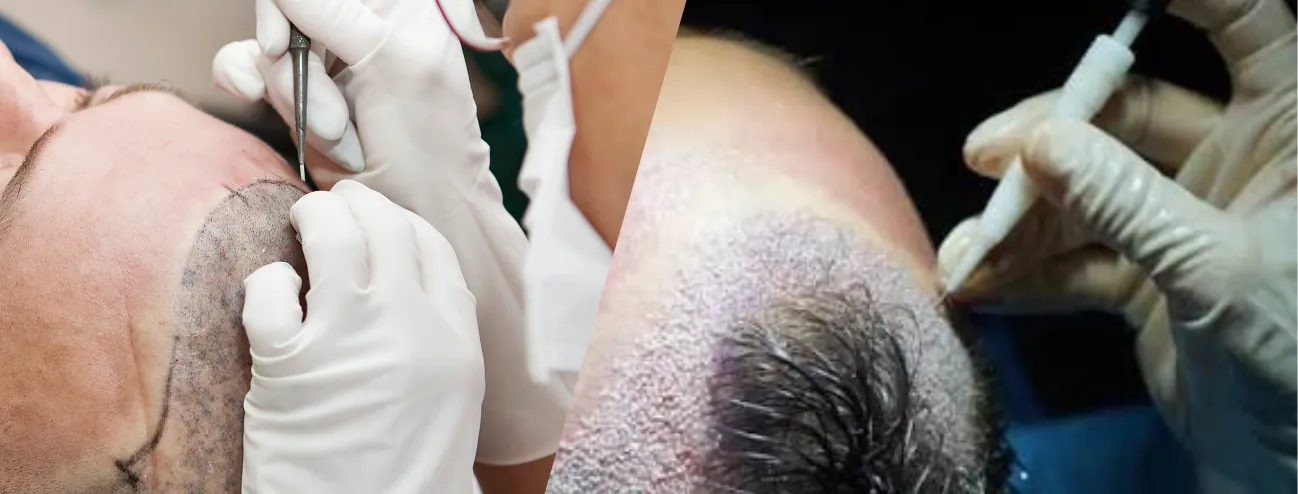
What is a combined FUE + DHI hair transplant? It's a single operation in which every graft is extracted the same way, by FUE, and then placed with two different tools depending on where it's going: an implanter pen where angle and density control matter most, typically the hairline and frontal zone, and pre-opened incisions, cut with a sapphire or steel blade, where placing a larger volume of grafts efficiently matters most, typically the mid-scalp and crown. It's a planning decision about placement, not a fourth surgical method, and not every clinic that uses the word plans it this precisely.
This guide sits alongside our broader guide to hair transplant methods, which covers FUE, DHI, FUT and Sapphire FUE individually in full depth; this page focuses specifically on why and how clinics combine placement tools within a single session, who that genuinely benefits, and the honest gap between a real zone plan and a marketing label. It also connects to the wider question of whether you're a candidate overall, since combining placement tools changes technique, not eligibility.
- Combined FUE + DHI extracts every graft with FUE; only placement is split, an implanter pen in precision zones like the hairline, incisions in volume zones like the mid-scalp and crown.
- The rationale is mechanical, not marketing: a pen creates the channel and sets the graft in one controlled motion, while a blade-opened incision is a separate, faster step better suited to covering a larger area.
- It earns its extra coordination mainly in larger, multi-zone sessions that also need a refined hairline, not in small, single-zone sessions.
- Combination and hybrid are used both for a genuine, zone-mapped plan and for ordinary sessions relabelled without a real per-zone breakdown; the name alone proves nothing.
- What separates the two is whether a clinic can name its specific zones, rough graft split and who places the hairline before you book, not what the technique is called.
What is a combined FUE + DHI hair transplant?
A combined FUE + DHI operation extracts every graft the same way, one by one with FUE, then splits placement between two tools depending on the zone: an implanter pen where angle and density control matter most, typically the hairline and frontal zone, and pre-opened incisions, cut with a sapphire or steel blade, where placing a larger volume of grafts efficiently matters most, typically the mid-scalp and crown. It is one operation with two placement techniques used in different zones, not a fourth surgical method.
The name suggests two separate procedures, but a combined operation is a single session with a single extraction step. Every graft, wherever it ends up, is harvested from the donor area one follicular unit at a time with FUE. What changes is only the second half of the operation, placement, and only within that, which tool touches which part of the scalp.
One extraction method, two placement tools
This follows directly from how FUE and DHI actually relate to each other: DHI is not a separate extraction method, it describes how grafts are placed once they're out. An implanter pen, sometimes called a Choi pen, loads a single follicle into a hollow needle that opens the recipient channel and sets the graft in the same motion, giving the surgeon direct control over the angle, direction and depth of that one hair. The alternative, used for the rest of a combined session, is the classic two-step approach: a blade, steel or sapphire, opens the recipient site first, and the graft is placed into it afterwards, usually by a separate hand.
Why the split runs by zone
The two tools are not interchangeable in what they're good at. The pen buys precision, one motion, one controlled angle, at the cost of pace. The blade-and-place approach buys pace, sites can be opened ahead of the team doing the placing, at some cost to how tightly angle and depth are controlled compared with a single continuous motion. A combined plan puts the pen where that precision is worth the slower pace, the hairline and the leading edge of the frontal zone, where every degree of angle is visible, and puts incisions where covering a larger area efficiently matters more than that visibility, the mid-scalp and crown.
What actually happens on the day
In practice this means the donor harvest happens first and looks identical to any FUE session. Grafts are then sorted, usually by hair count, with single-hair units set aside for the hairline. The hairline and frontal zone are opened and loaded with the implanter pen, typically by the most experienced hand in the room. The mid-scalp and crown are opened with blade incisions and loaded separately, often by a second team member working at the same time. Anaesthesia, timing and aftercare are the same as for any hair transplant; only this middle step is split.
Why combine placement methods at all?
Because no single placement method is the best choice everywhere on the scalp: an implanter pen buys precision at the cost of speed, and pre-opened incisions buy speed at some cost to how tightly a single motion controls angle and depth. Combining lets each zone get the trade-off suited to it, a precise, slower placement where the eye is most critical, and an efficient, faster placement where covering area matters more, instead of forcing one compromise across the whole scalp.
What one method everywhere gives up
Using an implanter pen across an entire large session keeps its precision everywhere but keeps its pace everywhere too, which is exactly why DHI on its own is described, including in our own guide to hair transplant methods, as more time-consuming and often more expensive to run at scale. Using incisions everywhere keeps the pace but puts more of the fine angle and depth control into a second, separate placing step rather than one continuous motion, which matters most in the one zone where the smallest error is most visible: the hairline.
Matching the tool to what each zone needs
The hairline and frontal zone are built from single-hair grafts, need a soft, slightly irregular edge, and sit at a low, forward angle that has to look right from every viewing distance for years. That is exactly the situation an implanter pen's one-motion control is suited to. The mid-scalp and crown cover more surface area, tolerate denser multi-hair grafts, and follow a whorled, multi-directional growth pattern where even, efficient coverage matters more than single-degree angle precision on any one hair. That is where the pace of pre-opened incisions earns its place.
Still the same building blocks
None of this describes a new operation. It is the same choice covered for the whole scalp in our methods guide, applied zone by zone within one session rather than uniformly across it. Combining several placement methods within one procedure is a routine, well-established part of planning, not a departure from it.
Who actually benefits from a combined approach?
People who need both a large treatment area and a precisely designed hairline in the same session tend to benefit most, typically an advanced pattern of loss covering the front and crown together, since combining lets a clinic spend implanter-pen time where it's visible and worth it while covering the larger, less visually critical zones efficiently. It is not usually a meaningful advantage for a small, single-zone session, such as a hairline-only refinement or a crown-only area.
The two-zone case is where it earns its place
Sessions covering both the front and the crown in more advanced hair loss often run to 4 000 grafts or more, sometimes split over two sessions, compared with roughly 2 000 to 3 000 grafts for a hairline and front alone. That is precisely the situation where an all-pen approach risks running very long, and an all-incision approach risks under-serving the hairline: a combined plan lets the team hold the pace on the larger zones while still giving the hairline the slower, more controlled placement it benefits from most.
When one method is already enough
A hairline-only touch-up or a crown-only area does not usually need two tools. If the whole session sits inside one zone, splitting placement adds coordination for a benefit that is hard to see: the pen alone is fine for a small, precision-led hairline case, and incisions alone are fine for a modest, volume-led crown case. Combining is a response to needing both things in one sitting, not a general upgrade over either method on its own.
Donor budget sets the ceiling either way
Splitting placement across two tools changes nothing about how much hair is actually available to move. A favourable donor area is ideally over 50 follicles per cm², and that supply, not the placement technique, is what decides how large a combined session can safely be. Our guide to donor hair supply covers how that budget is measured; our graft calculator gives a rough starting estimate of how many grafts a given area of loss might need before a personal assessment confirms the number.
What does combining change for session length, team size and logistics?
Total time in the chair is still driven mainly by the total graft count, not by how placement is split, but a combined session needs more coordination: typically one clinician trained on the implanter pen working the hairline while a separate, incision-trained hand works the larger zones, ideally at the same time. If a clinic only has one experienced person doing both jobs in sequence, the coordination benefit of combining shrinks and the session can run longer, not shorter.
Parallel work is the actual efficiency lever
The reason combining can hold, or even shorten, total time rather than lengthen it is that two zones can in principle be worked at once: one hand on the pen at the hairline, another opening and filling incisions in the mid-scalp or crown. That only holds if the clinic genuinely runs two competent stations simultaneously. Where it's really one experienced surgeon switching between a pen and a blade alone, the appeal of combining narrows to using the right tool per zone, not to saving time.
More hands raises the standard question
Splitting the work across more people is not automatically a problem, but it raises the same question that applies to any hair transplant: who specifically places the hairline, is it the same experienced hand throughout that zone, and is a second, less experienced hand ever used there or only on the lower-stakes areas. Our guide to choosing a clinic covers why medical involvement in exactly these critical steps is the single most important criterion to ask about, combined session or not.
What changes, and what doesn't
What changes is the instrument tray, which now holds both a pen and blades; the sorting workflow, with single-hair grafts earmarked for the pen and multi-hair grafts for incisions; and a clear handoff at each zone boundary. What doesn't change is the anaesthesia, the overall day length once graft count is fixed, typically 6 to 8 hours, and the healing timeline: shedding around weeks 2 to 3, new growth from roughly month 3 to 4, and a final result around 12 months, regardless of which tool placed a given graft. Our full aftercare guide covers that recovery course in depth.
Is "combination" a real protocol, or just packaging?
Both, depending on the clinic: splitting placement tools by zone is a legitimate, well-established planning decision with a clear technical rationale, but the word combination, or hybrid, is also used loosely in marketing for sessions that don't actually follow any zone logic. The label alone proves nothing; what matters is whether a clinic can describe, before surgery, which specific zone gets which tool and roughly why.
The legitimate version
The genuine rationale rests on what the two tools mechanically do, not on branding: an implanter pen creates the channel and sets the graft in one controlled motion, which is why it suits the hairline, and a blade-opened incision is a separate, faster step better suited to covering a larger area efficiently. A clinic using that logic can point to a specific boundary on the scalp and explain, in plain terms, why the tool changes there.
The marketing version
Some clinics attach a proprietary, trademarked name and a premium price to what is, mechanically, this same generic combination of extraction and split placement, without necessarily planning per zone at all, or without changing anything beyond the name on the quote. A distinctive name is not itself evidence of a distinct or superior protocol. Whatever a specific clinic chooses to call its version, the underlying decision, which tool where, is the same generic planning question covered on this page.
What actually separates the two
A real zone plan can be described before surgery: which specific area gets the pen, which gets incisions, roughly how many grafts each zone is getting, and who is placing the hairline specifically. A relabelled session usually can't answer with more detail than "we use a combination technique," because there isn't a per-zone plan behind the name, only two instruments in the same room. Asking for that detail, not the name of the technique, is what tells the two apart.
How does it compare to pure FUE, pure DHI and FUT?
A pure incision-based FUE session is faster and typically cheaper per graft but applies that pace across the whole scalp, including the hairline; a pure DHI session applies the implanter pen's precision everywhere but is slower and more expensive to run at scale. FUT yields the most grafts in a single sitting through a different extraction method entirely and leaves a linear donor scar. Combined FUE + DHI sits between pure FUE and pure DHI: pen precision where it's used, closer to FUE's pace and cost where incisions are used.
The table below sets out all four approaches on the same terms, extraction, placement, scarring and what each genuinely suits, without ranking one name above another.
| Approach | How grafts are extracted | How grafts are placed | Scarring | Best suited to |
|---|---|---|---|---|
| Pure FUE (incision placement) | One by one with a micro-punch | Channels opened with a blade first, grafts placed after | Scattered dot marks, hard to see | Most sessions; strong pace across a large area |
| Pure DHI (pen placement) | One by one with a micro-punch, same as FUE | Implanter pen opens the channel and sets the graft in one motion | Scattered dot marks, hard to see | Sessions where hairline-level precision matters across the whole area |
| FUT | A strip of donor skin removed and dissected into grafts | Channels opened first, then grafts placed | A single fine linear scar | Very large single-session graft counts or a limited FUE donor |
| Combined FUE + DHI | One by one with a micro-punch, identical either way | Split by zone: implanter pen at the hairline and front, incisions at the mid-scalp and crown | Scattered dot marks, hard to see | Larger, multi-zone sessions that also need a precisely designed hairline |
Combined isn't just "DHI with extra steps"
The terms get blurred easily here. DHI on its own can be, and often is, used across an entire scalp, not only the hairline; that's simply an all-pen session. Combined specifically means the tool changes by zone within one session, so it isn't the same thing as "more DHI" or "better DHI," it's a different allocation of the same two placement tools.
Our full guide to hair transplant methods covers FUE, DHI, FUT and Sapphire FUE individually and in depth, including the extraction-versus-placement distinction this page builds on; this page focuses specifically on the zone logic behind using more than one of them in a single operation.
How is a combined session usually priced?
Combined sessions tend to be priced closer to, or somewhat above, a pure DHI quote rather than a pure incision-based FUE quote, because pen placement is the more time- and skill-intensive component wherever it's used, even on only part of the scalp. The exact premium depends on how many grafts actually go through the pen versus the blade, not on the word combined appearing on the invoice.
What actually drives the number
Classic incision-based placement and pen placement don't cost the same; DHI is often somewhat more expensive because it takes longer and needs a more experienced team on the pen. In a combined session, that cost applies to whichever share of the graft count goes through the pen, so a session that's mostly hairline-and-pen work prices closer to a pure DHI quote, while one that's mostly incision-based volume work with a small pen-placed hairline prices closer to a pure FUE quote. The label combined says nothing about that ratio on its own.
Price per graft is still the right comparison
Whatever the technique mix, the same rule applies: convert any quote to a price per graft before comparing clinics, and confirm in writing how many grafts the price actually covers. Our price guide covers why price per graft is the more honest comparison than a headline package price, and our graft calculator gives a starting estimate of how many grafts your own area of loss might need.
A reasonable question at consultation
It is entirely reasonable to ask a clinic quoting a combined session for a rough breakdown, how many grafts are planned for the pen and how many for incisions, and to expect that breakdown to correspond to a real price difference, not just to a higher number attached to a more advanced-sounding word.
What questions separate a real zone plan from a marketing label?
Ask the clinic to name the specific zones getting implanter-pen placement and the zones getting incisions, roughly how many grafts are planned for each, and who places the hairline specifically. A clinic with a genuine plan answers in specifics; one that's just selling the word tends to answer only in reassurance, and if it can't describe its own zone boundaries before surgery, the label isn't doing any technical work.
Five questions worth asking directly
- Which zones get the pen, and which get incisions, specifically, and why that split for my case? A real plan names the boundary; a label doesn't.
- Roughly what share of my total graft count goes through each method? A number, even an approximate one, is a stronger signal than a description of the technique alone.
- Who places the hairline grafts specifically, and is it the same person throughout that zone? This is the single most consequential hand in the room, combined session or not.
- Are the two placement steps happening at the same time, or is combined really one person switching tools in sequence? That answer tells you whether you're paying for coordination or just for a name.
- Can you show results where this specific zone split was used, not a general portfolio? Documented, consistent results matter more than the acronym on the price list.
Why the answer matters more than the name
None of this is unique to combined sessions; it's the same standard that should apply to any hair transplant, covered in full in our guide to clinic red flags. A name on a price list doesn't verify a plan. A clinic that answers with zones, numbers and a named hand is showing you a plan; a clinic that answers only with reassurance or a brand name is not.
Comparing clinics on this basis
Once you have real answers to the questions above, they're worth checking against the same criteria for any clinic on your shortlist, compared in full in our clinic ranking and our guide to the best clinics. A clinic that plans by zone and can prove it is a stronger choice than one that simply owns both instruments.
Frequently asked questions
Is a combined FUE + DHI transplant a different surgery from FUE or DHI?
No. Extraction is FUE either way, one follicle at a time from the donor area. Combined FUE + DHI is a placement decision split by zone within a single session, an implanter pen at the hairline and front, incisions at the mid-scalp and crown, not a fourth surgical method.
Does combining methods mean two separate procedures or two visits?
No. It happens in one session on one day, under the same local anaesthesia, with the same recovery course as any other hair transplant. Only the placement step is split between two tools.
Is combined FUE + DHI more expensive than FUE or DHI alone?
Usually priced closer to, or somewhat above, a pure DHI quote, since pen placement is the more time-intensive step wherever it's used. The real driver is how many grafts go through the pen versus the blade, not the word combined itself, so ask for that breakdown before comparing prices.
Which zone typically gets the implanter pen?
The hairline and frontal zone most often, where angle, depth and a soft, natural edge matter most. The mid-scalp and crown more often get blade-opened incisions, where covering a larger area efficiently matters more than single-degree precision on any one hair.
Can a clinic call a session "combined" without actually planning it by zone?
Yes, and that's the main honest downside to know about. Some clinics use combined or hybrid as a marketing label for an ordinary session, without a specific per-zone graft plan behind it. Asking for the zone boundaries and rough graft split in writing before booking is how to tell the two apart.
Does splitting placement between two tools change the recovery timeline?
No. Shedding around weeks 2 to 3, new growth from roughly month 3 to 4, and a final result around 12 months apply the same way regardless of which tool placed a given graft. Recovery is driven by graft handling and aftercare, not by which placement method was used where.
Is a combined approach worth it for a small, single-zone session?
Usually not. Combining earns its extra coordination mainly in larger, multi-zone sessions that also need a precisely designed hairline. A small hairline-only or crown-only session is typically well served by one placement method on its own.
The only reliable way to know whether your case needs a zone-split plan, or whether a single placement method is enough, is a proper look at your own pattern of loss and donor supply, not a general article. Get a free hair analysis and hear back from our #1-ranked clinic with an honest read on your case and what it supports, with no obligation to go further.
General educational guidance, not medical advice. Whether a combined approach genuinely suits your case is confirmed by a qualified surgeon at a personal assessment.
Last updated: August 2026 · Editorial standards