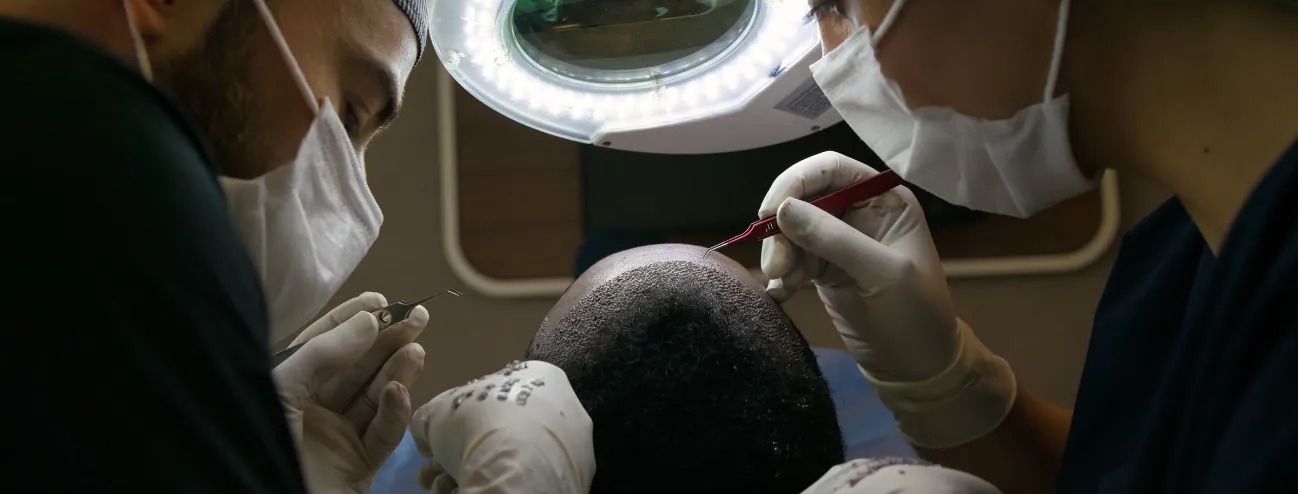
Can afro-textured hair be transplanted? Yes: tightly coiled, curly and afro-textured hair transplants successfully and can achieve excellent, natural results, provided the surgeon adapts extraction technique to the curl and correctly diagnoses any traction alopecia, CCCA or other scarring alopecia first. The biology and eligibility rules are the same as for any other hair type; what changes is extraction technique, graft yield, and how carefully the scalp needs to be assessed before surgery.
This guide is a deeper, dedicated look at afro-textured hair specifically, sitting alongside our broader guide to hair type and texture and our guide to whether you're a candidate overall. It goes through why the curved follicle raises transection risk; why curl can be a genuine coverage advantage; the two conditions that come up most often in afro-textured hair, traction alopecia and CCCA; keloid and hypertrophic scarring tendency; how FUE, DHI and FUT compare for this hair type; how to choose a clinic with documented experience; and what aftercare looks like once you're healed.
- Afro-textured hair transplants just as successfully as any other hair type; curl changes technique and planning, not basic eligibility.
- The coiled follicle curves under the skin, which raises transection risk during extraction unless the surgeon uses curl-adapted punches, a slower pace, and ideally a small test extraction first.
- Traction alopecia from tight braids, weaves, locs or extensions is typically the most common reason people with afro-textured hair consult about a transplant, and candidacy depends on the pulling having stopped and the pattern being stable.
- CCCA and other scarring alopecias must be diagnosed by a dermatologist and confirmed quiet for at least six months before any transplant is considered.
- A personal or family history of keloid or hypertrophic scarring doesn't rule out surgery, but it does change the plan, usually toward FUE over FUT.
Can Afro-textured hair be transplanted, and does it work as well as other hair types?
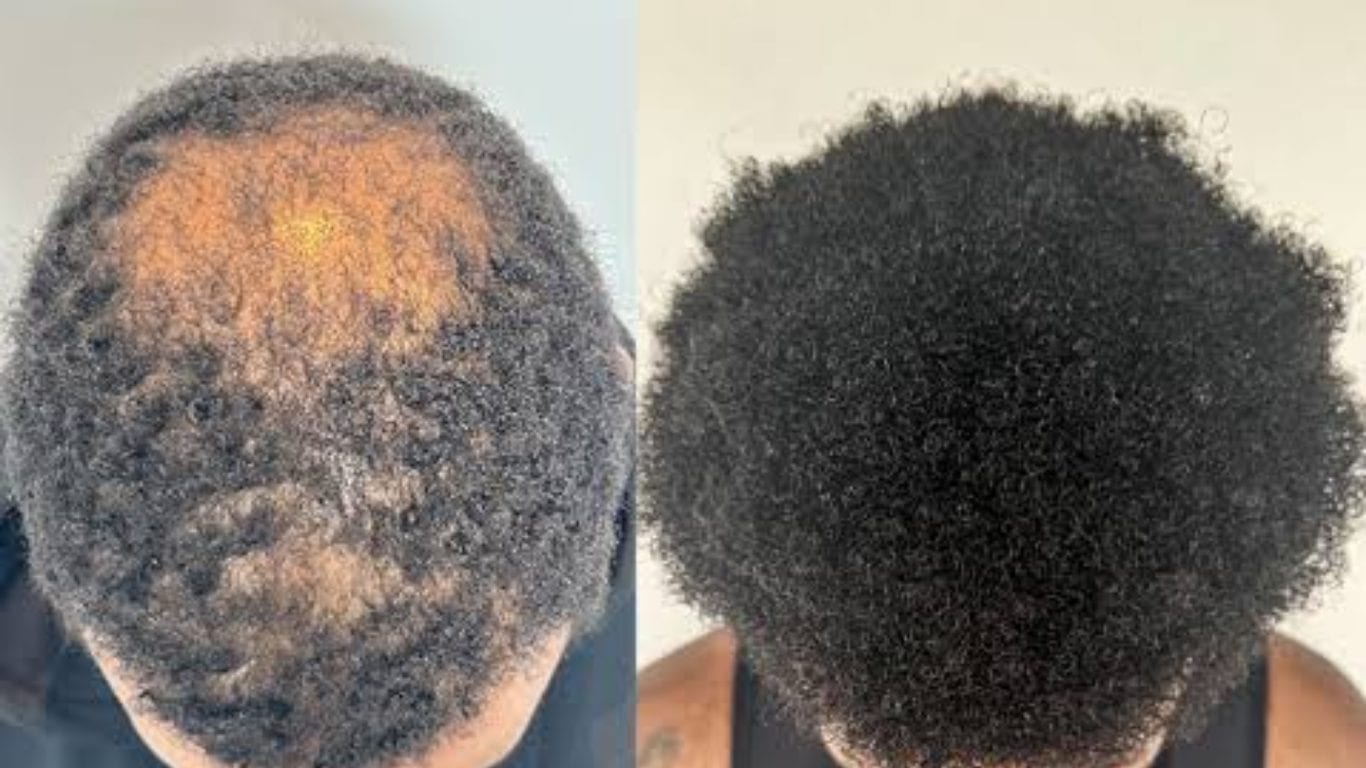
Yes. Afro-textured hair transplants successfully and, in experienced hands, achieves results that are just as natural and durable as any other hair type. The follicle's curl changes how it's extracted and how many grafts are needed for a given amount of visible coverage, but it does not change basic eligibility, which still depends on a stable pattern of loss and a healthy donor supply, exactly as for straight or wavy hair.
The honest starting point is that outcome quality in afro-textured hair is not inherently different from any other texture. What changes is the process behind it: the same curved follicle that makes extraction harder, covered next, also gives curl a genuine coverage advantage once it's transplanted, so a good plan actually leans on that difference rather than fighting it.
What decides candidacy, regardless of hair type
Two things decide whether anyone is a candidate for a hair transplant at all: a stable, patterned area of loss rather than active diffuse thinning, and a genetically resistant donor area at the back and sides with enough density and calibre to cover it. Neither check changes because of curl, texture or ethnicity, which is why our full candidacy guide and our broader guide to hair type and texture don't treat afro-textured hair as a separate eligibility category, only a separate technique one.
Why the result lasts just as long
Longevity works the same way, too. The grafts used come from the occipital donor band at the back of the scalp, which is more resistant to DHT, the hormone that drives most pattern hair loss, than hair at the hairline or crown, whatever your hair type or texture. No follicle is completely immune to DHT, so no honest clinic promises absolute permanence, but that relative resistance is what makes a transplant durable in afro-textured hair in exactly the same way it does in straight or wavy hair.
What genuinely does need extra care
Where afro-textured hair does need dedicated attention is upstream of the surgery itself: correctly identifying whether hair loss is traction alopecia, a scarring alopecia such as CCCA, or ordinary pattern loss, since the three call for different next steps and only one of them is straightforwardly ready for a transplant. The rest of this guide goes through each of those in turn.
Why is extraction technically harder in curly, coiled Afro-textured hair?
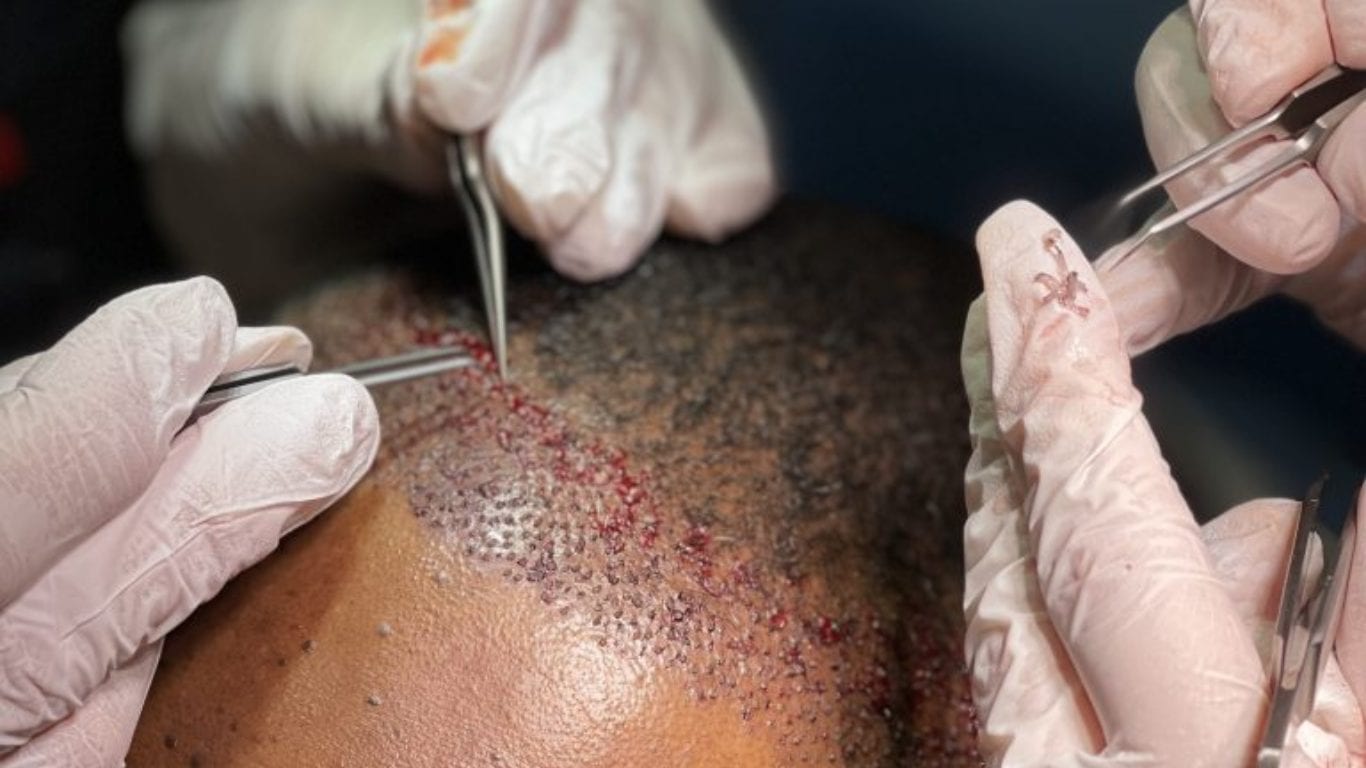
Because the follicle curves beneath the skin, sometimes close to 180 degrees, a standard straight FUE punch is more likely to sever it partway down, a transection, than it would in straight hair. Experienced surgeons manage this with curl-adapted punches, larger or flared punch tips, a slower extraction pace, and often a small test extraction before committing to a full session, rather than avoiding afro-textured hair altogether.
Afro-textured hair follows a genuinely curved, sometimes tightly coiled path under the scalp's surface, even where the visible hair above the skin looks only wavy. A standard FUE punch is built to travel in a straight line down to the follicle; when the root bends away beneath the surface, a punch that can't see or follow that curve is more likely to cut through the follicle partway down, a transection, which damages or destroys that graft's chance of surviving.
Punch size and technique adjustments
Surgeons who regularly work with afro-textured hair typically use a slightly larger, flared or blunt-tipped punch that follows a curved path with less shearing force, adjust the angle and depth case by case rather than using one setting throughout, and work more slowly per graft to keep transection rates low. None of this is exotic equipment; it's a deliberate, learned adjustment to a standard toolkit, which is exactly why it's the surgeon's specific experience with this texture, not the clinic's general FUE volume, that predicts your transection rate.
The value of a small test extraction
Because transection risk in tightly coiled hair genuinely varies from person to person, a cautious approach some experienced clinics use is a small test extraction, often somewhere in the range of a few dozen to around 100 grafts, before committing to a full session. This gives the surgeon a direct, individual read on how your specific curl behaves under the punch and what transection rate to expect, rather than assuming a number from experience with other patients. It's a reasonable, low-cost question to ask at consultation, not a standard every clinic offers.
Why this is a technique problem, not a limit on the result
None of this makes afro-textured hair a poor candidate for transplantation; it makes surgeon-specific, texture-specific experience the deciding factor in how many of the grafts extracted actually survive and grow, which is a different thing from how many extractions are attempted. A donor area that's otherwise strong, ideally over 50 follicles per cm², can still produce a disappointing functional yield if transection rates run high, which is exactly why the test extraction above is worth asking about. Our guide to donor hair supply covers density and yield in more depth; the point specific to curl is that a real transection rate, not a headline graft number, is what determines your actual result.
Why can Afro-textured hair look fuller with fewer grafts?
Curled and coiled hair covers more visible scalp per graft than straight hair, because each strand loops and doubles back on itself rather than lying flat, casting more shadow and taking up more visual space for the same length. This means a realistic graft target for a given area of loss is often somewhat lower in pronounced afro-textured curl than in straight hair covering the same area.
It's a genuine, if counter-intuitive, trade-off against the higher transection risk in the previous section: the same curl that makes extraction harder also makes the transplanted result look fuller for a given graft count. A straight hair lies flat and covers roughly a line's width of scalp; a tightly coiled strand of the same length loops back on itself repeatedly, covering a noticeably larger visual footprint and creating more shadow between strands, which reads to the eye as denser hair.
Coverage per graft, not just graft count
Two people with an identical number of viable grafts, one with straight fine hair and one with tightly coiled afro-textured hair, will not look equally dense once the hair grows in; the coiled result generally reads fuller. This is one reason graft-count comparisons across hair types can be misleading taken alone, and why a realistic target for an area of loss in pronounced curl is often lower than the same area would need in straight hair.
Curl also softens the hairline
Curl gives a hairline some natural forgiveness, too. A gently irregular edge already reads as more natural than a razor-straight line, and natural coil reinforces that softness on its own, giving a surgeon a little more room for error at the hairline than dead-straight hair allows.
Working out your own number
None of this cancels out the extraction difficulty covered above; the two effects simply pull in opposite directions, harder to extract cleanly, but more forgiving and higher-yielding once it's placed. Our graft calculator gives a rough first estimate, but curl is exactly the kind of variable that needs a direct, personal look at your own hair to translate into a real number, not a generic area-based formula.
Is traction alopecia the most common reason for an Afro hair transplant?
Yes, traction alopecia, hair loss from sustained pulling by tight braids, weaves, locs, extensions or ponytails, is typically the most common reason people with afro-textured hair consult about a hair transplant, most often thinning along the hairline and temples. Caught early it can be reversible with no surgery at all; once the pulling has fully stopped and the pattern has stayed stable for a period, it becomes a genuinely good, common indication for transplantation.
Traction alopecia develops from sustained pulling on the hair rather than from hormones, and it's a mechanical injury, not a pattern-loss condition, which is exactly why it behaves differently from the androgenetic loss covered in most of this site. It typically starts subtly, a slightly receded or thinned edge along the hairline or above the ears, and worsens gradually with continued tension from the same styles that caused it.
Reversible early, permanent late
Caught early, while the follicle is only stressed rather than destroyed, traction alopecia is often reversible simply by removing the tension: looser styles, more rest between protective styles, or a period without braids, weaves or extensions at all. Left untreated for years, the same follicle can be permanently destroyed and replaced with scar tissue, at which point regrowth stops being possible and a transplant becomes the only way to restore visible density. This is one of the more common patterns our guide to the causes of hair loss covers in more depth.
What candidacy actually requires
Two things need to be true before traction alopecia is ready for a transplant: the styling that caused it has genuinely stopped, or changed enough to remove the tension, and the affected area has stayed stable for a meaningful period rather than still visibly worsening. Operating into an area that's still under active tension, or where the pattern hasn't settled, risks a result that looks fine today and thinner again in a few years as the same habit continues. This mirrors the general age-and-stability guideline used across hair transplants, usually from around 25 once loss has stabilised, except traction alopecia is mechanical rather than hormonal, so it's judged by whether the pulling has stopped, not by a birthday.
Why a scalp check still comes first
Because long-standing traction alopecia can look similar at a glance to a scarring alopecia such as CCCA, covered next, a careful assessment confirms which one you actually have before any transplant plan is made, since the two are managed very differently. This is also a pattern seen often, though not exclusively, in women's hair loss, where traction from tight hairstyles is one of the well-defined, patterned causes that responds well to transplantation once it's stable.
What about CCCA and other scarring alopecias in Afro-textured hair?
Central centrifugal cicatricial alopecia (CCCA) is a scarring alopecia seen more often in people with afro-textured hair, especially women, that starts at the crown and spreads outward, permanently destroying the follicle as it goes. Like other scarring alopecias, it must be diagnosed by a dermatologist and confirmed quiet for at least six months before a transplant is considered, since operating into active disease risks poor graft survival and can trigger a flare.
CCCA is a primary scarring, or cicatricial, alopecia that typically begins at the crown and spreads outward in a centrifugal pattern, gradually replacing the follicle with scar tissue as it progresses. It sits in the same broader category as lichen planopilaris, frontal fibrosing alopecia and discoid lupus, conditions our candidacy guide covers for hair loss generally, but CCCA specifically is seen more often in people with afro-textured hair, and predominantly in women, than in the population as a whole.
Why active disease is the real concern
The concern with any scarring alopecia is never that the transplant itself will be "rejected": the grafts remain the patient's own tissue throughout. It's that placing grafts into inflamed, actively scarring tissue risks poor graft survival, and that the surgical trauma can potentially trigger a flare of the underlying disease in the surrounding skin. Neither risk is worth taking while the disease is still active.
The six-month quiet rule
For this reason, transplantation into CCCA or any other scarring alopecia is only considered once the condition has been confirmed quiet, generally for at least six months, under a dermatologist's ongoing supervision. This isn't a formality: it's what separates a transplant that has a real chance of taking from one that risks losing the new grafts and reactivating the original condition.
Diagnosis has to come first, not a transplant consultation
Because early CCCA can look similar to traction alopecia or ordinary thinning at a glance, and because the right next step is completely different depending on which one you actually have, anyone with gradually spreading crown thinning, especially with any tenderness, itching, burning or visible scalp change, should see a dermatologist for a diagnosis before a hair transplant consultation, not instead of one. A transplant surgeon can then plan around a confirmed, quiet diagnosis, rather than guessing at one.
Does a keloid or hypertrophic scarring tendency rule out an Afro hair transplant?
No, but it changes the plan. Keloid and hypertrophic scarring is reported more often in people with afro-textured hair and darker skin tones in general dermatology literature, so a personal or family history is discussed carefully at consultation, mainly because it affects donor-area healing. FUE, which leaves small scattered puncture marks rather than one long incision, is usually preferred over strip (FUT) harvesting for exactly this reason.
A keloid is a raised, thickened scar that grows beyond the edges of the original wound, sometimes considerably, and can be itchy or tender; a hypertrophic scar is similar but stays within the wound's original boundary. Both are a real planning consideration for any surgery, including a hair transplant, because extraction and, especially, closing a donor incision create small wounds that heal like any other.
Why it matters most for the donor area
Strip (FUT) harvesting removes a linear strip of scalp and closes it with one long incision, exactly the kind of wound that can produce a keloid or hypertrophic scar in someone prone to them. A visible, thickened scar at the back of the head is a genuinely bigger practical problem than most other scars, since it limits future hairstyle choices, including very short cuts or shaved styles, and is difficult to hide fully.
Why FUE is usually favoured here
FUE removes individual follicles through tiny, round punch wounds scattered across the donor area instead of one long incision. These heal as small, generally far less noticeable dot marks, which meaningfully lowers, though doesn't entirely eliminate, the practical risk of one large, visible keloid forming in the donor area. For someone with a known keloid tendency, this is usually the technique a surgeon leans toward, sometimes alongside a smaller first session to see how the individual scalp actually heals before planning a larger one.
What's actually assessed at consultation
A careful clinic asks about three things. Personal history: has the person developed a keloid or hypertrophic scar from a previous cut, piercing, vaccination or surgery. Family history: keloid tendency has a genetic component, so a strong family history matters even without a personal one. And skin type. None of this is a pass/fail test; it's information that shapes technique choice and session size, not a reason to assume surgery is off the table. See our broader guide to clinic red flags for what a genuinely thorough pre-operative assessment should cover beyond this one point.
FUE, DHI or FUT: which technique actually suits Afro-textured hair best?
FUE is the default choice for most afro-textured hair because its scattered, punctate scarring carries a much lower risk of one large, visible keloid than FUT's single linear scar. DHI shares the same punch-based extraction step as FUE, so it doesn't reduce curl-related transection risk, but its placement control can help match afro-textured hair's often multi-directional growth. FUT can still yield strong results in very tightly coiled hair, since the strip is dissected under magnification rather than extracted blindly through the skin, at the cost of a linear scar.
The names matter less than what each technique actually changes for curl specifically: how the follicle is taken out, and how visible the resulting scar is, both covered from different angles earlier in this guide.
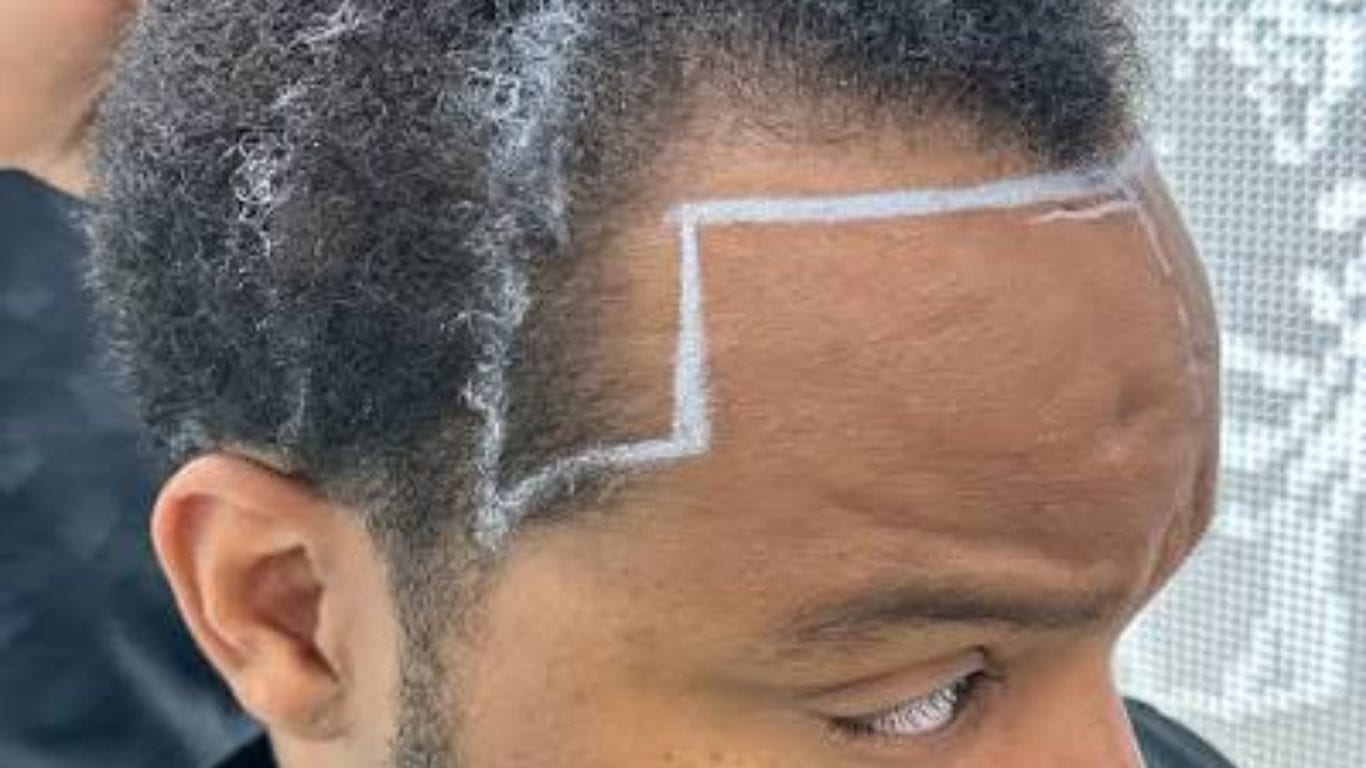
FUE: the default for most afro-textured cases
FUE is extracted one follicular unit at a time through a small punch and leaves scattered, generally inconspicuous dot marks rather than a line, which is exactly why it's usually preferred where keloid tendency, covered in the previous section, is a genuine consideration. The trade-off, covered in depth earlier, is that the curved follicle raises transection risk at the extraction step unless the surgeon uses curl-adapted punches and a careful, unhurried pace.
DHI: a placement difference, not an extraction one
DHI most often uses the same FUE-style punch to extract follicles; what's different is placement, where an implanter pen creates the channel and sets the graft in a single motion, giving the surgeon fine control over angle, direction and depth. That control can genuinely help with afro-textured hair's growth pattern, which is often more multi-directional than straight hair, but DHI does nothing to lower the curl-related transection risk at extraction, since that step is identical to FUE. The technique that changes your transection rate is how the follicle is taken out, not how it's placed.
FUT: still a real option for the most tightly coiled hair
FUT removes a strip of donor scalp and dissects it into grafts under a microscope, where the team can see the follicle's actual curve directly rather than following it blindly with a punch through the skin. In very tightly coiled hair, this can mean comparatively low transection rates and strong yield in a single session. The cost is a single linear donor scar, which is a bigger consideration for anyone with a keloid tendency or a strong preference for very short donor-area styles, so it's a genuine trade-off rather than an inferior option.
The bottom line
None of the three technique names predicts your result on their own; what predicts it is the team's specific, demonstrated experience extracting and placing afro-textured hair. Our broader guide to hair transplant methods covers FUE, DHI, FUT and Sapphire FUE in full depth for anyone comparing techniques beyond the curl-specific points here.
How do I choose a clinic specifically for an Afro hair transplant?
Ask for before-and-after results specifically in afro-textured or tightly curled hair, not the clinic's general portfolio, and ask directly how many cases like yours the team performing your surgery, not just the clinic overall, has done. A clinic confident in its afro-hair experience should be able to discuss transection rates, punch technique and test-extraction options without hesitation.
Every point covered earlier in this guide, transection risk, coverage advantage, traction alopecia, CCCA, keloid tendency, converges on the same practical question at consultation: does this specific team have real, demonstrable experience with afro-textured hair, not just hair transplants in general.
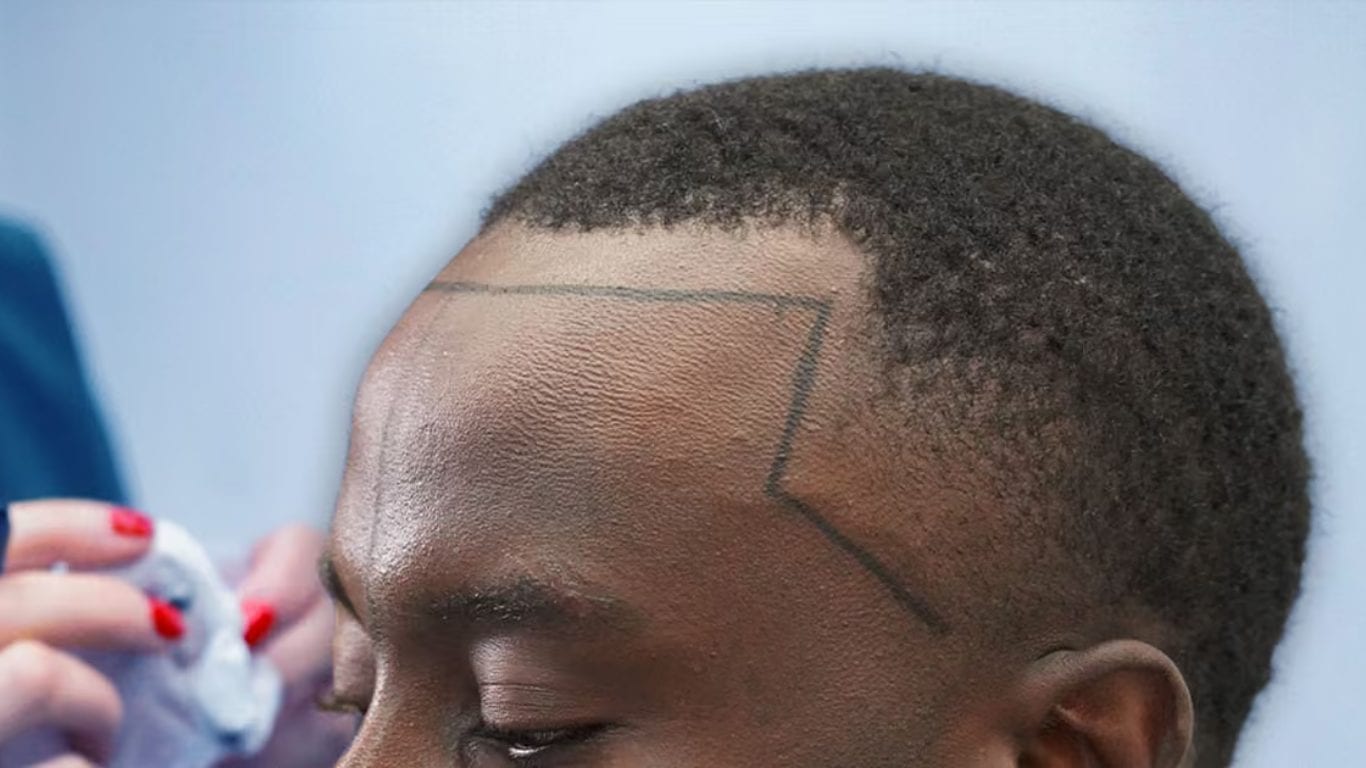
What to ask for
- Documented afro-hair cases in the portfolio. Before-and-after results in tightly coiled or afro-textured hair specifically, not a general gallery dominated by straight hair.
- Real experience volume. How many cases with this specific texture the team performing your surgery, not just the clinic's marketing figures as a whole, has actually done.
- A clear answer on punch technique. What punch type, size and angle they use for tightly coiled hair, and why.
- A test-extraction policy. Whether a small trial extraction is offered before a full session, and how transection rate is checked and communicated.
- A dermatology pathway. Whether the clinic asks about, and can refer out for, a proper diagnosis before transplanting into any area with a history of tight styling or scalp symptoms.
Why this matters more than headline graft numbers or price
A large advertised graft count means little if transection rates in tightly coiled hair run high, since damaged grafts don't survive regardless of how many extractions were attempted. The number that actually matters is viable, well-placed grafts in your specific texture, which depends on hands-on experience with that texture far more than on a clinic's general session size or price point. Our broader guide to clinic red flags covers the wider checklist, named surgeons, verifiable accreditation, transparent pricing, that applies to any hair transplant; the questions above are the layer specific to afro-textured hair on top of it.
Where to start
A close-up, well-lit set of photos of your area of loss, your donor area and, if relevant, the area affected by traction or scarring lets an experienced team give a genuinely useful first read on your texture and a realistic graft plan before you travel anywhere. See how you choose a clinic step by step, compare options in the clinic ranking, and check the best clinics; then bring the afro-hair-specific questions above to whichever clinics you shortlist.
What's different about aftercare after an Afro hair transplant?
The surgical healing timeline is the same as for any hair transplant: shedding around weeks 2 to 3 is normal, new growth begins from roughly month 3 to 4, and the final result is judged at about 12 months. What differs is the practical routine around it, gentler, less frequent moisture and product use early on, and waiting until the grafts are firmly established before returning to any tight braids, weaves, locs or wigs.
Nothing about afro-textured hair changes how a graft actually heals; the biology is identical to any other texture. What changes is the everyday routine layered on top of that healing, because afro-textured hair and scalps are typically managed with more product, more manipulation and more tension-bearing styles day to day than straight hair is, and all three need to be handled differently in the weeks after surgery.
Moisture and product routine early on
In the first days and weeks, both the donor and recipient areas need to stay clean but shouldn't be weighed down with heavy oils, butters or styling product while tiny scabs are forming and grafts are securing themselves; most clinics give a specific, gentle washing routine for exactly this period. Once the clinic confirms the area has healed, normal moisturising can generally resume, though reintroducing heavier products is usually done gradually rather than all at once.
When protective styles are safe again
Tight braids, weaves, locs, extensions or wigs with clips or tension anywhere near the transplanted or donor area put mechanical stress exactly where fragile, newly placed grafts are trying to establish a blood supply, the same mechanism covered earlier for traction alopecia itself. There's no single universal date that applies to everyone; grafts are still securing themselves through the early shedding phase at weeks 2 to 3, and most clinics ask patients to wait considerably longer than that, often several months, before any tension-bearing style goes back near the treated area. The safe, specific timing for your case is confirmed by your own clinic at follow-up, not fixed in advance by an article.
The same growth timeline as any hair transplant
The transplanted hairs shed around weeks 2 to 3, which is normal and expected, not a sign the graft failed. New growth begins from roughly month 3 to 4, and the final result, including how the hair sits and its density, is generally assessed at around 12 months. Our full aftercare guide covers the general routine, sleeping position, washing, exercise, that applies whatever your hair type; this page covers only what's specifically different for afro-textured hair on top of it.
Supporting the result long-term
Because traction alopecia is a habit-driven condition, protecting the result over the years generally means genuinely changing, not just pausing, whatever styling tension caused the original thinning. The same general principles that protect any transplant long-term, caring for native hair around the graft, realistic expectations about ageing hair, sensible follow-up, are covered in full in our guide to how long a hair transplant result lasts.
Frequently asked questions
Does an afro hair transplant leave visible scarring?
Usually very little. FUE leaves small, scattered dot marks that are typically inconspicuous even in short afro-textured styles once healed. FUT leaves a single linear scar, which is a bigger consideration for anyone with a keloid tendency or a preference for very short hair at the back and sides, which is why FUE is usually the default choice for afro-textured hair.
Can hair be transplanted directly into braids, locs or a weave?
No. A hair transplant moves living follicles into your own scalp; it doesn't attach hair to braids, locs or a weave, and grafts need direct contact with healthy scalp skin to survive. What a transplant can do is rebuild a hairline or area thinned by traction alopecia once the pulling has stopped and the pattern is stable, restoring your own growing hair rather than adding to a style.
Does transplanted hair keep its natural curl pattern?
Yes. Curl pattern, like calibre and colour, is a property of the hair itself, not the place it's grown, so a graft keeps its natural coil once it's moved and starts growing in its new location, the same way donor hair keeps its texture in a beard or eyebrow transplant.
Is a hair transplant safe for Black women specifically?
Yes, when the same candidacy criteria are met as for anyone else: a stable pattern of loss, a healthy donor area, and no active scarring alopecia. Traction alopecia, one of the more common patterns behind hair loss in women with afro-textured hair, is a well-established, good indication for transplantation once styling tension has stopped and the pattern is stable; see our broader guide to hair loss and transplants in women for the fuller picture.
Do I need to stop relaxers, texturizers or chemical treatments before surgery?
Any clinic will want the scalp calm, clean and free of active irritation before surgery, so harsh chemical treatments, relaxers, dye or heavy heat styling close to the donor and recipient areas are usually paused for a period before and after the procedure. The exact timing is confirmed by your clinic, since it depends on your scalp's condition, not fixed by a general rule.
How many grafts does an afro hair transplant typically need?
There's no fixed number specific to afro-textured hair; it depends on the area of loss, donor density and calibre, exactly as for any hair type. Because curled hair often covers more visible scalp per graft, a realistic target for a given area can be somewhat lower than the same area would need in straight hair, but the only reliable number comes from a personal assessment of your own donor area and curl.
Is an afro hair transplant more expensive because of the extra technique required?
Not inherently. Price is still driven mainly by the number of grafts and the clinic's general pricing structure, not by hair type on its own. Where cost can differ is time: a slower, more careful extraction pace in tightly coiled hair can mean more surgical time per graft, which some clinics factor into planning a session, so it's worth asking directly rather than assuming a flat per-graft price applies unchanged.
The only reliable way to know your real transection risk, your realistic graft target, and whether traction alopecia, CCCA or ordinary pattern loss is behind your thinning, is a proper look at your own scalp, not a general article. Get a free hair analysis and hear back from our #1-ranked clinic with an honest read on your hair, scalp and options, with no obligation to go further.
General educational guidance, not medical advice. Whether you're ready for a transplant, and what your afro-textured hair can realistically achieve, is confirmed by a qualified surgeon, and where relevant a dermatologist, at a personal assessment.
Last updated: August 2026 · Editorial standards