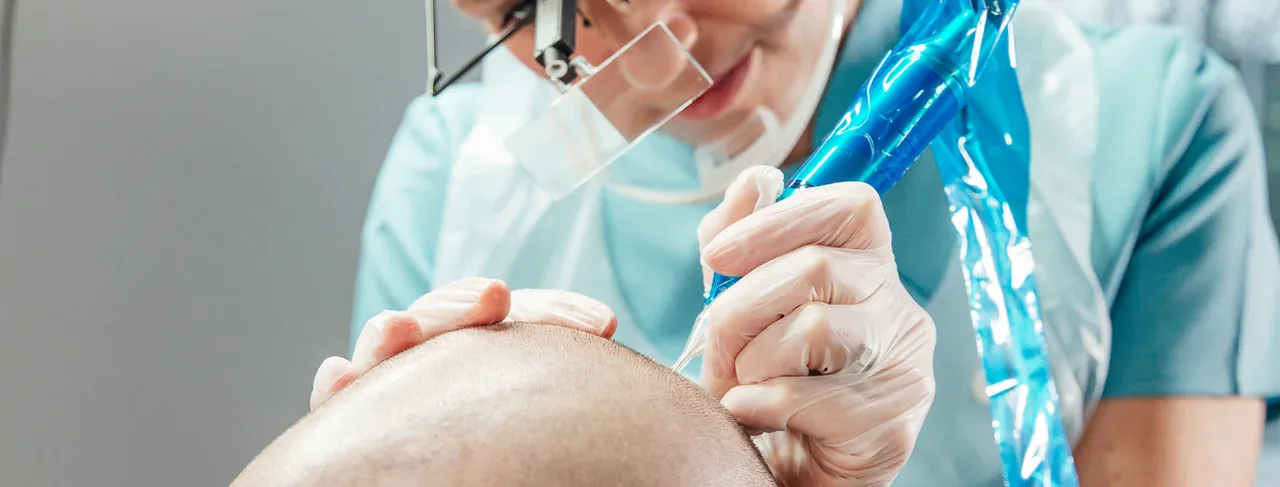
Scalp micropigmentation, abbreviated to SMP, is a cosmetic treatment in which pigment is placed into the upper layers of the skin on the scalp as thousands of tiny dots. Each dot is placed so that, from a distance, it resembles the end of a short, freshly cut hair. Together they create the impression of a denser head of hair, or of a sharply drawn, closely shaved hairline.
The most important thing to understand first: SMP adds no hair. It does not change the number of hair follicles, it does not start hair growth, and it does not slow hair loss that is already under way. It changes how the scalp looks. That distinction decides whether SMP is a sensible choice for you, or whether what you are really after is something else.
This page goes through what the treatment involves, how a course of treatment is usually structured, who it may be relevant for, and where the limits lie. If you are considering moving real hair follicles instead, you can read about the surgical options in our review of hair transplant methods.
What is Scalp Micropigmentation?
Scalp micropigmentation is a cosmetic pigmentation of the scalp in which tiny dots of pigment are placed into the skin with a fine needle, visually mimicking short hair follicles. The treatment adds no hair and does not affect hair growth. It changes only how the scalp looks, by reducing the contrast between hair and skin.
Technically, SMP resembles a tattoo, but it is carried out differently. The pigment is placed more superficially than in an ordinary tattoo, the dots are considerably smaller, and only a few tones are used, chosen to match the colour of the hair and the skin. The aim is not a drawing but an illusion: that the eye reads a series of small dark points as hair stubble in the skin.
Why it gives the impression of more hair
Thinning hair looks thin because the paler scalp shows through between the strands. The contrast between dark hair and light skin is what the eye reads as “visible scalp”. When the dots of pigment fill in the gaps, that contrast drops and the hair is perceived as denser, even though the number of hairs is exactly the same.
It is also why the effect is greatest where the contrast is greatest, and less pronounced in people with fair hair on fair skin, where there is not much contrast to remove to begin with.
Two different aims, one technique
In practice, SMP is used for two rather different things. The first is added density: pigment is placed between existing hairs in an area that has thinned, so the scalp does not show through. The second is the shaved look: the whole hairless area is pigmented so that it resembles dense, freshly clipped hair with a drawn hairline. The two give very different results and call for different decisions, and it is worth knowing which of them you are talking about before the first consultation.
How does SMP work?
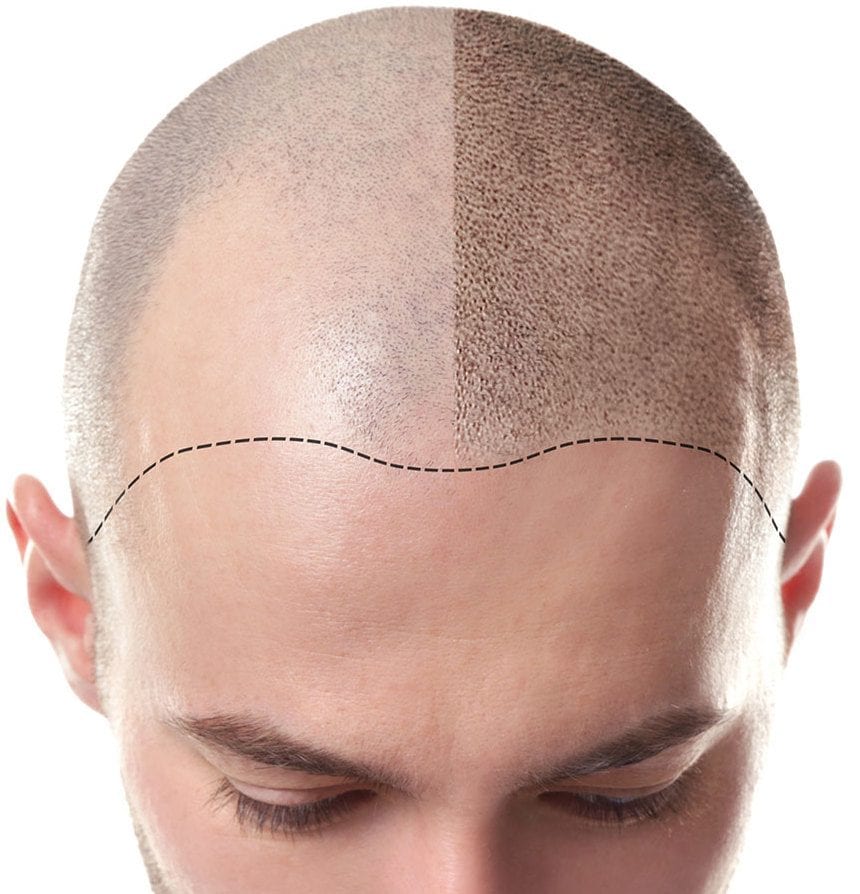
A course of SMP is built around a consultation, an agreed hairline design, an assessment of the scalp and skin type, a choice of pigment tone, and then the pigmentation itself spread over several sessions. Between sessions the result is assessed, and a further layer is usually added until the density looks right. Aftercare is mostly about keeping the area clean, dry and out of the sun while the skin heals.
There is no single, universal protocol for SMP. Below is the order a course of treatment normally follows. The specific details, including the number of sessions and the intervals between them, are set by the practitioner you choose.
- Consultation. Your hair loss history, your expectations and the end result you want are gone through. This is also where it is established whether SMP is the right tool at all for what you want to achieve.
- Hairline design. The hairline is drawn on before any pigment is placed. It is the single decision that matters most for whether the result looks natural, and you should approve it while it can still be washed off.
- Assessment of the scalp. Skin type, scars, existing hair coverage, any skin conditions, and how readily the skin bleeds and reacts all affect both technique and result.
- Choice of pigment. The tone has to match the hair colour and the skin tone. A neutral, grey-toned base is normally used rather than a black colour, precisely to avoid the pigment taking on a bluish cast over time.
- First session. A deliberately conservative layer is placed. It is easier to add pigment later than to remove it again.
- Assessment. Once the skin has healed, the actual result becomes visible. Some of the pigment always fades in the first weeks, and that is expected.
- Further sessions. Density is built up in layers until the result looks right.
- Maintenance. The pigment fades over time, and a top-up may become relevant.
Why it is split into several visits
The split is not a question of time, but of control. Pigment can be added, but not readily removed. By building the density up over several rounds, both you and the practitioner can assess the result along the way and adjust tone and density before it is too late. A course in which everything is placed at full density in one go is a warning sign rather than a gain in efficiency.
Who might SMP be relevant for?
SMP may be relevant for a receding hairline, diffuse thinning, a visible scalp, scars left by a hair transplant, and for people who wear their hair very short or shaved. It is also an alternative for those who do not want, or are not suited to, a surgical procedure. It is not the answer if the aim is longer hair, or more hair to run a comb through.
Situations in which SMP is typically considered
- A receding hairline. Pigmentation can draw the line back in and make the transition less abrupt. With a shaved look it can define an entirely new hairline.
- Thinning hair. Where hair remains, pigment between the strands can reduce how much skin shows through.
- Diffuse hair loss. Where the thinning is even across the crown, added density can give a more uniform impression.
- A visible scalp. The crown is where the contrast between skin and hair usually becomes obvious first.
- Short or shaved hairstyles. This is where SMP is strongest, because the result has to match something that is already very short.
- Scars from earlier procedures. See the section on scars further down.
- Choosing against surgery. Some people do not want an operation, and some are not suited to one, for example because the donor area is too weak. See what determines suitability in our review of who is a candidate for a hair transplant and of the donor area.
When SMP is not the answer
SMP does not solve everything, and that is just as important to know. The treatment does not give you longer hair, it does not give you hair that can be combed or styled, and it makes no difference if you wear your hair long. Nor does it stop hair loss: if the underlying hair loss continues, the area around the pigmented one will thin over time, and the result can end up looking uneven if it has not been planned with that in mind. If your hair loss is active and early, it is worth first reading about treating hair loss without surgery, which is what can actually influence how it develops.
SMP and hair transplants – what is the difference?
A hair transplant moves your own hair follicles from an area with permanent hair to an area without. The result is hair that grows and can be cut and styled. SMP moves nothing: it places pigment in the skin so that the area looks denser. One adds hair, the other changes the appearance. Neither is generally better than the other – they solve different problems.
| Hair transplant | SMP | |
|---|---|---|
| What happens | Your own hair follicles are moved | Pigment is placed in the skin |
| Adds hair | Yes | No |
| Hair can grow and be styled | Yes | No |
| Surgical procedure | Yes | No |
| Requires a donor area | Yes | No |
| Result becomes visible | Gradually, over months | Essentially straight away |
| Longevity | Lasting, but hair loss around it can continue | Fades over time, a top-up may become relevant |
| Works with long hair | Yes | No, best with short hair |
So the choice is not about what is “best”, but about what you want to achieve. If you want to be able to comb your hair, SMP is not the answer. If you want a sharp hairline for a shaved look, a transplant does not necessarily do it better. And for some people the answer is both. Read about the surgical techniques under Sapphire FUE, the DHI method and FUT.
Advantages of SMP
The real advantages of SMP are that the result is visible almost straight away, that it is not a surgical procedure, that it does not require a donor area, and that it can be used where a transplant is not possible. Against that, it is a purely cosmetic result that has to be maintained.
- A quickly visible result. Where a transplant only shows its final result after around a year, the difference with SMP is visible after the first session, although the final tone only settles once the skin has healed.
- Not surgery. Nothing is cut, and there is no operative procedure with the recovery that goes with it.
- Independent of donor hair. This is the decisive difference for people with a depleted or weak donor area, where a transplant is not realistic.
- Can be used alongside other things. SMP rules out neither medical treatment nor a later transplant.
- Can disguise scars. See the section below.
These advantages have to be weighed against the fact that this is a maintenance-dependent, cosmetic solution that does nothing about the cause of the hair loss. If you want to know how results hold up over the long run, you can read about long-term durability.
SMP for scars left by a hair transplant
SMP is often used to disguise scars in the donor area, both the long, thin strip left by FUT and the small pale dots left by FUE. The pigment does not remove the scar, but it reduces the contrast between the pale scar tissue and the surrounding skin, so that it becomes less noticeable with short hair. Scar tissue often takes pigment differently from normal skin, which makes the result harder to predict.
Scars are one of the most widely accepted uses of SMP, precisely because the problem is visual rather than biological. A scar at the back of the head rarely bothers anyone as long as the hair is long enough to cover it. It only becomes a problem when the hair is cut short, and that is exactly where reduced contrast is what is needed.
What to know beforehand
- Scar tissue has a different structure from normal skin and does not necessarily take up pigment evenly across the whole scar. The result can therefore be less uniform than on undamaged skin.
- A scar has to be fully healed before it makes sense to pigment it.
- The aim is usually to make the scar less visible, not to make it disappear.
If you are unhappy with the result of an earlier procedure, the scar is rarely the only question. Our review of repair after a failed hair transplant describes how the whole situation is assessed, and where micropigmentation fits in.
How many SMP treatments are needed?
The number of sessions is set individually and cannot meaningfully be stated in advance. It depends on how large an area has to be covered, the result you want to achieve, how much hair you have left, how your skin takes up and holds pigment, and whether scar tissue is involved. Always have the expected number and the price for the whole course confirmed before you start.
SMP is carried out in layers, and few courses are finished after a single visit. How many are needed is governed by:
- The result you want. Lightly adding density to a thinning crown is a different job from building a full shaved look with a drawn hairline.
- The size of the area. More skin takes more time.
- Skin and skin type. Skin reacts differently from person to person, and some pigment is always lost during healing.
- Existing hair. If there is hair to work between, less is often needed.
- Scar tissue. Scars usually call for more, and more cautious, rounds.
A fixed number promised in advance, without anyone having seen your scalp, says more about the marketing than about the treatment. We go through the same principles for what you should be able to get in writing before any treatment in warning signs you should know.
How long does SMP last?
SMP is long-lasting, but not unchanging. The pigment sits in the skin and fades gradually, because the body slowly breaks it down and because UV light bleaches it. How quickly that happens varies from person to person and depends on, among other things, skin type, sun exposure and how deeply the pigment was placed. A top-up may therefore become relevant over time. The treatment should not be described as permanent and unchanging.
Two things change over time, and they are worth keeping apart.
The pigment fades
The intensity gradually drops. It happens to everyone, and it is not a sign that anything has gone wrong. Sun exposure is the factor most people can do something about themselves: UV light breaks pigment down, and a scalp is hard to keep out of the sun. Sun protection is therefore not only a question of skin health, but also of how long the result lasts.
The tone can shift
Pigment in skin can change shade over time. That is among the reasons neutral grey tones are used rather than black, and why the pigment is placed relatively superficially. It is also one of the reasons experience counts for so much: a tone that looks right in the first week has to look right several years later too.
And the hair loss continues
The third change has nothing to do with the pigment. If your hair loss is active, it carries on around the treated area. A result that fits perfectly today can therefore look different in a few years, not because the treatment was poor, but because the starting point has moved. We go through how hair loss typically develops under how hair loss progresses.
Does SMP hurt?
Most people describe SMP as uncomfortable rather than painful, but the experience is individual. Needles are being worked into the skin, and you feel it. How bothersome it is depends on the area, on your own sensitivity and on how long the session lasts. Some areas, particularly along the hairline and over scar tissue, are typically more sensitive than others.
It would be misleading to call the treatment pain-free. It would also be misleading to describe it as an operation. The reality lies in between: a persistent, prickling sensation over a long stretch of time, which most people can sit through without difficulty, but which is tiring.
- Duration matters. A short session over a small area feels different from several hours over the whole crown.
- The area matters. The skin is not equally sensitive everywhere on the head.
- Scar tissue feels different. It can be either more or less sensitive than normal skin.
Ask in advance what pain relief is offered and how long a session is planned to take. These are reasonable questions, and a decent provider answers them concretely.
SMP for men and women
SMP is used for both sexes, but typically in different ways. In men it is often either added density at the crown or the building of a fully shaved look with a drawn hairline. In women, where hair loss is usually diffuse and the hair is worn long, it is nearly always added density between existing hairs rather than a shaved look.
In men
Male hair loss usually follows a recognisable pattern, with a receding hairline and thinning at the crown. That makes both added density and the shaved look relevant. Precisely because the pattern is predictable, it is important to design with an eye to how the hair loss will look in ten years, not only today. See also hair loss in men and the hairline.
In women
Women rarely lose hair in sharply defined areas. The thinning is usually even, often clearest along the parting, and the hair is typically worn long. A shaved look therefore rarely makes sense, while added density along the parting and at the crown can reduce how much scalp shows through. Because the hair is long, the pigment has to be placed so that it is not visible when the hair moves. More on the patterns under hair loss in women.
For both sexes, the cause of the hair loss should be established first. Diffuse thinning may be down to something that can be treated, and that is worth knowing before you choose a cosmetic solution. See causes of hair loss.
Aftercare following SMP
After SMP the scalp should be treated as recently irritated skin: kept clean and dry for the first few days, not rubbed or scratched, and protected from the sun. Sweating, swimming pools, saunas and hard physical activity are typically advised against for a short period. The specific guidance has to come from the practitioner who carried out the treatment, since it depends on technique and extent.
There is no single official aftercare protocol for SMP, and this page does not prescribe one. Below are the principles that recur, which you can use to judge the guidance you are given.
- The first few days. The skin is open and irritated. It is kept clean and dry, and left alone.
- Sweat and heat. Sweating on recently treated skin is usually advised against for a period, and the same goes for saunas, steam rooms and hard training.
- Water. Swimming pools and chlorinated water are typically avoided until the skin has healed.
- Sun. Sun protection is a healing question in the short term and a durability question in the long term.
- Longer term. Ordinary skin care and continued sun protection are what preserve the result best.
Note that this is not the same as aftercare following a hair transplant, where there are transplanted grafts that have to survive. You will find that review under aftercare.
What should you ask about before booking SMP?
Ask to see work on hair and skin types similar to your own, and ideally photographs taken several years after treatment, not only immediately afterwards. Get the number of sessions, the total price, the choice of pigment and the aftercare in writing, and establish what happens if the result fades unevenly, or if your hair loss continues.
- How many sessions are expected in my case, and what does the whole course cost, not just the first visit?
- Can I see results on people with my hair colour and skin type?
- Do you have photographs of work that is three to five years old?
- Which pigment tone is used, and why that one for my skin?
- How is the possibility that my hair loss continues taken into account?
- What does a top-up cost later on, and when is it expected?
- What happens if I am not happy with the hairline?
- What does the aftercare consist of in practice, and for how long?
These are the same principles we recommend for any procedure: get the specifics in writing, and be wary of promises that sound too good. See how to choose a clinic.
Frequently asked questions about SMP
What is SMP?
SMP stands for scalp micropigmentation. It is a cosmetic treatment in which tiny dots of pigment are placed into the upper layers of the skin on the scalp so that they visually mimic short hair follicles. The treatment adds no hair.
How does SMP work?
Thinning hair looks thin because the paler scalp shows through between the strands. SMP places pigment in the gaps, so that the contrast between skin and hair drops. The eye therefore reads the area as denser, even though the number of hairs is unchanged.
How long does SMP last?
The treatment is long-lasting but not unchanging. The pigment fades gradually, partly because of UV light and partly because the body breaks it down, and a top-up may become relevant. How quickly that happens varies from person to person.
Is SMP permanent?
No, not in the sense of unchanged for ever. The pigment stays in the skin for a long time, but both intensity and shade can change over the years. SMP should therefore not be described as permanent without qualification.
Does SMP hurt?
Most people describe it as uncomfortable rather than painful, but the experience is individual. Needles are worked into the skin, so you feel it. Areas along the hairline and over scar tissue are typically more sensitive. Ask about pain relief in advance.
How many treatments are needed?
That is set individually and depends on the size of the area, the result you want, how much hair you have left, how well your skin holds pigment, and whether there is scar tissue. SMP is built up in layers, so a single session is rarely enough. Have the expected number confirmed before you start.
Can SMP hide scars left by a hair transplant?
SMP can make both the FUT strip and the small FUE dots less visible by reducing the contrast between scar tissue and the surrounding skin. The scar is not removed. Scar tissue often takes up pigment less evenly than normal skin, so the result is harder to predict, and the scar has to be fully healed first.
Can SMP make hair look denser?
Yes, that is precisely the aim when pigment is placed between existing hairs. The effect is greatest where the contrast between skin and hair is marked, and more limited with fair hair on fair skin. No more hair appears – it simply looks denser.
Can women have SMP?
Yes. In women it is nearly always used to add density between existing hairs, particularly along the parting and at the crown, rather than for the shaved look. Because the hair is typically worn long, the pigment has to be placed so that it still looks right when the hair moves.
Is SMP suitable for everyone?
No. The treatment gives neither longer hair nor hair that can be styled, so it solves nothing for someone who wants more hair to run a comb through. The effect is also less pronounced where the contrast between hair and skin is low. Active skin conditions on the scalp, and hair loss that is still changing quickly, can also be reasons to wait. An individual assessment is important.
Can SMP be combined with a hair transplant?
The two do not rule each other out, and in practice they are often used together, for example to pigment donor scars or to strengthen the visual impression of density between transplanted hairs. The order and timing should be planned specifically, since transplanted hair needs time to grow out before the final need for pigment can be judged.
What does SMP cost?
The price depends on the size of the area, the number of sessions and where the treatment is carried out, so we do not quote fixed prices. Always ask for the price of the whole course, not just the first session, and find out what a later top-up costs.
Can SMP be removed again?
Pigment in skin can be treated with laser, but that is a separate treatment, it takes several sessions, and the outcome cannot be promised in advance. That is precisely why SMP is built up in layers: it is far easier to add pigment than to remove it again. Always approve the hairline design while it can still be washed off.
SMP is a visual tool, not a treatment for the cause of your hair loss. Whether it is the right choice depends on how much hair you have left, how your hair loss is developing, and the result you are after. Get an independent assessment before you decide.
Last updated: September 2026 · Editorial standards