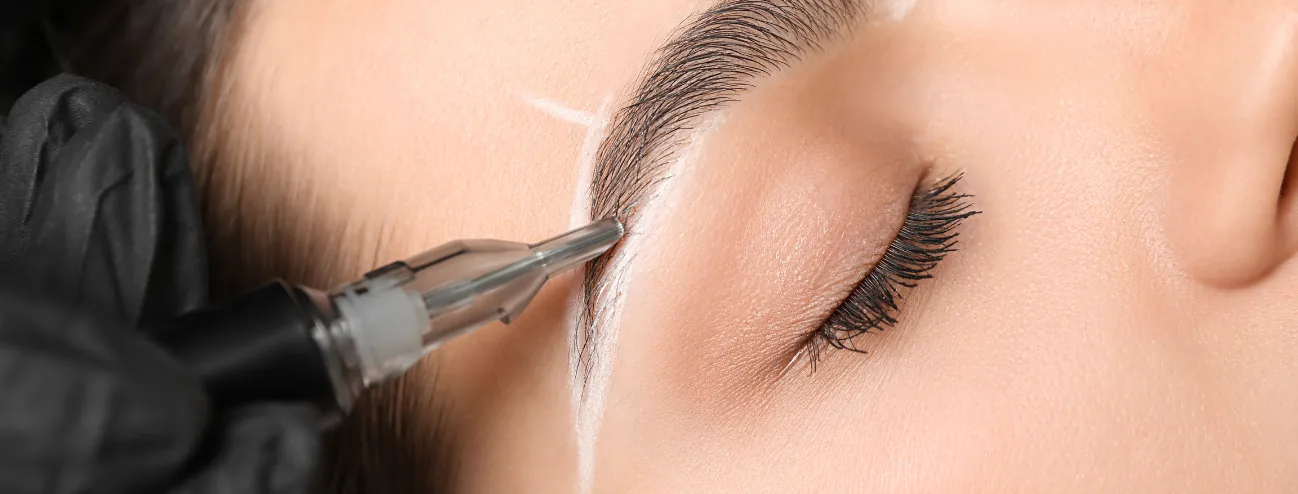
You may have over-plucked your brows for years, thinned them with age, or lost density to alopecia, a scar or an accident, and now the hair simply will not come back on its own. An eyebrow transplant rebuilds the brow with your own hair, moved one single-hair follicle at a time from your scalp, in a shape you choose in advance with your surgeon.
What is an eyebrow transplant?
An eyebrow transplant is a procedure where single-hair follicles are moved from your scalp to the brow with the FUE method, rebuilding or reshaping thin, over-plucked or scarred eyebrows with your own hair. Each hair is extracted and placed individually, which is what allows the result to blend into the brow rather than sit on top of it.
An eyebrow transplant uses the same FUE (follicular unit excision) principle as a scalp or beard transplant, but the demands on precision are higher. The surgeon extracts individual follicles from the donor area at the back of the head and places them one by one into the brow, working almost exclusively with single-hair grafts rather than the two- or three-hair units commonly used on the scalp. A brow built from multi-hair grafts looks tufted and unnatural at close range, so the extra time spent isolating single hairs is not optional, it is the difference between a brow and a row of dots.
Most people who consider the procedure have tried other routes first: brow pencils, tinting, microblading, growth serums. These can disguise a thin brow but none of them grow new follicles. A transplant is the only option that adds permanent, living hair to the area, because the grafts are viable follicles that continue their own growth cycle once relocated, rather than a pigment or product sitting on the surface of the skin.
The technique sits in the same family as a beard transplant, drawing from the same scalp donor bank and using the same extraction tools, but the placement work on the brow is finer and slower, hair by hair, angle by angle, because the visible unit of failure on a brow is a single misplaced follicle in a way it rarely is on a beard or scalp. A session usually covers both brows in one sitting, planned together so the final shape reads as a matched pair rather than two separate procedures.
Who is an eyebrow transplant suitable for?
You are a candidate if your brows are thin from over-plucking, age or genetics, patchy or absent due to alopecia, scarred from surgery, burns or an accident, or congenitally sparse. The requirement is a sufficient scalp donor area and skin in the brow that is not actively affected by a scarring condition.
Most people who have an eyebrow transplant fall into one of these groups:
- Over-plucked or tweezed brows that never grew back, often from years of shaping in the eyebrow trends of the past.
- Age-related thinning, where brow density fades the way scalp hair can.
- Alopecia areata or totalis, where the brow has lost hair along with the scalp or elsewhere.
- Scars from surgery, burns, piercings or accidents that sit across the brow line.
- Congenitally sparse or asymmetric brows that have never been dense.
- Transgender patients seeking a more defined or differently shaped brow.
The main requirement is a scalp donor area with enough single-hair grafts to spare, assessed the same way as for any other transplant. Because eyebrows need only a modest number of grafts relative to a scalp or beard case, donor supply is rarely the limiting factor on its own, but it still needs to be checked, particularly if you may also want a scalp or beard procedure later and want the donor bank managed with that in mind.
Active scarring alopecia in the brow itself, such as frontal fibrosing alopecia, generally needs to be quiet and stable before a surgeon will transplant into it, exactly as for any other scarring condition affecting hair, since placing grafts into active inflammation risks losing them. Asymmetry between the two brows, whether from birth or from uneven loss, is also a common and entirely treatable reason to consult, since a plan can target one brow more heavily than the other to bring them into balance. For the fuller picture of what makes someone a suitable candidate overall, see our candidacy guide.
Where do the grafts come from, and how many does an eyebrow transplant need?
Grafts are taken from the scalp donor area, typically the nape of the neck or just above the ear, where hair grows finer and can be isolated as single hairs. A full eyebrow transplant usually needs between 100 and 350 grafts per brow, depending on your starting density and the fullness you want.
The donor site for an eyebrow transplant is the same genetically resistant band at the back and sides of the scalp used for any hair transplant, covered in detail in our guide to whether you have enough donor hair. For brows specifically, surgeons often favour the nape of the neck or the area just above and behind the ear, where the hair tends to be finer in calibre and easier to isolate as clean single-hair units, since a coarse scalp hair placed in a brow can look conspicuously thicker than its neighbours.
Graft counts for eyebrows are far lower than for a scalp or beard case, typically somewhere between 100 and 350 grafts per brow. Someone filling in a few sparse patches or rebuilding the tail of the brow needs the low end of that range; someone building a brow almost from scratch, after significant loss or a scar running through it, needs the higher end. The number depends on your existing density, the width and shape you want, and how the two brows compare to each other, which is not something that can be estimated accurately from a mirror alone.
Because the count is modest, an eyebrow transplant rarely competes with a future scalp or beard donor need. What matters more than the raw number is how carefully each graft is selected for calibre and matched to natural brow hair, which is a planning decision made at assessment, not a generic figure applied to everyone.
Why does angle and direction matter more here than almost anywhere else?
Eyebrow hairs grow flat against the skin and change direction across the brow: upward near the nose, angled sideways through the body of the brow, and pointing down and out at the tail. Matching that pattern hair by hair is what separates a natural eyebrow transplant from one that looks spiky, pluggy or drawn on.
Nowhere in hair restoration does direction matter as much as it does on the brow. Scalp hair grows at a fairly consistent angle across a wide area, and beard hair follows the contour of the jaw in broad, forgiving patterns. Brow hair does neither. It lies almost flat against the skin, and its direction rotates through the brow in a short distance: hairs near the bridge of the nose point up and slightly out, hairs across the main body of the brow angle across and downward, and hairs at the tail sweep down and out toward the temple.
A graft placed at the wrong angle or direction does not simply look slightly off, it stands out immediately, because a single hair sitting at 90 degrees to its neighbours reads as a spike rather than a strand. This is why eyebrow transplantation is done under magnification, hair by hair, with the surgeon constantly checking the emerging pattern against the natural flow of the surrounding native brow hair, rather than working from a fixed template.
It is also why experience specifically with eyebrows matters more than general FUE volume. A surgeon who places thousands of scalp grafts a year has not necessarily placed many brows, and the skill set only partly overlaps. When you are assessing a clinic for this procedure, ask directly how many eyebrow cases they have done and whether they can show close-up results, not just a general portfolio, a point our candidacy guide also raises for hair type generally.
Do transplanted eyebrows keep growing, and do they need trimming?
Yes. Because the grafts come from the scalp, transplanted brow hairs keep the growth behaviour of scalp hair and grow considerably longer than native brow hair, which naturally stops after a short length. You need to trim them regularly, typically every one to two weeks, to keep a natural brow shape.
This is one of the most important things to understand before an eyebrow transplant, and one clinics do not always explain clearly. A hair follicle carries the growth programme of the place it came from, not the place it ends up. Native brow hair has a short growth cycle and stops at a few millimetres. Scalp hair does not; left alone it will grow to whatever length your scalp hair normally reaches. Moving a scalp follicle into the brow does not reset that programme, so the transplanted hairs keep growing well past the length of the surrounding native brow hair.
In practice this means routine maintenance becomes part of having the procedure. Most patients trim their transplanted brow hairs with small, curved scissors roughly every one to two weeks, the same way you would tidy a beard line, to keep the shape defined rather than shaggy. Some people find the hair also grows somewhat more upright than native brow hair and needs a touch of brow gel or a light brush to sit flat during the day, particularly in the first year while the new hairs are finding their settled direction.
This is a manageable routine, not a drawback that should rule the procedure out, but it is a permanent addition to your grooming, not a one-off change. A clinic that does not mention this before your consultation is skipping a detail you are entitled to know in advance, and it is worth asking directly what upkeep to expect before you book anything.
Is an eyebrow transplant permanent?
The donor hair used is largely resistant to DHT, the hormone that drives most hair thinning, which is why it keeps growing after transplantation and the result is long-lasting. No follicle is completely immune to DHT, so this should be understood as durable rather than an absolute, unconditional guarantee.
The honest answer sits between two extremes you will see online: neither "it falls out again" nor a flat "100% permanent." The grafts are taken from the occipital donor area at the back of the scalp, which is genetically far more resistant to DHT (dihydrotestosterone) than hair at the hairline or crown, and that resistance travels with the follicle when it is moved. This is the same donor dominance principle that makes a scalp or beard transplant durable, and it is why the same hair, taken from the same place, keeps working wherever it is moved.
What that means practically is that a transplanted eyebrow is not subject to the same thinning process that may have caused the original loss, whether that was age-related, hormonal or from years of plucking. The transplanted hairs behave like scalp hair in the brow and generally continue growing for the rest of your life. It does not mean the result is chemically indestructible; trauma, certain scarring skin conditions, or an underlying autoimmune process affecting the area could still affect individual grafts, which is why an honest surgeon frames the result as long-lasting and stable rather than an absolute guarantee.
For most patients considering the procedure for over-plucking, age-related thinning or a stable scar, this distinction rarely matters in practice. The result holds, year after year, with the only ongoing requirement being the regular trimming already covered above. It is simply worth understanding the mechanism rather than taking a marketing claim of permanence at face value.
How does healing progress, and when does the final result show?
Small crusts form around each graft in the first few days and fall off within one to two weeks. The transplanted hairs then shed around weeks 2 to 3, which is normal, before new growth begins from roughly month 3 to 4. The final, full result is visible at about 6 to 12 months.
The procedure itself is done under local anaesthetic and typically takes a few hours, since the graft numbers are small compared with a scalp or beard session and the placement work is slow and precise by design. You go home the same day with tiny scabs at each graft site, which fall away naturally over one to two weeks. Avoid touching, scratching or applying makeup to the area until the clinic confirms it is healed, and expect some mild swelling or redness in the first days, which settles quickly for most patients.
Around week 2 to 3, the transplanted hairs shed. This alarms almost everyone the first time, but it is a normal, expected phase, not a sign the graft failed; the follicle itself stays in place under the skin and is simply resetting before its next growth cycle. There follows a quiet period of a couple of months where little visible change happens before new growth begins, typically from month 3 to 4 onward.
The brow fills in gradually from there, and the full, final result, including how the hair sits, its density and its length once you begin trimming, is generally assessed at 6 to 12 months. Some patients see most of the shape by month 6; others need closer to a year for the last grafts to mature fully. Patience through the shedding phase is the part most people underestimate going in, and it is worth being told about it clearly before the procedure rather than discovering it alone at home.
What does an eyebrow transplant cost, and how do I choose a surgeon?

Cost is driven mainly by the number of grafts, typically 100 to 350 per brow, and by the surgeon's specific skill with brow angling, which makes eyebrow work more labour-intensive per graft than a comparable number of scalp grafts. Choose a surgeon with documented eyebrow-specific experience, not just general FUE volume.
Eyebrow transplants involve far fewer grafts than a scalp or beard case, but the price per graft is often comparable or higher, because the placement work is slower and more exacting. A surgeon extracting and placing single hairs at constantly shifting angles across a small area cannot move through a brow case at scalp speed, and that time, not the raw graft count, is what the procedure mostly costs.
Beyond graft count, the biggest driver of price is the surgeon's specific track record with eyebrows. This is a narrower skill than general FUE competence, and clinics that do it well tend to price it accordingly, which is a reasonable trade against the alternative of a rushed, poorly angled result that needs correction later, often at greater cost than getting it right the first time.
Because the need is individual, both the graft count and the price are best confirmed after your own brows have been assessed, rather than quoted generically over the phone. When comparing clinics, ask specifically for before-and-after eyebrow results, not a general hair transplant gallery, and confirm how many eyebrow cases the surgeon performing your procedure, not just the clinic as a whole, has completed. If you want to start that conversation, you can request a consultation and get an assessment of your own brows before deciding anything.
Frequently asked questions
Do eyebrow transplants look natural?
Yes, when performed by a surgeon experienced specifically with eyebrows. Because brow hair grows flat and changes direction across the brow, near the nose, through the body, at the tail, each single-hair graft has to be angled individually to match. Done well, the result is indistinguishable from natural brow hair, even close up; done poorly, it can look spiky or drawn on, which is why surgeon-specific eyebrow experience matters more than general case volume.
How many grafts does an eyebrow transplant need?
Typically between 100 and 350 grafts per brow, depending on your existing density, the shape you want and how much of the brow needs rebuilding. Filling a few sparse patches sits at the low end; rebuilding a brow almost from scratch after significant loss or a scar sits at the high end. Your own number is confirmed at a personal assessment.
Do transplanted eyebrows keep growing?
Yes. The grafts come from the scalp donor area and keep the growth behaviour of scalp hair, which grows considerably longer than native brow hair. You need to trim the transplanted hairs regularly, typically every one to two weeks, to maintain a natural brow shape. This ongoing trimming is a permanent part of having the procedure, not a temporary adjustment.
Is an eyebrow transplant permanent?
The donor hair used is largely resistant to DHT, the hormone responsible for most hair thinning, and keeps that resistance after transplantation, which is why the result is long-lasting. No follicle is completely immune to DHT, so this is best understood as durable and stable rather than an absolute, unconditional guarantee.
How much does an eyebrow transplant cost?
Cost depends mainly on the number of grafts needed, usually 100 to 350 per brow, and on the surgeon's specific skill and experience with eyebrow angling, which makes the procedure more labour-intensive per graft than comparable scalp work. Because the need is individual, an accurate price follows a personal assessment rather than a generic quote.
How long until the final eyebrow transplant result shows?
Transplanted hairs typically shed around weeks 2 to 3, which is normal, before new growth begins from roughly month 3 to 4. The final, full result, density, shape and the length you will be trimming, is generally assessed at around 6 to 12 months after the procedure.
Where does the hair for an eyebrow transplant come from?
From your own scalp donor area, usually the nape of the neck or just above and behind the ear, where hair can be found fine enough to isolate as single-hair grafts. Each follicle is extracted individually with FUE and placed one at a time in the brow, matched for calibre and angled to follow the natural direction of growth.
Get a free hair analysis and find out how many grafts your brows specifically need, whether that means filling in a few patches or rebuilding a brow from scratch. It is without obligation, takes place from home, and you decide nothing until you can see what a natural, defined brow would mean for you. Get a free hair analysis to start.
Last updated: August 2026 · Editorial standards