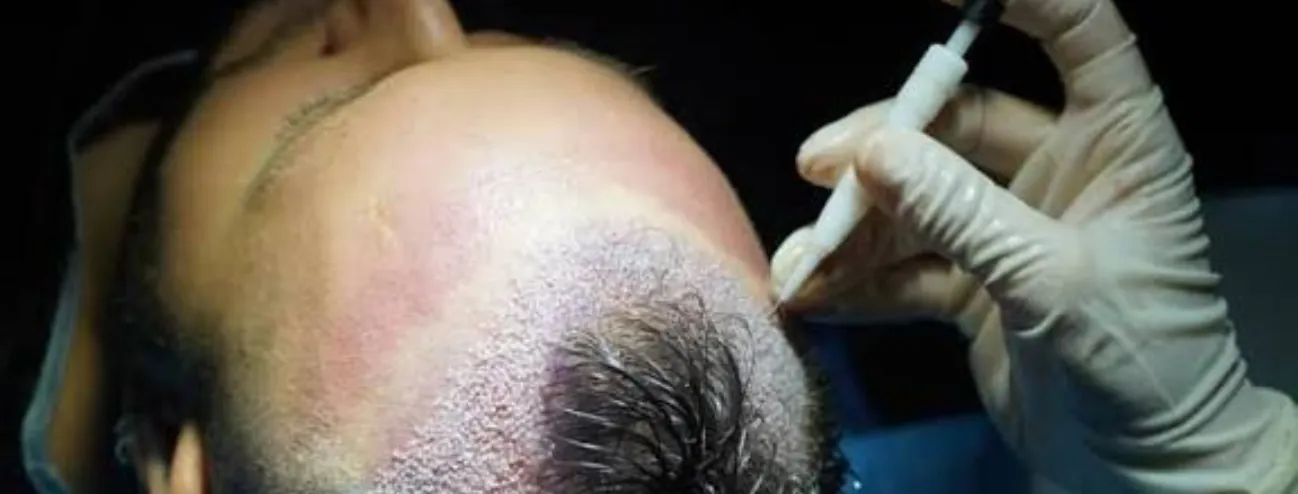
DHI (Direct Hair Implantation) is a graft-placement technique, not a separate way of harvesting hair. The follicles are still extracted one by one with FUE; DHI changes only the second half of the procedure, replacing the usual two-step sequence of opening a channel and then placing the graft with a single motion from a handheld implanter pen, most often called a Choi pen. That one mechanical change is where every real difference between DHI and standard FUE placement comes from.
This guide sets out what genuinely differs, in plain terms and without the marketing gloss some clinics add to the name: how the pen changes control over angle and depth; where DHI has a real practical edge, in hairline work, small zones and sessions with little or no shaving; and where it does not, in very large sessions, in cost, and in how much it leans on one team's specific skill. It sits alongside our broader guide to whether you're a candidate for a hair transplant at all; your hair type and donor supply, covered there, affect your result at least as much as which placement technique your surgeon uses.
- DHI is a placement technique used within FUE (occasionally FUT), not a rival extraction method; the follicles are harvested the same way either way.
- The mechanical difference is real: a Choi implanter pen opens the recipient site and inserts the follicle in one motion, instead of channels being cut first and grafts placed into them afterwards.
- DHI's genuine strengths are precise angle and depth control, dense placement among existing hair, and a no-shave or partial-shave option in smaller areas.
- There is no strong published evidence that DHI produces better graft survival or growth than well-performed standard FUE; the surgeon's and team's skill affects the outcome far more than the technique's name.
- DHI is frequently, though not universally, more expensive per graft than standard FUE, mainly because it takes longer and requires specific, repeated training with the pen.
What is DHI (direct hair implantation)?
DHI (Direct Hair Implantation) is a hair transplant placement technique in which a handheld implanter pen, usually called a Choi pen, opens the recipient site and inserts the follicle in the same motion. The follicles themselves are still extracted one by one with FUE, exactly as in a standard procedure; DHI changes only how each graft is placed, not how it is harvested. It is best understood as a specific way of doing FUE's placement step, not as a rival method to FUE itself.
The two steps every hair transplant has
Every hair transplant, whatever it is called, has two separate stages: extraction (removing follicles from the donor area) and placement (setting them into the thinning or bald area). DHI is entirely about the second stage. The extraction itself, removing individual follicular units one by one, is ordinary FUE, done with the same micro punch used in any FUE session. Nothing about how the hair is harvested changes when a clinic offers DHI.
What the implanter pen actually does
The tool that gives DHI its name is a handheld implanter, most often called a Choi pen after the surgeon credited with first describing it in the early 1990s at Kyungpook National University in South Korea, which is why the name has stuck for three decades. Each pen is a fine, hollow needle mounted on a plunger. A technician or surgeon loads a single follicular unit into the needle, then the surgeon presses the tip against the scalp at the planned spot and depresses the plunger: the needle opens a tiny channel and the follicle is pushed into it in one continuous action. In standard FUE placement, by contrast, those two actions are split; channels are opened across the whole area first with a blade or needle, and grafts are placed into them afterwards, often by a different member of the team.
Why the naming causes confusion
Because DHI only replaces the placement half of the operation, it is frequently combined with other elements from the same toolkit: many sessions extract with standard FUE and place the hairline with a Choi pen while a larger area behind it is placed into pre-made channels, sometimes cut with a sapphire blade. A clinic offering "DHI" is describing how it places grafts, not a wholesale different operation, which is worth remembering when a price list treats DHI as an entirely separate product from FUE.
How does the implanter pen change graft placement?
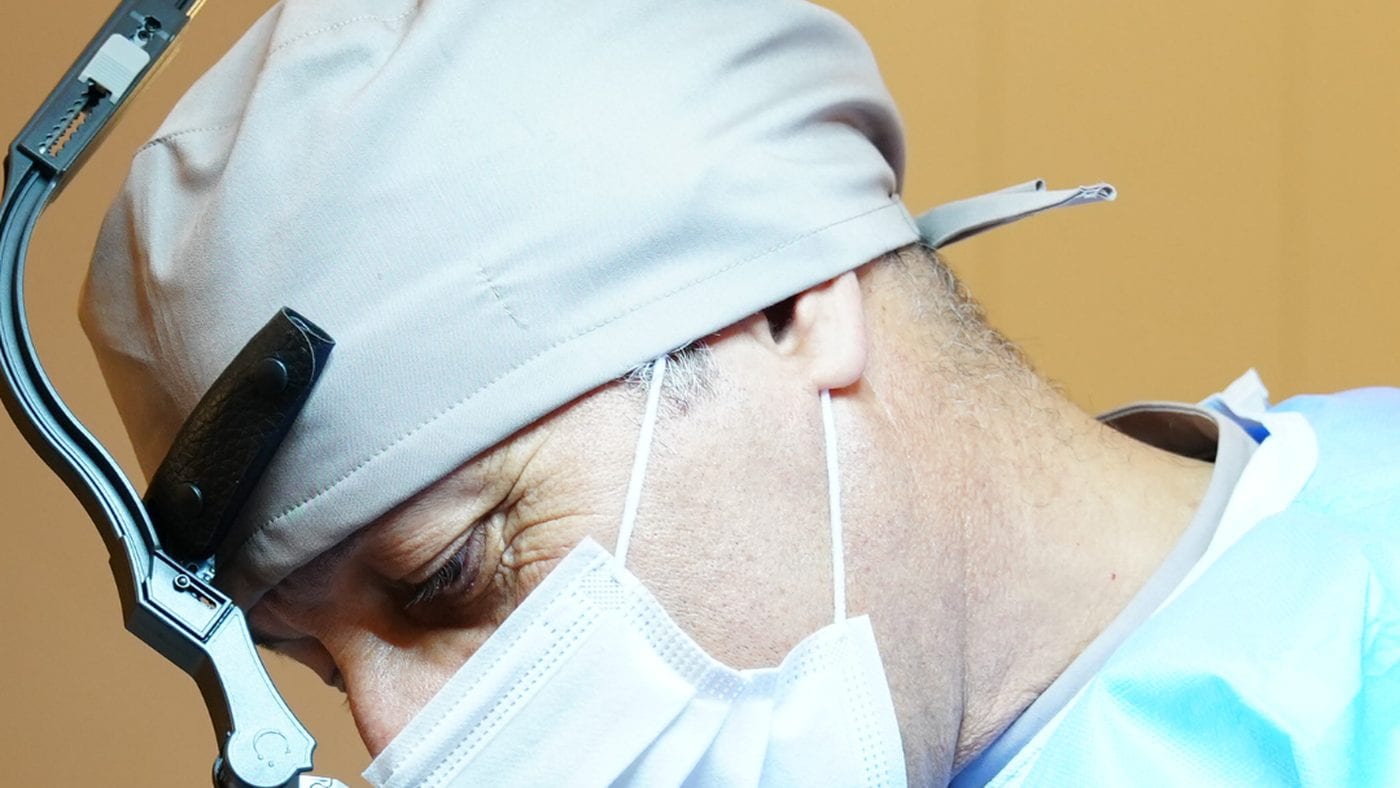
The implanter pen gives the surgeon direct, real-time control over the angle, direction and depth of each follicle at the exact moment it goes in, rather than that decision being fixed earlier when a channel is cut. This is the mechanical reason DHI is associated with precise hairline work: the person placing the hair controls its final lie personally, graft by graft. It does not change the underlying biology of how a graft heals or how quickly hair grows back, which follows the same course whichever placement method is used.
Angle, direction and depth in one decision
With a pre-made channel, the angle a hair will grow at is set when the channel is cut, sometimes by one team member, and locked in before a different team member places the graft into it. With the pen, the same person controls the angle, direction and depth at the instant of insertion, hair by hair. That one-step control is genuinely useful wherever the direction of a handful of hairs is highly visible, above all along the front hairline, where hairs need to sit low and point forward to look convincing.
Less time outside the body, in theory
Because the pen loads and places a follicle in close succession, grafts can sometimes spend less time sitting in a holding solution before they go in than they might while a whole area of channels is opened first. The idea that this could help survival is biologically plausible, but it has not been shown in good-quality studies to produce a meaningfully higher survival rate than well-handled standard FUE placement. Careful graft handling, keeping follicles cool, moist and out of the body for as little time as possible, matters with either method; it is a discipline of the team, not a property of the pen alone.
The same biology, whichever pen or blade is used
Nothing about the implanter pen changes how a graft heals. The transplanted hairs shed within about two to three weeks, which is expected and not a sign of failure, new growth begins from around month three to four, and the final, settled result is assessed at around twelve months. Whichever placement method your surgeon uses, this timeline plays out the same way, because it is set by the biology of hair growth cycles, not by the instrument used to place the graft. Aftercare in the weeks after surgery, covered in full in our aftercare guide, matters equally regardless of which technique placed the hairs.
How is DHI actually different from standard FUE?
The real differences are practical, not dramatic: DHI skips the separate channel-opening step, which suits dense packing in small areas and can allow less or no shaving, but it is generally slower per graft and often costs more. What DHI does not reliably deliver is a better result than skilfully performed standard FUE; there is no strong published evidence that graft survival or growth is higher with one placement method than the other, and the surgeon's experience affects the outcome far more than which technique is named on the price list.
Where the two placement methods genuinely differ
| Aspect | DHI (implanter pen) | Standard FUE (pre-made channels) |
|---|---|---|
| Placement step | Pen opens the site and inserts the follicle in one motion | Channels opened first, grafts placed afterwards as a separate step |
| Angle/depth control | Set individually at the moment of placement | Set earlier, when the channel is cut |
| Dense packing in small areas | Can be very precise, well suited to tight spacing | Achievable, but less precise at very high density |
| Shaving | Can sometimes be done with no shave or partial shave | Usually needs the recipient area, and often the donor area, shaved |
| Speed per graft | Slower; a deliberate, one-graft-at-a-time process | Faster once channels are prepared in bulk |
| Typical cost | Often higher | Often lower |
| Best suited to | Hairline detail, small zones, density among existing hair | Larger areas, higher graft counts, big sessions in one day |
None of these rows say DHI heals better or grows better, because there is no reliable evidence that it does.
Where marketing sometimes overreaches
Marketing sometimes implies DHI is a fundamentally different, superior operation. ISHRS (the International Society of Hair Restoration Surgery), the field's main professional body, describes DHI as a graft-placement technique using an implanter, not a separate hair transplant method, and cautions patients to look twice when a clinic gives standard FUE a new, proprietary-sounding name. Both placement methods extract the same follicular units the same way; they differ in how the graft goes in, not in what it is.
The placement method does not change durability
The placement method also has no bearing on how long the result lasts. Donor hair used in a transplant, whichever pen or blade places it, is largely resistant to DHT, the hormone that drives most hereditary hair loss, which is why it keeps growing once transplanted; no follicle is completely immune, so this is best understood as durable rather than an absolute, unconditional guarantee. DHI does not add to or subtract from that biological fact, it only changes how precisely the graft is angled and how much of the head needs to be shaved to do it.
Who does DHI suit best?
DHI tends to suit smaller, well-defined areas where precision matters more than raw speed: hairline refinement, adding density between existing hairs, and cases where a patient wants to avoid a full shave. It also comes up frequently for women, whose hair loss more often calls for blending grafts among existing hair rather than covering a fully bald area, and who are, on average, less willing to have the scalp or donor area shaved completely.
Hairline work and small, detailed zones
Because the pen gives one person direct control of angle and depth graft by graft, it is well suited to the front hairline and temple points, where a handful of degrees of angle change is the difference between a natural, forward-lying edge and one that obviously looks placed. The same precision is useful for touching up or densifying an already-established hairline rather than building an entirely new one from scratch.
Adding density among hair that is still there
DHI has a genuine practical edge when the goal is thickening an area that still carries some of the patient's own hair, rather than covering an area that is fully bald. Placing a graft precisely between existing hairs, without a separate channel-cutting step that risks catching a native follicle, suits early or moderate thinning better than it suits advanced, fully bald patches, where speed and coverage across a large area usually matter more than fine placement.
Patients who want to avoid a full shave
A no-shave or partial-shave approach is one of DHI's most cited practical advantages, and it is genuinely possible in the right case, typically a smaller area or a density top-up rather than a large session. This is a common reason DHI comes up specifically for women's hair transplants: female hair loss more often follows a diffuse, wide-parting or receding-hairline pattern that calls for blending new grafts into existing hair, and women are, on average, considerably less willing to have a large area of the scalp shaved for the procedure. Whether a no-shave approach is realistic in a specific case still depends on the size of the area and the surgeon's assessment, not on DHI being requested by name.
Who it suits less well
DHI is not the automatic right answer just because a patient likes the idea of precision. Someone with extensive, fully bald areas needing several thousand grafts in a single, efficient day is usually better served by standard or Sapphire FUE, covered in the sections below, where placement can proceed faster once channels are prepared in bulk.
What are the limits of DHI?
DHI's main limits are practical: it is slower per graft, which makes very large single-day sessions harder to complete efficiently, grafts still need careful handling and cannot sit in holding solution indefinitely, and the technique has a real learning curve, so results depend heavily on a team that performs it routinely rather than occasionally. None of these are reasons to avoid DHI where it fits; they are reasons to ask specifically how experienced the team is with the pen, not just with hair transplants in general.
Large sessions take longer, or need to be capped
Because each graft is loaded and placed as a deliberate, individual action, DHI does not scale to a very high graft count in a single day as efficiently as channels-then-placement FUE does. For extensive hair loss needing several thousand grafts, a clinic may need to plan a longer day, split the work across more than one session, or shift part of the area to standard or Sapphire FUE placement to keep the day realistic. A plan promising a very large, DHI-only session in a short day is worth questioning.
Grafts still have to be handled with care
Follicles placed with a pen are not exempt from the general rule that a graft's survival depends on how well it is protected between extraction and placement, kept cool, moist and out of the body for as little time as possible. A pen does not fix careless handling elsewhere in the process; a rushed team can damage grafts with excellent instruments just as a careful team gets good results with simpler ones.
The technique depends heavily on the specific team
The implanter pen has a real learning curve. Used well, it is precise; used by someone without much hands-on repetition, it can bruise or misalign follicles during loading, which does not show up until the graft fails to grow months later. Standard FUE placement is practised far more widely, simply because more teams have done it for longer, which is not a reason to prefer it in the abstract, but it does mean that a team's specific, repeated experience with the pen matters more for DHI than it does for placement methods most teams already know well. Our Nordic clinic ranking weighs documented team experience for exactly this reason: a technique is only as good as the hands using it.
DHI vs Sapphire FUE: what is the real difference?
DHI and Sapphire FUE are not really opposites, because they answer different questions: DHI is about how the graft is placed, using a pen instead of pre-made channels, while Sapphire FUE is about what tool opens those pre-made channels, a sapphire blade instead of a steel one. Many clinics use both in the same session, sapphire-cut channels across a larger area and a Choi pen for the hairline, so the honest comparison is not which one wins but which job each tool is doing.
Two answers to two different questions
It helps to separate the question DHI answers from the question Sapphire FUE answers. DHI replaces the entire channel-then-place sequence with a single pen motion; there is no separate incision step at all. Sapphire FUE keeps that two-step sequence, channels first, grafts placed afterwards, but changes the blade used to cut the channels from steel to a sharper, smoother synthetic sapphire edge, which can create smaller, more precise openings and support tighter, more natural channel angles. They sit on different parts of the same process, which is why comparing them head to head as if choosing one excludes the other is slightly misleading.
A direct comparison, side by side
| Feature | DHI | Sapphire FUE |
|---|---|---|
| Recipient site | Opened and filled in one motion by the pen | Opened with a sapphire blade, then filled as a separate step |
| Instrument | Choi (implanter) pen | Sapphire-tipped blade plus forceps |
| Angle control | Set at the instant of placement, by the person placing | Set when the channel is cut |
| Shaving | Can allow no-shave or partial-shave in smaller areas | Usually needs the area shaved for channel work |
| Typical strength | Hairline precision, dense placement among existing hair | Fast, even channel-cutting across larger areas |
| Scarring, healing | Same as FUE: scattered, dot-sized marks | Same as FUE: scattered, dot-sized marks |
Why clinics often combine them
Because they solve different parts of the same procedure, a single session can reasonably use both: a Choi pen along the hairline where placement angle matters most, and sapphire-opened channels across the mid-scalp or crown where speed and even coverage across a larger area matter more. If a clinic presents DHI and Sapphire FUE as a strict either/or choice, that is a simplification of what is actually a modular set of tools a surgeon combines to fit the plan. See the full breakdown of every method, including FUT, in our hair transplant methods guide.
What does DHI cost, and how many grafts does a session need?
DHI is frequently, though not universally, priced higher than standard FUE at the same clinic, mainly because it takes longer per graft and requires specific training most teams do not have for large-scale work. How many grafts you actually need depends on your stage of hair loss and the area being treated, not on the placement method, so the sensible starting point is a graft estimate first and a placement-method discussion second.
Why DHI often costs more
The price difference, where it exists, mostly traces back to time and training: loading and placing each graft individually through a pen takes longer than opening channels in bulk and placing grafts into them, and a team needs specific, repeated practice with the implanter before it can use it confidently at volume. Some clinics price DHI as a flat premium over FUE; others price by graft regardless of placement method and simply charge more for a longer procedure day. Ask directly which model a quote uses. See indicative country-by-country figures and what drives them in our price guide.
Grafts needed is a separate question from placement method
The number of grafts a plan calls for depends on your Norwood or Ludwig stage and the area being treated, hairline, mid-scalp, crown or a combination, not on whether the surgeon places them with a pen or into pre-made channels. Get a rough, indicative range for your own case with our graft calculator before you compare quotes, so a headline price is anchored to a graft number you understand rather than taken at face value.
Reading a DHI quote properly
Because DHI sessions can take longer, ask whether a quoted price covers the full area in a single day at the pace the team actually works, or whether reaching a high graft count with DHI placement would require a second day, extra staff, or a partial switch to standard or Sapphire FUE placement. None of that is a problem in itself, but all of it should appear in the plan and the price before you book, not as a surprise once you arrive.
What should you ask a clinic that offers DHI?
Ask how many DHI cases the specific surgeon or technician placing your grafts has performed, not the clinic's general case count, whether they can show results in a case similar to yours, and how they decide when to use the pen versus pre-made channels within the same session. A clinic that cannot answer these specifically, or that presents DHI as an automatic upgrade everyone should buy, is worth treating with caution.
Questions specific to DHI
Because the implanter pen has its own learning curve, general hair transplant experience is not the same as specific DHI experience. Worth asking directly: how many DHI procedures has this exact surgeon or technician performed, who loads the pen versus who places it, and can they show recent results in a case with a similar area and graft count to yours. Vague answers, or a redirect to the clinic's overall reputation instead of the individual team's DHI track record, are worth noting.
Questions about the plan, not just the technique
Ask how the clinic decides which parts of your session use the pen and which use pre-made channels, since a purely DHI session is not automatically the best plan for every case, and a competent team should be able to explain that decision in terms of your specific hairline, area and graft count rather than reciting the technique's marketing points. Also ask what happens if the graft count runs higher than expected mid-session, since DHI's slower pace makes that scenario more consequential for the day's schedule than it would be with faster channel-based placement.
The general checks still apply
Every general warning sign for choosing a clinic applies just as much to a clinic offering DHI as to any other: a named, qualified surgeon who is actually present and involved, verifiable medical regulation, transparent written pricing, and a documented aftercare plan. See the full list in our clinic red flags guide, and our wider guide to choosing the right clinic for the complete checklist beyond DHI specifically.
Frequently asked questions
Is DHI better than FUE?
Not reliably, no. DHI is a different way of placing grafts, not a proven way of growing more or healthier hair; there is no strong published evidence that it produces higher graft survival than well-performed standard FUE placement. It can be a better fit for specific goals, hairline precision, dense work among existing hair, avoiding a full shave, while standard or Sapphire FUE is usually the more efficient choice for very large sessions.
Is DHI a completely different hair transplant method, or just a version of FUE?
It is a placement technique used within FUE, not a separate way of extracting hair. The follicles are still removed one by one exactly as in standard FUE; DHI only changes how they go back in, using an implanter pen instead of pre-made channels. Professional bodies such as ISHRS describe it as a graft-placement variant rather than a distinct hair transplant method in its own right.
Can I have a DHI hair transplant without shaving my head?
Sometimes, yes, particularly for a smaller area or when adding density among hair you still have. It is not guaranteed for every case, and it becomes harder to promise as the area or graft count grows, since a no-shave approach also slows an already slower placement method further. Raise it early in your consultation so the surgeon can tell you honestly whether it is realistic for your specific plan.
Why does DHI often cost more than standard FUE?
Mainly because it takes longer per graft and requires a team with specific, repeated training on the implanter pen, both of which add to a clinic's costs. The size of the premium varies a great deal by clinic and country, and it is not a guarantee of a better result on its own, so compare what a quote actually includes and who performs the work rather than choosing on the technique name alone.
Is DHI a good option for women's hair transplants?
It is frequently discussed for women, mainly because female hair loss more often calls for blending new grafts into hair that is still there rather than covering a fully bald area, and because a no-shave or partial-shave approach tends to matter more to women than to men. Whether it is the right placement method still depends on the individual case, covered in full in our guide to hair transplants for women, not on gender alone.
Does a DHI hair transplant leave scars, or take longer to heal?
DHI leaves the same kind of scarring as any FUE-based extraction, tiny, scattered dot marks that are hard to see even with short hair, not a linear scar. Overall healing follows the same timeline as any placement method, shedding around week two to three, new growth from about month three to four, and a settled result at around twelve months; DHI does not speed up or slow down that biological process.
Whether DHI, standard FUE or a mix of the two is the right choice depends on your area of loss, your donor supply and the team's specific, demonstrable experience with the pen, not on which name sounds more advanced. Get a free hair analysis and hear back from our #1-ranked clinic with an honest read on which placement method actually fits your case, with no obligation to go further.
General educational guidance, not medical advice. Whether DHI is the right placement method for your specific case is confirmed by a qualified surgeon at a personal assessment.
Last updated: August 2026 · Editorial standards