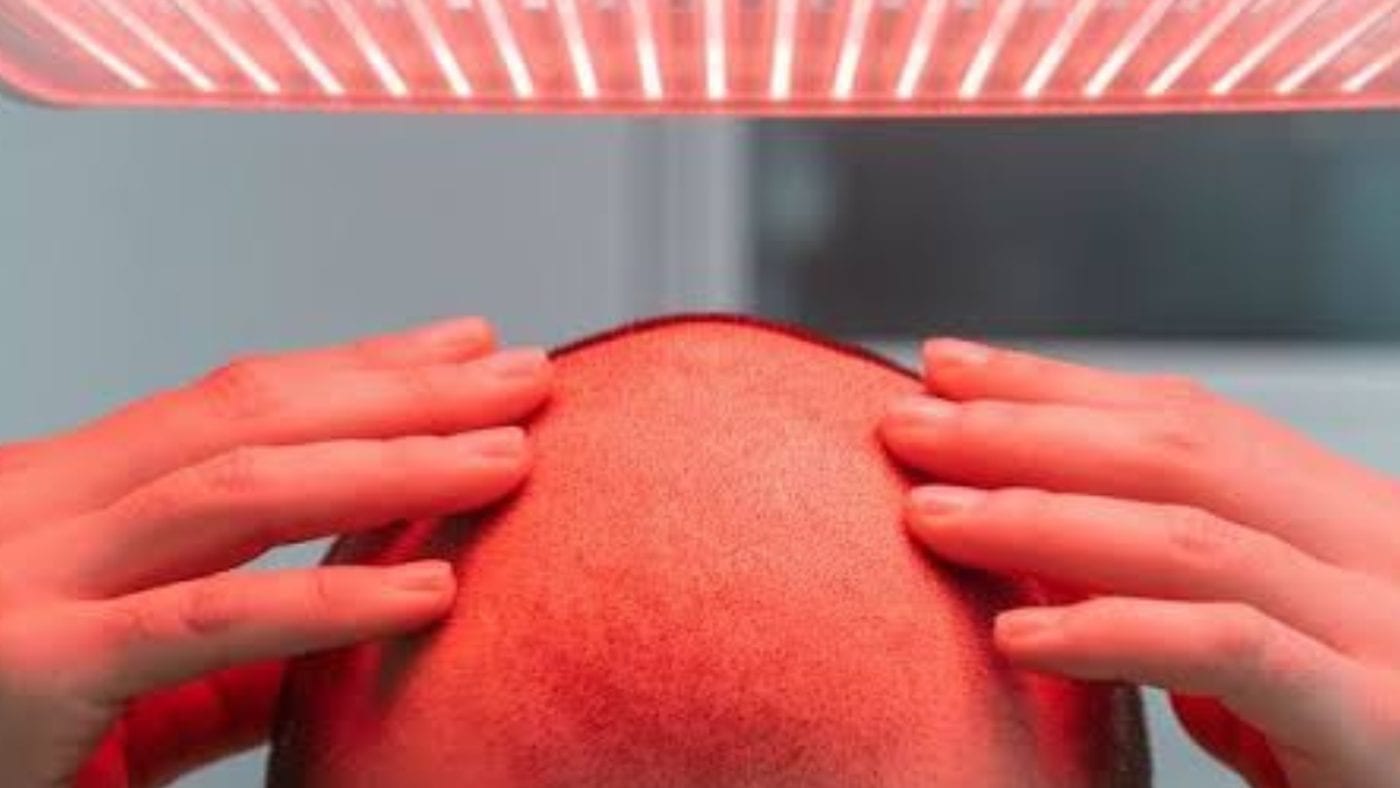
LLLP stands for Low-Level Laser/Light Therapy: treatment of the scalp with low-intensity light, typically red light, with the aim of supporting hair growth. The treatment is also known as low-level laser therapy, red light therapy or photobiomodulation, and the abbreviation LLLT, Low-Level Laser Therapy, is used in the professional literature for the same principle.
The light is delivered through helmets, combs or panels, and the treatment is pain-free and almost free of side effects. It is also one of the better documented among the alternative treatments, with several approved devices behind it.
There is, though, one point there is no sense in dressing up: the effect is generally mild. It is best documented as a supplement to other treatment rather than as a standalone cure. That is the assessment the rest of this page is built on, and it is the same one you will find in our review of treating hair loss without surgery.
What is LLLP?
LLLP is treatment of the scalp with low-intensity red light from laser diodes or light-emitting diodes. The light is not hot and does not cut into tissue the way a surgical laser does. It is delivered through helmets, combs or panels and repeated in short sessions over an extended period. It is pain-free and has very few side effects.
The name confuses some people, because for most of us “laser” means something that cuts or burns. That is not the case here. The crucial word is low-level: the intensity is so low that the light neither heats nor damages tissue. That is why the principle is also called photobiomodulation, meaning that light influences how cells function rather than destroying tissue.
LLLP or LLLT?
In practice the two abbreviations cover the same principle. LLLT, Low-Level Laser Therapy, is the term that appears most often in the professional literature and in studies. LLLP is used as a label for the same treatment area and takes in both laser and light sources, which is convenient, since many devices today use light-emitting diodes rather than actual laser diodes. If you come across both terms, they are as a rule describing the same type of treatment.
How the treatment is delivered
- Helmets and caps. These cover the whole scalp at once and are typically used at home.
- Combs and handheld devices. These are moved across the scalp in sections and require you to keep track of timing and coverage yourself.
- Panels. Typically used in a clinic setting, where you sit under a fixed unit.
The form factor does not change the principle, but it does affect how consistently the treatment actually gets done, and that matters, because LLLP demands persistence over a long period.
How does Low-Level Laser/Light Therapy work?
The light is thought to stimulate energy production in the cells of the hair follicles and to improve microcirculation in the scalp, which in theory can support hair growth and extend the active growth phase. The mechanism is an explanatory model, not a definitively established chain of cause and effect, and that is worth holding on to when the effect is being judged.
The explanation most often given concerns energy production in the cells. Red light at particular wavelengths is assumed to be taken up by the mitochondria, the energy-producing part of the cell, and thereby to increase their activity. A hair follicle in the growth phase is metabolically active and needs energy, and the thinking is that increased activity can support that process.
Two further mechanisms are often mentioned: improved microcirculation, that is blood flow in the smallest vessels around the follicle, and a dampening of inflammation in the scalp.
What it does not do
LLLP does not affect the hormone DHT, which is the driving factor in hereditary hair loss. That is the single most important difference between light treatment and the medical treatments, and it explains why light can realistically support, but not stop, hereditary hair loss. For the mechanism behind hereditary hair loss, see causes of hair loss.
So how strong is the evidence?
We describe it as mild, and that is a deliberate choice of word. There are studies showing a measurable effect, and there are approved devices on the market. That is more than can be said for many alternative treatments. But the size of the effect is modest compared with Finasteride and Minoxidil, and that is why our review places LLLP as a supplement rather than as a foundation.
Who might LLLP be relevant for?
LLLP is most relevant with early to moderate thinning, where there is still hair to support, and for someone who wants a supplement without systemic side effects, or who cannot or will not take medication. It is not a realistic choice where the scalp is already completely bare, since light cannot activate follicles that no longer exist.
Where it can make sense
- Early to moderate thinning. There have to be follicles left to support. The earlier, the more there is to work with.
- As a supplement to medical treatment. This is the use the evidence supports best.
- Where medication is not an option. Some people cannot or will not take Finasteride or Minoxidil. Here light is one of the few remaining options without systemic side effects, albeit with a more modest effect.
- Diffuse thinning in women. See hair loss in women, where the treatment choices are often different from those in men.
- After a hair transplant. See the section further down.
Where it is not the answer
- Completely bare areas. If the follicles are gone, light cannot call them back. Here a transplant is the only way to get hair again.
- As the only treatment in advanced hereditary hair loss. The effect is too modest to carry the job on its own.
- If the cause has not been established. If the hair loss is down to a deficiency or an illness, that is treated first.
On when surgery becomes the realistic choice, see who is a candidate for a hair transplant.
Advantages of LLLP
The real advantages are that the treatment is pain-free, that it has very few side effects, that it does not affect the body systemically, and that it can be carried out at home. The drawbacks are that the effect is mild, that it demands persistence over a long period, and that the devices can be expensive to buy.
- Pain-free. The light is not hot, and the treatment is barely felt.
- Very few side effects. This is the main reason the treatment is attractive at all, despite the modest effect.
- No systemic impact. Unlike tablet treatment, the body as a whole is not affected.
- Can be done at home. Helmets and caps do not require you to turn up anywhere.
- Can be combined. Light treatment rules out neither medication, supportive treatments nor surgery.
And what belongs on the other side of the ledger
The effect is mild, and it comes slowly. The treatment has to be repeated regularly for months before anything can be judged, and if you stop, whatever effect there was disappears. Equipment for home use also carries a substantial purchase price, which is worth weighing against what the best-documented treatments cost.
How the treatment is carried out
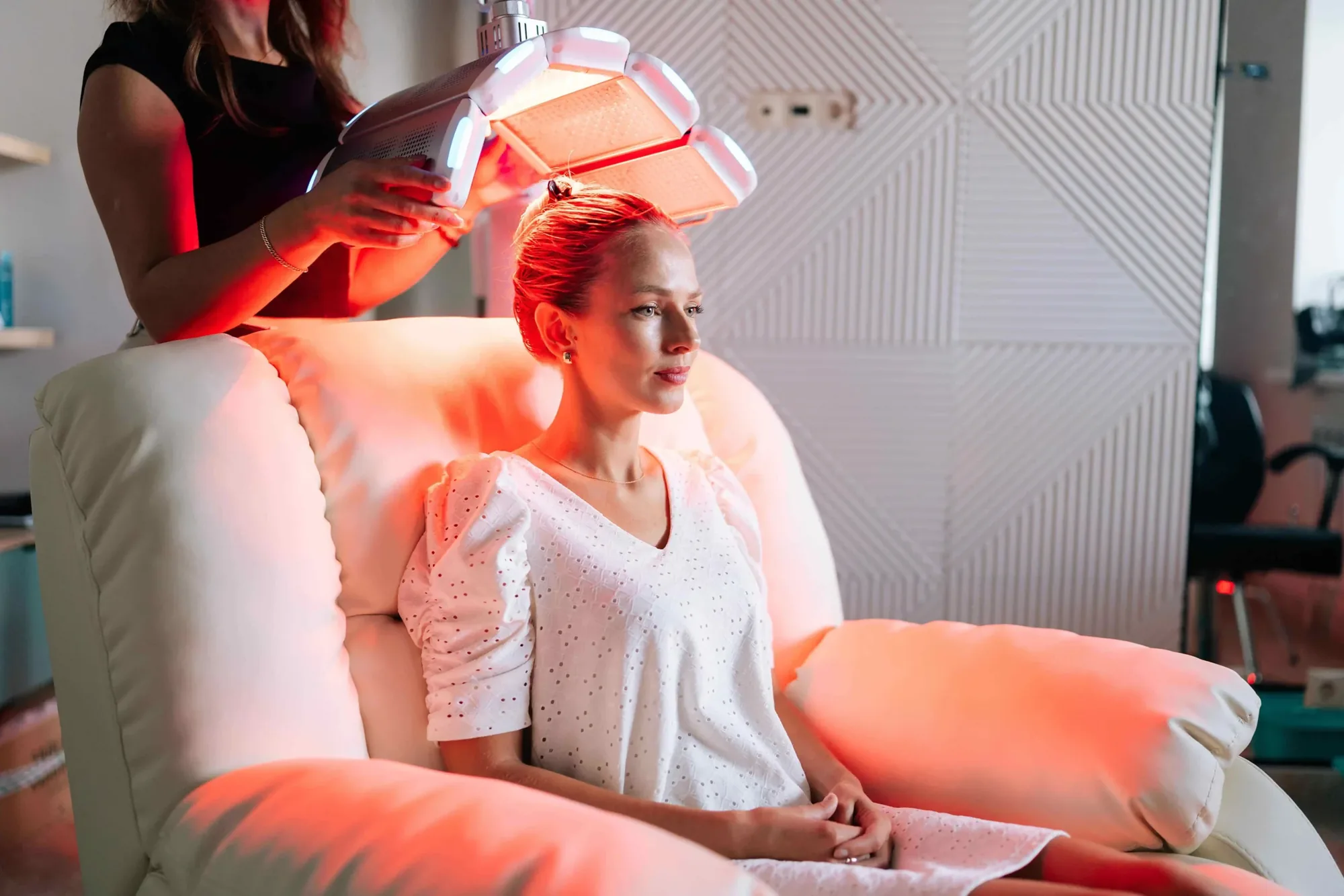
A course should begin with an assessment of the scalp and clarity about what is driving the hair loss, and then a plan for where light treatment fits in relative to the rest of the treatment. The treatment itself consists of short, repeated sessions over months, with follow-up along the way. The specific duration and frequency follow the device being used.
- Consultation. The pattern of the hair loss, how it has developed and family predisposition are gone through.
- Assessment of the scalp. Ideally with trichoscopy, so that it can be judged how much there actually is to support.
- Establishing the cause. Light does not treat a deficiency or an illness, and that sort of thing has to be found first.
- A plan. Including, above all, where light treatment belongs relative to the rest of the treatment.
- Treatment. Short, repeated sessions according to the instructions for the device.
- Follow-up. With photographs taken in the same light and from the same angles, so that a modest effect can be read at all.
Precisely because the effect is mild, standardised photographs matter more here than with treatments that have an obvious effect. Without them it is close to impossible to tell whether anything has shifted.
How often should LLLP be carried out?
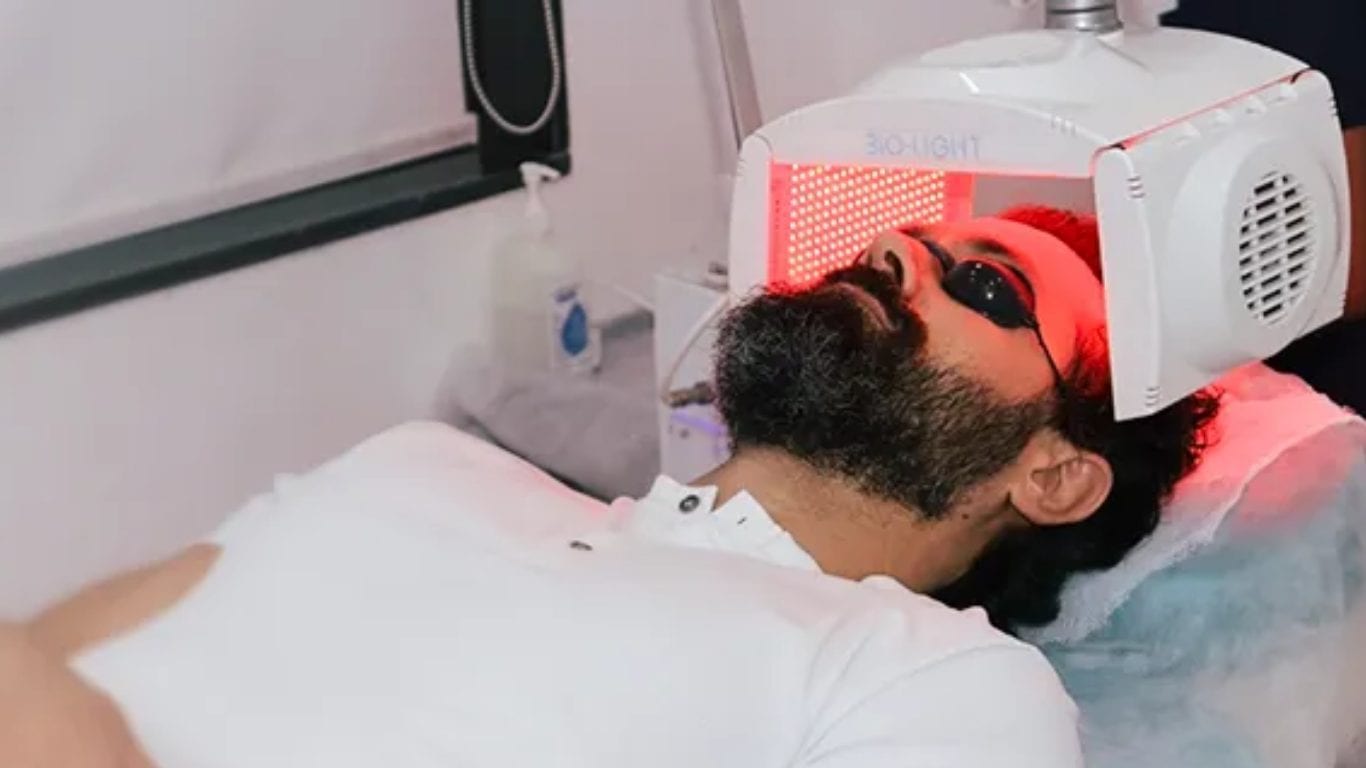
The treatment is given in short, repeated sessions several times a week over an extended period, but the precise duration and frequency follow the instructions for the specific device and cannot be stated in general. We do not give a fixed schedule, because it varies between devices. What matters is that the treatment is ongoing: any effect is maintained only for as long as it continues.
Two things are worth understanding about frequency.
It is not a course you complete. LLLP is not a cure with an end date. If the treatment stops, whatever effect there was stops too. The same is true, incidentally, of the medical treatments for hereditary hair loss, and it is one of the most important things to have understood before you begin.
Persistence is the real limitation. A treatment that has to be repeated several times a week for years stands or falls on whether it actually gets done. That is often where courses genuinely run aground, rather than on the technical specifications of the device. So choose the solution you will realistically use.
Always follow the manufacturer’s instructions for the device you are using, or the clinic’s instructions if the treatment is given there. We are not going to invent a schedule meant to apply across devices with different wavelengths and strengths.
When can you expect results?
Hair grows slowly, so a change can only be read after months, not weeks. Results vary from person to person and depend on how advanced the hair loss is and on what else is part of the treatment. Because the effect is mild, it is typically a question of slowing or stabilising rather than of visible new growth, and results that fail to appear are not unusual.
It would be misleading to promise a timeline. What can be said with reasonable confidence is that the growth cycle of the hair sets the limit: whatever the treatment, it takes months before anything can be seen. Any treatment described as working within a few weeks should prompt scepticism.
What “works” realistically means here
With a mild treatment, the main outcome is rarely obvious new growth, but that the thinning slows, or that the situation stabilises. That is a genuine gain, but it is a different kind of gain from the one marketing photographs tend to imply, and it is harder to spot without systematic photographs.
And if nothing happens
That does occur. Results vary, and a mild treatment does not work for everyone. Agree in advance when you will take stock, and what you will do if nothing has happened by then. We go through how results should generally be assessed over time under long-term durability.
LLLP compared with other hair loss treatments
Measured on documentation, Finasteride and Minoxidil stand strongest and form the foundation in hereditary hair loss. LLLP belongs with microneedling and PRP among the supplements. A hair transplant solves something else, namely areas where the follicles are gone, and SMP changes appearance alone. None of them is generally best: they have different roles.
| Treatment | Type | Evidence | Role |
|---|---|---|---|
| Finasteride | Medical | Strong | Foundation |
| Minoxidil | Medical | Strong | Foundation |
| PRP | Medical | Promising | Supplement |
| Microneedling | Non-medical | Moderate | Supplement |
| LLLP, red light | Non-medical | Mild | Supplement |
| SVP, nutrients delivered locally | Non-medical | Weak | Possible supplement |
| Hair transplant | Surgical | Established | When the follicles are gone |
| SMP | Cosmetic | Not applicable, adds no hair | Visual impression of density |
The point is the order, not the ranking. Build from the bottom up: a supplement on top of a foundation is sensible, while a supplement instead of a foundation rarely is. You will find the full review of the evidence under treating hair loss without surgery.
LLLP and hair transplants
The two do not rule each other out. Red light is mentioned among the alternative treatments that in theory can support healing and growth after a transplant, and it is also relevant for looking after the hair you have left outside the transplanted area. The timing has to be agreed with the clinic that carried out the procedure, since the scalp needs to be left in peace during the healing phase.
There are two different reasons to consider light treatment around a transplant, and they are worth keeping apart.
After the procedure
Red light is among the better documented alternative treatments in the period after a transplant, where the thinking is that it can support healing and growth. The effect is still mild, and it is not what decides whether an operation succeeds. What matters in that phase is following the clinic’s aftercare closely, and we go through that under aftercare.
The hair that has not been transplanted
This is often the overlooked point. A transplant moves hair to where it is missing, but it does not stop hair loss in the original hair around it. If the thinning there continues, the result can end up looking disjointed over time. A long-term plan for the remaining hair is therefore part of any serious treatment plan, and LLLP can form part of it as a supplement.
An important note on timing
Do not start light treatment on a recently operated area without agreeing it with the clinic. The scalp needs to be left in peace while the grafts settle, and what may be layered on top, and when, is the clinic’s decision.
Is LLLP safe?
LLLP is regarded as one of the gentlest treatments for hair loss, with very few reported side effects, and the light is not hot enough to damage tissue. No treatment is entirely without risk, though. The eyes should be protected from direct light, active skin conditions on the scalp should be assessed first, and certain medicines can make the skin more sensitive to light.
Our review of the non-surgical treatments describes light treatment as pain-free and almost free of side effects, and that is a fair description. But “almost free of” is not the same as “free of”, and there are some points that should be mentioned:
- The eyes. Do not look directly into the light source. Properly made equipment is designed so that this is not possible in normal use.
- Light sensitivity. Certain medicines and skin conditions make the skin more sensitive to light. If you are on regular medication, ask your doctor.
- Skin conditions on the scalp. Active eczema, psoriasis or infection should be assessed before treatment is started.
- Temporary irritation. Mild redness or dryness of the scalp does occur.
- The quality of the equipment. The safety profile assumes that the device stays within the intensities it is designed for.
If you are pregnant or breastfeeding, or you have a chronic condition or a known light sensitivity, you should discuss the treatment with your own doctor first.
Aftercare and everyday routine
LLLP requires no real aftercare: there is no wound healing, no recovery and no restrictions afterwards. What matters is the general condition of the scalp, and that the treatment actually gets done regularly. A clean scalp free of product residue also gives the light better access.
Because nothing is cut and nothing is injected, there is nothing to heal. There are, however, some practical points that affect whether the treatment makes sense:
- A clean scalp. Thick layers of styling product between the light source and the skin are not helpful.
- Regularity. This is the single factor that matters most. A helmet in the cupboard does nothing.
- Cleaning the equipment. Follow the manufacturer’s instructions.
- The rest of the groundwork. Light on top of smoking, poor sleep and an untreated deficiency is money poorly spent. Foundation first.
If you are combining light treatment with something that affects the skin, for example microneedling or treatments that break the skin barrier, agree the order with whoever is carrying them out.
What should you ask about before you invest?
Find out the wavelength and output of the device, what the manufacturer itself documents, what the total price is, and what the return policy is. For a course at a clinic: how many treatments are included, what the whole course costs, and what happens when it comes to an end. And most important of all: ask to have it explained where light treatment belongs relative to the rest of your treatment.
- What wavelength and output does the device use?
- What documentation does the manufacturer or the clinic specifically refer to?
- What does it cost in total, and is there a right of return if it does not work for me?
- How often and for how long will I realistically have to use it?
- What effect is expected in my case, and when do we take stock?
- What do we do if nothing has happened by then?
- Where does it fit relative to what is better documented?
The last question is the most important one. If a supplement is presented as an alternative to the treatments with the strongest evidence, that is not advice, it is sales. See warning signs you should know and how to choose a clinic.
Frequently asked questions about LLLP
What is LLLP?
LLLP stands for Low-Level Laser/Light Therapy, that is treatment of the scalp with low-intensity light, typically red light. The light is not hot and does not damage tissue. It is delivered through helmets, combs or panels in short, repeated sessions.
What is the difference between LLLP and LLLT?
In practice they cover the same principle. LLLT, Low-Level Laser Therapy, is the term most often used in the professional literature, while LLLP takes in both laser and light sources. That is convenient, since many devices today use light-emitting diodes rather than actual laser diodes.
How does LLLP work?
The light is thought to stimulate energy production in the cells of the hair follicles and to improve microcirculation in the scalp, which in theory can support hair growth. It is an explanatory model rather than a definitively established mechanism. The light does not affect DHT, which drives hereditary hair loss.
Can LLLP help with hair loss?
It may contribute, but the effect is generally mild. The treatment is best documented as a supplement to other treatment rather than as a standalone cure. There also has to be hair left to support: on completely bare areas, light cannot call back follicles that are gone.
How often should you have LLLP?
The treatment is given in short, repeated sessions several times a week over a long period, but the precise frequency follows the instructions for the specific device and varies between devices. We therefore do not give a fixed schedule. What matters is that the treatment is ongoing.
When can you see results?
Hair grows slowly, so a change can only be read after months, not weeks. Results vary, and because the effect is mild it is more often a question of slowing or stabilising than of visible new growth. Standardised photographs are needed in order to judge it at all.
Is LLLP painful?
No. The treatment is pain-free. The light is not hot, and most people feel next to nothing during a session. Mild redness or dryness of the scalp can occur, but it is temporary.
Is LLLP suitable for men?
Yes, most often with early to moderate thinning, where there are still follicles to support. With hereditary hair loss it should be regarded as a supplement to the treatment with the strongest evidence, not as a replacement for it.
Is LLLP suitable for women?
Yes. The treatment is also used for diffuse thinning in women, where the treatment choices are often different from those in men, partly because Finasteride is not an option on the same terms. The cause of the hair loss should be established first.
Can LLLP be combined with a hair transplant?
Yes, the two do not rule each other out. Red light is mentioned among the treatments that in theory can support healing after a procedure, and it can form part of the plan for the hair that has not been transplanted. Do not start on a recently operated area, though, without agreeing the timing with the clinic.
How long does a treatment take?
A single session is short, but the precise duration follows the device being used, and we do not give a figure meant to apply across devices with different wavelengths and strengths. Follow the manufacturer’s or the clinic’s instructions.
Is LLLP safe?
It is regarded as one of the gentlest treatments for hair loss, with very few reported side effects. No treatment is entirely without risk, though: the eyes should not be exposed to direct light, active skin conditions on the scalp should be assessed first, and certain medicines can make the skin more sensitive to light.
Does the effect last if I stop?
No. LLLP is not a cure with an end date. If the treatment stops, whatever effect there was stops too. The same applies, incidentally, to the medical treatments for hereditary hair loss, and it is worth having understood before you begin.
What does LLLP cost?
The price depends on whether you buy equipment for home use or have the treatment at a clinic, so we do not quote fixed prices. Equipment for home use carries a substantial purchase price, which is worth weighing against what the best-documented treatments cost. Always ask about the right of return.
LLLP is a reasonable supplement, but a poor foundation. Establish what is driving your hair loss, and what belongs at the bottom of your treatment ladder, before you invest in equipment or in a course at a clinic.
Last updated: September 2026 · Editorial standards