Longevity: will the result last a lifetime?

Introduction: the short answer and the long answer
One of the most frequently asked questions before a hair transplant is: “Will it last a lifetime?” The short answer is that the transplanted hair is in principle permanent. The long, and more important, answer is that a beautiful long term result depends on more than the relocated grafts alone: it depends on how your original hair develops, and on the planning that went into the procedure.
This guide explains the biology behind the durability, why a result can change over the years even after a successful operation, and what you can do in practical terms to keep a natural appearance for decades. The purpose is to give you realistic, long term expectations, not a sales promise.
Donor dominance: why the transplanted hair lasts
The basis for the durability of a hair transplant is the principle of donor dominance. The follicles at the back and sides of the head are genetically far more resistant to DHT, though not completely immune, the hormone that miniaturises hair in hereditary hair loss. When these follicles are moved to the crown or the hairline, they take their genetic properties with them. They are therefore not affected by androgenic hair loss in their new position and stay in place, even as the surrounding original hair thins.
That is precisely why a hair transplant works at all in the long run: you are not just moving hair, you are moving DHT resistant hair. As long as the extraction is done from the stable donor area and by an experienced team, there is good reason to expect the transplanted hairs to last for many years, often for life.
The important exception: your original hair keeps thinning
Here lies the most overlooked point. A transplant does not stop the underlying hereditary hair loss in your original, non transplanted hair. If you are young and still losing hair, a problem can arise over the years: the transplanted hairs are still standing, while the original hair around them disappears. The result can be an unnatural “island” of dense hair with thin or bald zones around it.
This is not a flaw in transplantation as a technique, but a consequence of the fact that the androgenic process continues. It is the main reason why responsible surgeons plan for the future, and why medical treatment is often recommended as a companion to the surgery.
Planning for the future: donor capacity and hairline
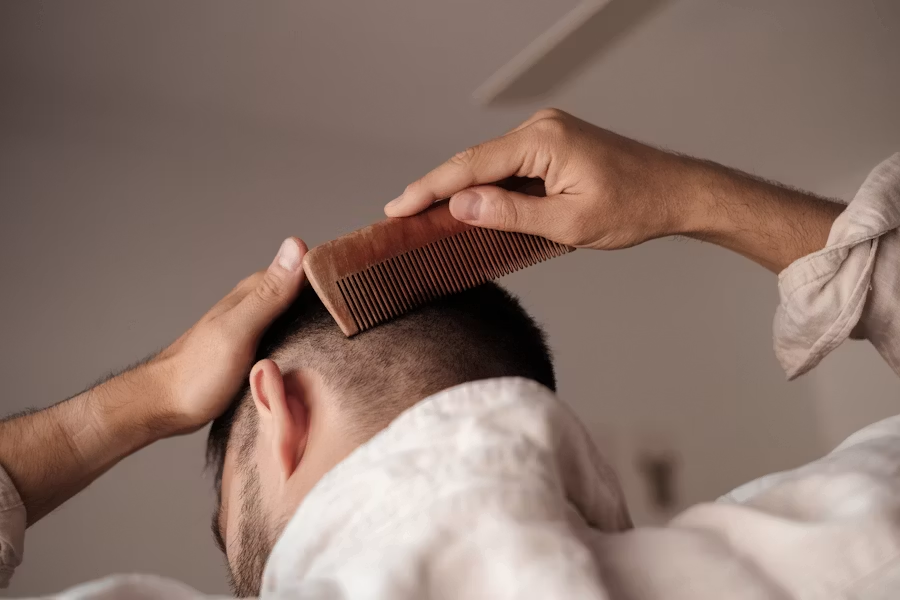
A skilled surgeon does not operate only on what you see in the mirror today, but on the hair loss you are likely to have in 10-20 years. Two considerations are central:
- Donor capacity as a lifelong resource: The donor area is limited. If too many grafts are used too early, there will not be enough left to keep pace with a progressing loss later. Good planning keeps a reserve.
- An age appropriate, conservative hairline: A hairline that is too low, a “teenage” hairline, can look fine for a while, but becomes unnatural as the face ages and the hair behind it thins. A slightly higher, maturely designed hairline holds up better over time.
This forward looking approach is one of the clearest hallmarks of a serious clinic, read more under choosing a clinic.
Get a free hair analysis
- 1Start
- 2Info
- 3Done
How to preserve the result: medical maintenance
The most effective way to protect the long term result is to slow the loss of your original hair. Here medical treatment plays a central role. DHT blockers such as Finasteride can stabilise the non transplanted hair, and Minoxidil can support the density, so that the transplanted and the original hair age more evenly.
The combination of a well executed transplant and continuous medical maintenance is the recipe for a result that remains natural for decades. See the whole toolbox under slowing hair loss without surgery. The decision about medication should always be taken in consultation with a doctor.
A realistic timeline over the years
- Year 1: The final result has grown in (typically 12-18 months after the operation) with full density and texture.
- Year 2-5: The transplanted hairs are stable. If the original hair keeps thinning, there may be a need to consider medical treatment or an additional procedure.
- Year 5-10: In well planned patients, preferably on medical maintenance, the result remains natural. Some choose a second, smaller session to keep pace with an advancing loss of the original hair.
- Year 10+: The transplanted hair typically still lasts, but the overall appearance depends on how well the original hair has been preserved.
In other words: the transplant lasts, but the overall impression across a whole lifetime is shaped by planning and maintenance.
When can an additional session be relevant?
Some patients have a second session in time, not because the first one failed, but because the original hair loss has progressed, or because they want greater density. As long as the donor capacity has been managed wisely, an additional procedure can restore the balance. That is one more reason not to empty the donor area at the first attempt.
An honest surgeon will speak openly at the first consultation about the fact that future procedures may become relevant, and will plan accordingly. Promises that “one operation solves everything for ever” regardless of age and degree of hair loss should arouse scepticism.
Summary
A hair transplant is lasting because it is built on donor dominance: DHT resistant hairs moved from the back of the head keep their resistance and typically stay in place for life. But the result as a whole is not “set in stone” the day the hair has grown in, it is shaped continuously by how your original hair develops.
The two keys to a beautiful long term result are therefore forward looking planning (a conservative hairline and a preserved donor reserve) and medical maintenance of the original hair. With both in place you have good reason to expect a natural, durable result for many years to come.
Frequently asked questions
Does a hair transplant last a lifetime?
The transplanted hair is in principle permanent, because it is taken from the DHT-resistant donor area at the back of the head and keeps its resistance (donor dominance). The overall result across a whole lifetime does, however, also depend on how well your original hair is preserved.
Why can the result change even though the operation succeeded?
Because a transplant does not stop the hereditary hair loss in your original, non transplanted hair. If that hair keeps thinning, the transplanted hairs can end up standing as a denser island surrounded by thinner zones. That is why medical treatment is often recommended alongside.
What can I do to preserve the result for as long as possible?
Slow the loss of your original hair with medical treatment (typically Finasteride and/or Minoxidil on your doctor's guidance), choose a clinic that plans conservatively for the future, and look after your donor capacity. The combination gives the most durable, natural result.
Will I need more than one operation?
Some people have a second session in time, not because the first one failed, but because the original hair loss has progressed, or because they want more density. Wise management of the donor reserve at the first procedure makes an additional procedure possible later.
Why is a conservative hairline better in the long run?
A very low hairline can look fine for a while, but it often becomes unnatural as the face ages and the hair behind it thins. A slightly higher, maturely designed hairline keeps a natural appearance over decades and spares the donor resource.
Can the transplanted hair fall out again with age?
The transplanted follicles are DHT-resistant and typically continue to last, including into old age, although the thickness of the hair can naturally decrease a little with age as with all other hair. What most often changes the overall impression is the loss of the original hair around them, not of the transplanted grafts.
Get a no-obligation assessment against fixed criteria, directly on WhatsApp.