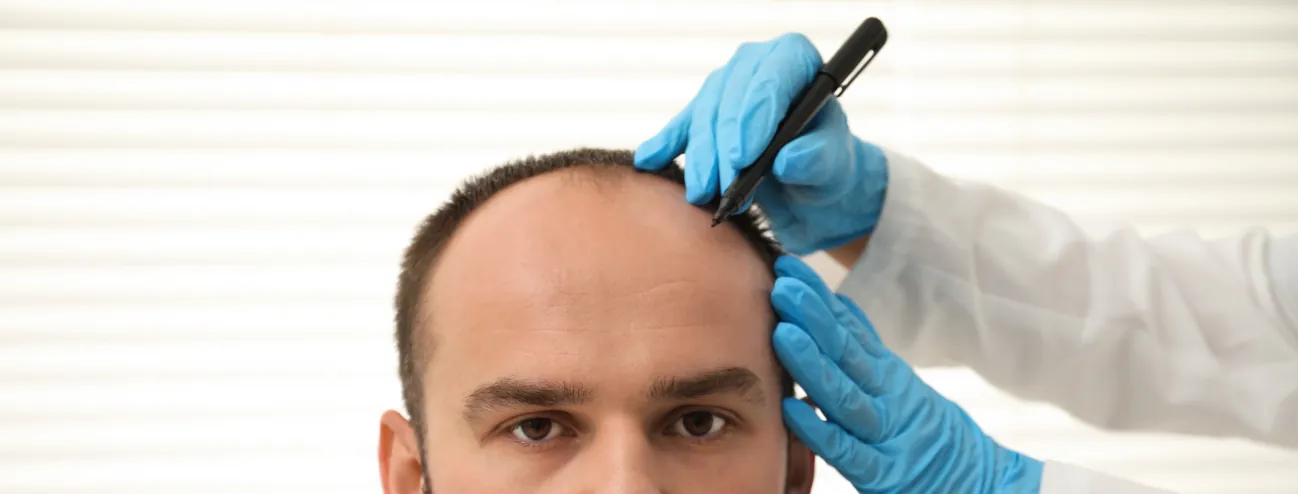
Is a hair transplant the right move for male pattern baldness? For many men, yes, once the loss has settled into a stable, recognisable pattern and the donor area at the back and sides is confirmed healthy; for a man still losing hair quickly, medical treatment usually comes first, and surgery follows once the picture has stopped moving. Male pattern baldness (androgenetic alopecia) is graded with the Norwood scale, and that stage, alongside your donor supply, is what actually decides how many grafts a transplant needs and what it can realistically achieve.
This guide walks through the decisions specific to men, in order: whether surgery is the right fix at all, what your Norwood stage means for graft demand, whether the hairline or the crown should be prioritised first, why stabilising loss with Finasteride or Minoxidil usually comes before or alongside surgery, which method (FUE, DHI or FUT) tends to suit which case, the realistic growth timeline, how cost actually scales, and the concrete next step to confirm candidacy. It sits alongside the fuller candidacy guide, which covers the same factors for any pattern of loss; this page is written specifically around male-pattern baldness and the Norwood scale used to grade it. If you're asking on behalf of a woman's hair loss instead, which is usually diffuse rather than patterned and graded on the Ludwig scale, see hair loss and transplants in women.
- A transplant works best on stable, patterned male hair loss with a healthy donor area; loss that is still actively progressing is usually treated medically first, then reassessed.
- Your Norwood stage is the single biggest driver of graft demand, from roughly 500 to 1 400 grafts at stage II to well over 6 000 at stage VI-VII.
- Donor supply is finite, so hairline and crown compete for the same budget; most plans prioritise the hairline and mid-scalp first and treat the crown more conservatively.
- Finasteride and/or Minoxidil are usually started before or alongside surgery to protect the native hair a transplant does not touch, not because the transplanted grafts themselves need it.
- The timeline is the same for every method: shedding around weeks 2-3, new growth from about month 3-4, and a result judged at around 12 months.
Is a hair transplant the right fix for male pattern baldness?

Yes, once your hair loss has settled into a stable, recognisable pattern and your donor area at the back and sides is healthy. A transplant is not usually the first step while loss is still actively progressing; rapidly changing hair loss is generally treated medically first, then reassessed once photos over 6–12 months confirm it has genuinely slowed. Once stability and donor supply are confirmed, most men with a clear Norwood pattern are good candidates.
Male pattern baldness, androgenetic alopecia in men, is the reason a transplant can work at all: follicles at the hairline, temples and crown are genetically sensitive to DHT (dihydrotestosterone) and gradually miniaturise, while follicles at the back and sides largely keep their own, separate resistance. A transplant only makes sense once that split is visible as a stable, recognisable pattern, not while the whole picture is still moving.
When a transplant is usually the right next step
Three things generally line up before surgery makes sense for a man: the pattern has been stable, or clearly slowing, for a meaningful period rather than changing month to month; the donor area is dense and healthy enough to support the plan; and expectations are realistic, a transplant redistributes existing hair into a fuller, natural-looking shape, it does not add to your lifetime hair count. Most men who reach a clear Norwood III to VI pattern with a solid donor area meet all three.
When it's usually not yet the right step
Surgery is usually deferred, not refused outright, when loss is young and still progressing quickly, when a scarring alopecia or another medical cause has not yet been ruled out, or when the donor area itself shows signs of thinning. Operating into a pattern that has not settled risks a hairline that looks well placed today and isolated in a few years, as untreated hair around it keeps receding. None of this is a permanent verdict; many men who are told to wait become good candidates a year or two later, once the pattern has genuinely settled.
Beyond the male-pattern factors here, general health, scalp condition and hair type are covered in depth in the full candidacy guide, which applies to any pattern of loss.
What does my Norwood stage mean for graft demand?
Your Norwood stage is the single biggest driver of how many grafts a transplant needs: roughly 500–1 400 grafts to refine an early temple recession (Norwood II), rising to 7 100–8 600 once only a horseshoe rim of donor hair remains (Norwood VII). The stage also signals how much of your finite donor budget a plan can spend now versus needs to hold in reserve.
The Norwood scale grades male pattern baldness from I (no meaningful loss) to VII (only a horseshoe rim of donor hair left), and it is the starting point for any graft estimate, because the area actually needing coverage, not a general wish for "more hair", is what a surgeon plans against. Reading your own stage correctly, ideally from photos over 6–12 months rather than a single snapshot, is worth doing before you look at graft numbers at all.
Indicative grafts by stage
| Norwood stage | What it typically looks like | Indicative grafts* |
|---|---|---|
| II | Symmetrical temple recession | 500–1 400 |
| III | Clear temple recession, crown untouched | 1 500–2 800 |
| III vertex | Temple recession plus early crown thinning | 2 900–3 800 |
| IV | Front and crown loss, separated by a band | 3 900–4 900 |
| V | The band narrows; front and crown move closer | 5 000–6 200 |
| VI | Front and crown have merged into one area | 6 000–7 300 |
| VII | Only a horseshoe rim of donor hair remains | 7 100–8 600 |
*Ranges are summed across the hairline, mid-scalp, crown and temples in our own graft calculator, not a promise for your case; your own hair calibre, curl and donor density move the real number up or down, and hair type alone can shift it meaningfully in either direction. For how this is worked out stage by stage, see how many grafts each Norwood stage typically needs.
Why the number is a budget question, not just a coverage question
Every graft placed at the front or crown is a graft taken from a donor area that often has to last decades, against continued native hair loss around the transplant. A Norwood VII wanting full coverage everywhere is the clearest example of demand outrunning supply: the indicative figure above is often more than a typical donor area can safely deliver in full, which is why realistic planning at higher stages is about sequencing and priority, covered next, rather than one maximal session.
Hairline or crown: which should get grafts first?
When donor supply cannot cover everything at once, most surgeons prioritise the hairline and mid-scalp before the crown, because a natural hairline has the biggest effect on how a face reads, and a conservatively treated crown is easier to leave for a later session. The crown also tends to need denser placement to look convincing, which spends the donor budget faster for the same visual return.
This is less a fixed rule than a budgeting decision, and it becomes relevant the moment a Norwood stage's indicative graft count, covered above, gets close to or beyond what a donor area can comfortably support in one sitting.
Why the hairline usually comes first
A hairline frames the whole face, so even a modest, well-designed hairline reads as a complete change, while a partially treated crown reads as unfinished either way. A single-hair-unit front edge at a natural, slightly irregular line typically needs fewer grafts than a fully dense crown whorl to look convincing, which makes it the more efficient first investment when the budget is limited. See what actually makes a hairline look natural, rather than "transplanted", in our guide to hairline design.
Why the crown is treated more conservatively
The crown's whorled growth pattern needs denser placement to avoid looking thin from above, and, unlike the hairline, it sits directly beside a large area of native hair that may keep thinning for years. Committing heavily to the crown early, before the surrounding native hair has finished changing, risks a dense island that looks increasingly isolated as untreated hair recedes around it. Many surgeons treat the crown lightly at first, or leave it for a planned second session, precisely to avoid that outcome.
Splitting the plan across sessions
At higher Norwood stages, covering the front now and the crown later, once native loss has settled further, is a sign of forward planning rather than an unfinished result; it protects donor supply for a second pass instead of spending it all against a pattern that has not finished moving. Read more about when this staged approach makes sense in one or two sessions.
Should hair loss be stabilised before a transplant?
Yes, in almost every case: transplanting into hair loss that is still actively progressing risks a hairline or crown that looks well placed today and isolated within a few years, as untreated native hair keeps receding around it. Finasteride and/or Minoxidil are the usual tools for slowing that progression first, or alongside surgery, to protect the hair a transplant does not touch.
The whole logic of a transplant depends on a split that already needs to exist: donor follicles at the back and sides are largely resistant to DHT (dihydrotestosterone), the hormone that miniaturises hair at the hairline, temples and crown in genetically susceptible men, and they broadly keep that resistance once moved. No follicle is completely immune to DHT, so no honest guide calls a transplant permanent, but that relative resistance is real, and it's why donor hair keeps growing where native hair does not. See the full mechanism in our guide to DHT and heredity, or the broader causes of hair loss.
Why operating into active loss backfires
A transplant relocates hair into a scalp that, in a still-progressing case, may keep changing shape around it. Native hair beside and behind the new grafts is not protected by the surgery, so it can keep miniaturising for years, leaving a well-placed result looking increasingly boxed in as the untreated hair around it recedes further. This is the main reason surgeons ask for stability, not a birthday, before committing grafts permanently.
What "stabilising first" actually means
For a man whose loss is still moving quickly, often in his early twenties, this usually means starting Finasteride, Minoxidil, or both, then comparing photographs every six to twelve months rather than booking surgery straight away. A hair transplant is usually advised from around 25, once loss has clearly stabilised, as a guideline rather than a strict cutoff; some men in their early twenties with slow, clearly patterned recession are reasonable candidates, and some men older than 25 are still asked to wait a little longer. Read the full age and stability guide for where that leaves you specifically.
Why medical therapy often continues after surgery too
Because a transplant does not stop DHT acting on native hair, many surgeons recommend continuing or starting Finasteride or Minoxidil alongside the transplant, to protect the untreated hair around the new grafts rather than to help the grafts themselves. The full, documented non-surgical toolbox, doses, timelines and what the evidence actually supports, is covered in stop hair loss without surgery.
Which method suits which case: FUE, DHI or FUT?
FUE is the default for most men, extracting one follicle at a time through tiny punches with no linear scar. DHI uses the same FUE-style extraction but places grafts directly with an implanter pen for fine control over angle and density, which suits precise hairline work. FUT can still make sense for a large Norwood stage needing a very high graft count in one session, at the cost of a linear donor scar.
None of the three names decides your result on its own; what matters is how well the technique fits your specific Norwood stage, donor density and hairline plan, and how experienced the team is with it. This section covers the choice briefly; the full comparison, including Sapphire FUE, sits in our dedicated guide to hair transplant methods.
FUE: the default for most cases
FUE (follicular unit extraction) removes individual follicles one at a time through a small punch, leaving scattered, generally inconspicuous dot marks rather than a line. It suits the majority of male-pattern cases and is the most forgiving choice if you want to keep the option of a very short haircut at the back and sides.
DHI: precision at the hairline, not extra speed
DHI (direct hair implantation) uses the same punch-based extraction as FUE; the difference is placement, where an implanter pen sets each graft directly, without pre-made channels, giving fine control over angle and depth. That control is genuinely useful for a dense, natural-looking hairline, but it does not change how many grafts a session can move, and sessions can take longer.
FUT: still relevant for large sessions
FUT (strip harvesting) removes a strip of donor scalp, dissected into grafts under magnification, which can support a very high graft count in a single sitting, relevant for a Norwood VI or VII case wanting maximum coverage at once. The trade-off is a single linear donor scar, a bigger consideration if you like your hair very short. See when FUT still makes sense for the specific cases where it's worth considering.
Whichever method fits your case, the deciding factor is the same: a named surgeon with documented experience in that technique, not the technique's name alone.
What results and timeline should I expect?
Expect the transplanted hairs to shed around weeks 2–3, which is normal and not a sign of failure; new growth to begin from roughly month 3–4; and the final result, density, texture and how the hairline sits, to be judged at around 12 months. A transplant restores a natural, appropriately framed hairline and thicker coverage in the treated area; it does not recreate the density you had as a teenager.
The timeline is the same regardless of method: FUE, DHI or FUT change how grafts are taken and placed, not how they grow. Setting this expectation before surgery is part of what makes a result feel successful afterwards, since most disappointment traces back to a mismatch between what was promised and what any transplant, by its nature, can do.
Month by month
- Weeks 2–3: the transplanted hairs shed. This is expected, not a sign the graft failed; the follicle itself stays in place under the skin.
- Months 3–4: new growth begins, fine at first.
- Months 6–12: density and texture continue to mature, with most men seeing close to the final look around the 12-month mark; the crown is often the slowest area to finish.
What a realistic result looks like
A transplant is planned for a natural hairline shape and thicker, more even coverage in the treated area, not for matching the density you had at eighteen; grafts are deliberately spread to preserve the look of the donor area and to work within a finite lifetime supply. Most men find that a lower density than their teenage self, placed and angled well, still reads as full and natural. Some clinics also offer supportive treatments such as PRP alongside a transplant to support healing in the early months; see supportive treatments for what is well documented and what is not.
Protecting the result afterwards
The transplanted hair itself is largely resistant to DHT and keeps growing where native hair has stopped, but the native hair around and behind the new grafts is not protected by the surgery and can keep thinning for years, which is why medical therapy often continues, as covered above. The day-by-day healing routine, washing, sleeping position, exercise, is covered in full in our aftercare guide, and what genuinely happens to a result over 10, 20 or more years is covered in longevity.
What does a hair transplant for men actually cost?
Cost scales primarily with graft count, so a Norwood III case (roughly 1 500–2 800 grafts) costs meaningfully less than a Norwood VI–VII case (roughly 6 000–8 600 grafts), before location or method are even factored in. Turkey remains the standout value market, averaging around €3 500 for a typical procedure versus €8 000–15 000 for the same procedure in Denmark.
The single biggest lever on price is not the country or a clinic's marketing, it's the number of grafts your Norwood stage and plan actually require, covered above. A price quoted before your stage and graft count are known is not yet a real quote.
What else drives the number, beyond grafts
Method (FUT is sometimes priced differently from FUE or DHI), how many sessions the plan needs, and what's included, hotel, transport, translation and structured aftercare versus the surgery alone, all move the final figure. See exactly how price per graft is worked out in price per graft explained.
Turkey as the value benchmark
A hair transplant in Turkey averages around €3 500 for a typical procedure, with a range of roughly €2 500 to €5 500, which works out to well under €1 per graft, and commonly bundles hotel, transport and aftercare into that figure. The same procedure typically costs €8 000 to €15 000 in Denmark. The lower price does not mean fewer grafts or lower quality; it largely reflects lower living costs and very high procedure volume among Istanbul's leading clinics, not a shortcut in the surgery itself.
Working out your own number
Because cost tracks grafts so closely, the most useful first step is a rough graft estimate for your own Norwood stage and goals, not a general country price. Our graft calculator gives an indicative range in a couple of minutes; a full, written quotation only comes after a proper consultation confirms your donor density and plan. See the complete country-by-country breakdown on the prices page.
What's the next step to confirm I'm a candidate?
Get your Norwood stage, donor density and stability confirmed by a proper assessment rather than guessing from an article; that's the only way graft numbers, method and timing turn into an actual plan. A free hair analysis is a low-friction way to get that first read from home, with no obligation to go further.
Everything on this page, stage, hairline-versus-crown priority, stabilising loss, method and cost, comes down to the same handful of facts about your own scalp: how patterned your loss is, how much donor hair you have, how stable the pattern has been, and your general health. Only a hands-on or photo-based assessment turns those into a real plan rather than a general estimate.
Confirm the specifics that matter most
- Your Norwood stage and its trend. Not just where you are today, but whether photos over the last year show the pattern settling or still moving.
- Donor density and calibre. A favourable donor area sits ideally over 50 follicles per cm², but the number that matters is your own, measured directly; see do I have enough donor hair for how it's assessed and what it limits.
- Age and stability together, not age alone. There's no strict cutoff in either direction; am I too young or too old covers what actually gets checked at 20, 30 or 50-plus.
- General health. Diabetes, thyroid disease, blood thinners and similar conditions are reviewed individually rather than ruling anyone out; see hair transplants with diabetes and other medical conditions if any of this applies to you.
Where the full picture lives
This page is written specifically around male-pattern loss and the Norwood scale; the broader candidacy guide covers every factor above, plus scalp condition and hair type, in one place for any pattern of loss. Once you have a working sense of where you stand, work through how to choose a clinic, compare options in the clinic ranking, and see the best clinics before booking anything.
Frequently asked questions
What's the best age for a hair transplant for men?
There's no single best age, and no strict cutoff in either direction. A transplant is usually advised from around 25, once hair loss has clearly stabilised, because operating into a pattern that's still changing risks a result that looks isolated a few years later. Some men in their early twenties with slow, clearly patterned loss are good candidates; some older men are asked to wait a little longer if their pattern only recently settled.
Can a hair transplant cure male pattern baldness?
No. A transplant redistributes your own existing hair from a DHT-resistant donor area into a thinning one; it doesn't stop androgenetic alopecia or add to your total lifetime hair count. Native hair that wasn't transplanted, including the hair around the new grafts, can keep thinning afterwards, which is why many men continue or start medical therapy alongside surgery.
Do I have to take Finasteride or Minoxidil after a hair transplant?
Not as a rule, but it's commonly recommended. The transplant itself doesn't protect native hair around the new grafts from ongoing DHT-driven loss, so continuing or starting Finasteride and/or Minoxidil is a common way to keep the overall look consistent over time. Whether to start or continue is a decision to make with a doctor, since both carry their own considerations.
How many grafts does a Norwood 5 or 6 typically need?
Indicatively, around 5 000 to 6 200 grafts for Norwood V and 6 000 to 7 300 for Norwood VI, summed across the hairline, mid-scalp, crown and temples. These are starting estimates from a graft calculator, not a quotation; your actual number depends on donor density, hair calibre and how much of the crown you choose to treat now versus later.
Is FUE, DHI or FUT the better choice for men?
There's no single best method; each suits different cases. FUE suits most men and leaves no linear scar, DHI adds fine placement control that's useful for hairline work, and FUT can move a very high graft count in one session for extensive loss, at the cost of a linear donor scar. The right choice depends on your Norwood stage, donor area and the surgeon's specific experience with that technique.
What happens if my donor area can't fully cover my Norwood stage?
A responsible surgeon plans conservatively rather than overharvesting to chase full coverage. That usually means prioritising the hairline and mid-scalp, treating the crown more lightly or in a later session, and being honest that maximum density everywhere isn't realistic from a limited donor supply. This is exactly what a personal assessment is for, since a donor budget that looks tight on paper is sometimes more workable once density and calibre are actually measured.
Norwood stage, donor supply and stability are specific to you, not to a general article, and only a hands-on look at your own scalp turns them into an actual plan. Get a free hair analysis and hear back from our #1-ranked clinic with an honest read on your pattern, your timing and what a realistic graft plan looks like, with no obligation to go further.
General educational guidance, not medical advice. Whether, and when, a hair transplant is right for you is confirmed by a qualified surgeon at a personal assessment.
Last updated: August 2026 · Editorial standards