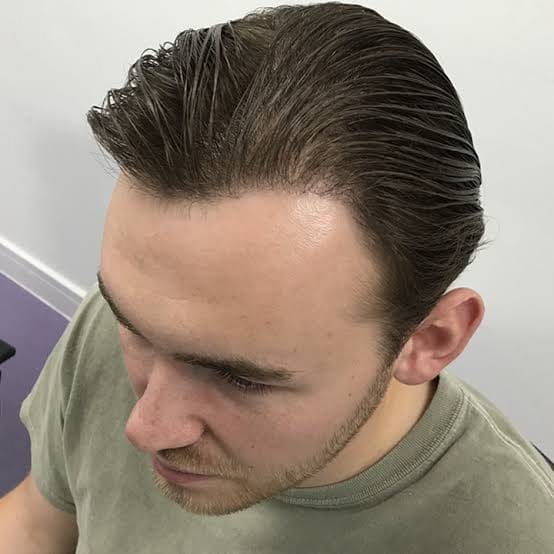
Why donor management is the whole game in a young patient
In a patient under about thirty, the pattern has not finished expressing itself and the donor zone's true boundaries are unknown.
In a patient under about thirty, the pattern has not finished expressing itself and the donor zone's true boundaries are unknown. Every decision made now constrains what is possible for the next forty years, which is why conservatism is not caution but arithmetic.
Why does a patient's age change how a hair transplant should be planned?
A stable 50-year-old is solvable: the area needing coverage and the donor zone are both known. A 26-year-old's pattern is unknown — he might stabilise at Norwood 3 or reach Norwood 6 by forty — so the same reserve could be sufficient or inadequate. Surgery is considered from around age 25, once loss has stabilised.
A 50-year-old at Norwood 5 whose pattern has been stable for a decade presents a solvable problem: the area needing coverage is known, the donor zone's boundaries are visible, and a plan can be matched to a reserve with reasonable confidence.
A 26-year-old at Norwood 3 presents a fundamentally different problem, because the most important input is missing. Nobody knows where his pattern will stop. He might stabilise at Norwood 3. He might reach Norwood 6 by forty. The same donor reserve is either comfortably sufficient or badly inadequate depending on which happens, and there is no test that resolves it in advance.
This is why the guideline exists that surgery is generally considered from around age 25, once loss has stabilised. It is not an arbitrary threshold — it is the point at which the pattern has usually declared enough of itself to plan against.
What does the typical failure sequence look like when a young patient is over-treated?
A young man is quoted a large session for a low, dense hairline that looks excellent at twelve months. Over the next decade the native hair behind it miniaturises and the crown thins, so a second session spends the remaining reserve. By his mid-forties he has a dense hairline fronting a bald, depleted crown.
The failure mode is consistent enough to describe as a standard sequence.
- A young man with a receding hairline is quoted a large session to restore a low, dense frontal hairline.
- The result at twelve months looks excellent, because the frontal third is dense and the crown has not yet opened up.
- Over the following decade the native hair behind the grafts continues to miniaturise. The crown thins. A gap develops between the transplanted zone and what remains behind it.
- He returns for a second session to close the gap. Some reserve remains, and it is spent.
- By his mid-forties he has a dense, low hairline sitting in front of a bald or thin crown, with a depleted donor area — a configuration that looks less natural than the loss he started with, and cannot be fixed.
Nothing in this sequence involves surgical error. Every individual step was performed competently. The failure was in the first plan.
What does conservative donor planning actually mean in practice for a young patient?
Concretely: a mature hairline placed where a 45-year-old's would sit, not an 18-year-old's; treating only the frontal third first and leaving the crown untouched; moderate rather than maximum density; a specific graft number held back for the future; and medical therapy to protect the native hair that determines how the result looks in fifteen years.
- A mature hairline, not a juvenile one. Placing the hairline where a 45-year-old's would sit, not where an 18-year-old's did. This is the highest-leverage decision and the one patients most resist.
- Frontal third only in the first session. Leaving the crown untouched preserves the option of addressing it later, when the pattern is known.
- Moderate density. A slightly lower density across a sensible area outlasts high density across a small one, because the surrounding native hair will thin.
- Substantial reserve held back. Not 'we'll see what's left' but a specific number retained for future work.
- Medical therapy first and alongside. The native hair behind the grafts is what determines whether the result still looks right in fifteen years. Preserving it is a matter for a doctor who knows your history, and it does more for a young patient's long-term result than any surgical decision.
Why is 'wait and reassess' sometimes the right advice, even though clinics rarely give it?
For many young patients the right advice is to wait, start medical treatment, and reassess in a few years — unpopular with patients and unprofitable for clinics. A surgeon telling a 24-year-old to return at 27 is behaving well; one quoting 3 500 grafts in a fifteen-minute video call is not.
The right advice for many young patients is to wait, start medical treatment, and reassess in a few years. That advice is unpopular with patients and unprofitable for clinics, which is why it is given less often than it should be.
A surgeon who tells a 24-year-old to come back at 27 is behaving well. A clinic that quotes a 3 500-graft session to the same patient in a fifteen-minute video consultation is optimising for a different objective.
The test is whether the discussion of your future pattern happened at all. If nobody has asked about your family history, examined your donor area under magnification, or discussed what your head might look like at fifty, then whatever plan you were given was not built on the information that matters.
If a young patient decides to go ahead anyway, what should they insist on?
Insist on a mature hairline — almost everyone who chose a low one eventually regrets it. Get the lifetime donor reserve estimate in writing, and ask exactly how many grafts are held back. Take standardised photographs of your donor area before surgery, and discuss medical therapy with a doctor outside the clinic selling you surgery.
- Insist on the mature hairline. You will not regret it; almost everyone who insisted on a low one eventually does.
- Get the lifetime reserve estimate in writing.
- Ask exactly how many grafts are being held in reserve.
- Take standardised photographs of your donor area before surgery.
- Have the medical therapy conversation with a doctor, separately from the clinic selling you surgery.
Sources
- Maas D, et al. Rethinking the occipital scalp as a control in advanced androgenetic alopecia. Journal of the American Academy of Dermatology, 2026 (ahead of print). pubmed.ncbi.nlm.nih.gov/42398778
- Xu Y, et al. Case Report: Paired vertex-occipital assessment reveals donor-area involvement in diffuse unpatterned alopecia. Frontiers in Medicine, 2026;13:1797275. pubmed.ncbi.nlm.nih.gov/41982548
- Jimenez F, Ruifernández JM. Distribution of human hair in follicular units. A mathematical model for estimating the donor size in follicular unit transplantation. Dermatologic Surgery, 1999;25(4):294-298. pubmed.ncbi.nlm.nih.gov/10417585
- Gupta AK, Venkataraman M, Talukder M, Bamimore MA. Finasteride for hair loss: a review. Journal of Dermatological Treatment, 2022;33(4):1938-1946. pubmed.ncbi.nlm.nih.gov/34291720
- Romera de Blas C, Vega Díez D, Ricart Vayá JM, Gómez Zubiaur A. Complications in follicular unit excision hair transplantation: current evidence and practical approaches. Frontiers in Medicine, 2026;13:1750989. pubmed.ncbi.nlm.nih.gov/41709896
This article summarises published research and standard clinical practice. It is general educational information, not medical advice, and it does not replace the instructions your own surgical team gives you. Where their guidance differs from anything here, follow theirs.
Get a no-obligation assessment against fixed criteria, directly on WhatsApp.