
The Norwood scale explained: how to read your stage
The Norwood scale is the standard for describing male hair loss. Here is what the seven stages actually mean for you.
What is the Norwood scale, and why does it exist?
The Norwood scale, also called the Norwood-Hamilton scale, is the most widely used tool in the world for grading male, hereditary hair loss. It divides the loss into seven main stages, from an almost imperceptible beginning to the most pronounced pattern, where only a rim of hair remains. The scale was developed to give doctors a common, objective language, so that hair loss can be described, followed and compared consistently over time.
For you as a patient the scale is more than academic. It helps you understand how far your loss has progressed, which treatments make sense at your stage, and, importantly, how many grafts a possible transplant will realistically require. Knowing your approximate Norwood stage also makes it easier to see whether a clinic's recommendation and price calculation are realistic.
The seven stages step by step
The scale moves from slight recession to extensive loss. Note in particular the difference between the front (the hairline) and the vertex (the crown), which can develop separately:
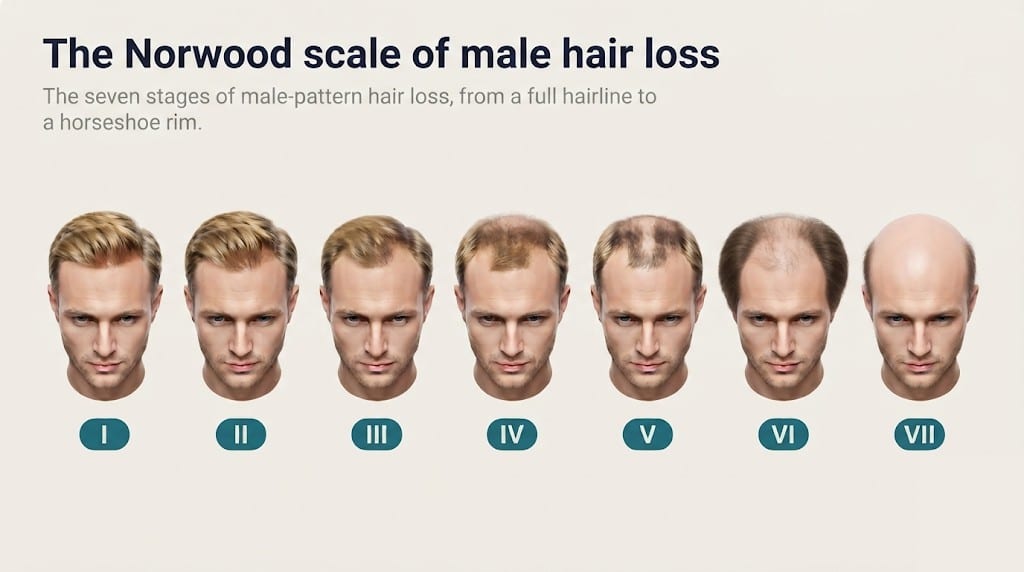
| Stage | Characteristics |
|---|---|
| I | No or minimal recession, in effect a full head of hair. |
| II | Slight, symmetrical recession at the temples; a “mature” hairline pattern that many adult men have. |
| III | Clear recessions at the temples, regarded as the first stage with genuine hair loss. In “III vertex” there is also early loss at the crown. |
| IV | Pronounced recession at the front combined with clear crown loss, separated by a relatively broad band of hair across the crown. |
| V | The band between front and crown becomes narrower and thinner; the two areas approach each other. |
| VI | The band disappears; front and crown merge into one large bald area. |
| VII | The most pronounced stage: only a horseshoe shaped rim of hair remains at the back and sides. |
There is also an “A variant”, where the loss moves steadily from the front backwards without the typical band, and it can require particular planning.
Why your stage shapes the choice of treatment
Your stage affects both which treatment makes sense and what you can realistically achieve. In the early stages (I-III) medical treatment is often the most important tool. Finasteride and Minoxidil can preserve the hair you still have and slow the androgenic process before the hair is lost. The earlier you act, the more you can keep, and the less invasive the process becomes.
In the middle and late stages (IV-VII) a transplant can rebuild coverage, but here your limited donor capacity becomes a central factor: the larger the area to be covered, the more important wise, forward looking planning is, so that the donor area is not emptied too early. Read more about the options under slowing hair loss without surgery and hair transplant methods.
Norwood and graft numbers: a rough relationship
Although it varies considerably from person to person, depending on head size, hair character and the density wanted, the graft requirement roughly follows the stage:
- Stage II-III: Often 1 500-2 500 grafts to restore the hairline and temples.
- Stage IV: Typically around 2 500-3 500 grafts for the front and early crown.
- Stage V-VI: Often 3 500-5 000+ grafts, sometimes spread over two sessions.
- Stage VII: A very large requirement, often exceeding what the donor area can realistically deliver for full coverage.
Be sceptical of clinics that promise full coverage of a high Norwood stage with an unrealistically low graft count, or conversely harvest extremely many grafts with no regard for your future donor reserve.
Get a free hair analysis
- 1Start
- 2Info
- 3Done
Female hair loss uses a different scale
The Norwood scale was developed for men and fits female hair loss poorly, as that is typically diffuse with a preserved frontal hairline. Women are therefore graded instead with the Ludwig scale (grade I-III), which describes increasing thinning along the central parting. It is an important distinction, because pattern, diagnosis and treatment differ between the sexes. See more under the causes of hair loss.
How to use your knowledge of the stage
Placing yourself on the scale is a good starting point, but it does not replace a professional assessment. With trichoscopy a specialist can see signs of miniaturisation long before a stage is obvious to the naked eye, and can therefore judge how quickly the loss is progressing. That is often just as important as the stage itself when planning treatment.
So use the Norwood scale as a common language when you talk to a professional: it helps you ask better questions, understand the recommendations and judge whether an offer is realistic. This article is for general information and does not replace an individual assessment.
Conclusion
The Norwood scale is a simple, useful map of male hair loss in seven stages. Knowing your stage helps you understand which treatments are relevant, and how many grafts will realistically be needed. In the early stages medical treatment is often most important; in the later stages, careful planning of the donor area becomes critical. Use the scale as a starting point for a conversation with a professional, not as a final self-diagnosis.
© IdealofMeD Research Academy. Republished with permission.
Get a no-obligation assessment against fixed criteria, directly on WhatsApp.