Combining HBOT with other adjunct therapies
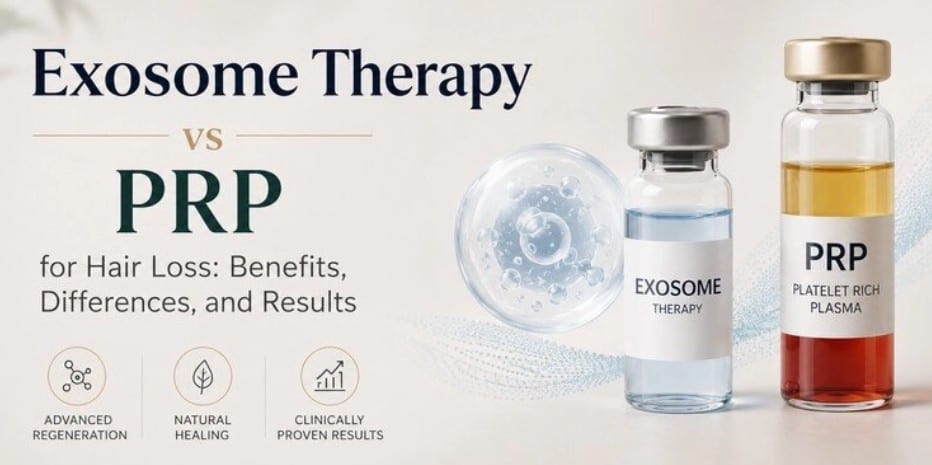
Packages that stack HBOT with PRP, exosomes, laser therapy and supplements are common.
Packages that stack HBOT with PRP, exosomes, laser therapy and supplements are common. No study has tested any of those combinations after a hair transplant, and combining unproven treatments does not produce a proven one.
Why is it hard to evaluate the evidence behind bundled adjunct packages?
Because clinics bundle several adjuncts — PRP, a hyperbaric course, exosome treatments, a laser device, supplements — into one priced package, while published research on each only examines them separately. No study has tested HBOT combined with PRP, exosomes, or laser therapy after a transplant, so the combination being sold has never been evaluated.
Adjunct treatments after a hair transplant are rarely sold individually. The typical premium package bundles several — PRP at the time of surgery, a course of hyperbaric sessions, exosome or growth-factor treatments, a laser device to take home, a supplement regimen — and prices them together.
This is commercially effective and evidentially opaque. The published research on each of these treatments, where it exists at all, examines them separately. There is no study of HBOT combined with PRP after a hair transplant, none of HBOT combined with exosomes, and none of HBOT combined with laser therapy. The combination being sold has never been evaluated as a combination.
Does combining several unproven adjuncts add up to proven benefit?
No. If each adjunct's effect on twelve-month survival is unestablished, several unestablished effects do not sum to an established one. Many treatments target the same inflammatory and angiogenic pathways, so taking several does not double the effect, and if a result is good, nobody — including the clinic — can tell which component mattered.
There is an intuition that if several treatments each might help a little, taking all of them should help more. It does not follow, for three reasons.
- Uncertain effects do not add. If each component's effect on twelve-month graft survival is unestablished, five unestablished effects do not sum to an established one.
- Mechanisms can overlap. Several of these treatments target the same inflammatory and angiogenic pathways. Two interventions doing the same thing do not necessarily do it twice.
- Attribution becomes impossible. If your result is good, you cannot know which component mattered, and neither can the clinic — which is precisely why uncontrolled clinical experience keeps producing confident claims that trials do not confirm.
What does the evidence show for each individual adjunct — HBOT, PRP, LLLT, exosomes?
HBOT's one 34-patient trial found less early shedding and folliculitis but no significant nine-month survival difference. PRP has a large alopecia literature but much less on survival after transplant. LLLT has trial evidence for treating existing hair, not new grafts. Exosome and growth-factor products are marketed heavily but studied poorly, with composition varying between suppliers.
HBOT
One randomised trial of 34 patients found less early shedding (27.6% versus 69.1%) and less itching and folliculitis (11.8% versus 35.3%), with nine-month survival of 96.9% versus 93.8% and no statistically significant difference. Plus a five-patient case report and a preliminary volunteer study.
PRP
A substantial literature in androgenetic alopecia, including systematic reviews and meta-analyses, with recognised methodological problems around preparation protocols and outcome measures. Much less evidence for the specific question of graft survival after transplantation.
Low-level laser therapy
A real randomised-trial literature in androgenetic alopecia — a 2025 meta-analysis of seven trials found greater density gains when LLLT was added to topical Minoxidil than with Minoxidil alone. Again, that is about treating existing hair, not protecting new grafts.
Exosomes and growth-factor products
This category is marketed heavily and studied poorly, and product composition varies enormously between suppliers. It does not have a comparable evidence base and should be evaluated with correspondingly more caution.
Could combining HBOT with other adjuncts cause problems?
Most combinations have no known interaction, but two points are worth raising with the surgical team. Scheduling can clash, since a hyperbaric course occupies the first post-operative week while PRP is often given at surgery. And hyperbaric oxygen is not pharmacologically inert, so whether it interacts with a growth-factor injection the same week is unknown.
Most of these combinations have no known interaction, but two practical points are worth raising with the surgical team rather than assuming.
The first is scheduling. A daily hyperbaric course occupies your first post-operative week. PRP is usually given at surgery or at intervals afterwards. Fitting both around each other, particularly if you have travelled, is a logistical question that should be answered before you pay rather than discovered afterwards.
The second is that hyperbaric oxygen is not pharmacologically inert. Thom's review describes it acting through reactive oxygen and nitrogen species that drive signalling cascades. Whether that interacts with an injected growth-factor preparation given the same week is not known, because nobody has looked. That is an argument for caution about stacking, not for confidence.
What's a reasonable approach to choosing post-transplant adjuncts?
Pick at most one adjunct, understand what its evidence supports, and ask for it priced separately to see the cost. Ask what the price is with each component removed — if unchanged, treat it as part of the surgical fee. A clinic willing to itemise and describe its evidence accurately is telling you something useful.
If you want to use adjuncts, a defensible position is to pick at most one, understand exactly what its evidence supports, and pay for it separately so you can see what it costs.
- Ask for the package to be itemised, with each adjunct priced individually.
- Ask what the price is with each component removed. If it does not change, the component is not really optional and you should treat it as part of the surgical fee.
- For each component, ask what specific study supports its use after a transplant. Note whether the answer is a study in transplant patients or a study in androgenetic alopecia.
- Remember that the treatments with the strongest evidence for a good five-year result are the ones aimed at your remaining native hair, and those are a conversation for a doctor.
A clinic that itemises willingly and describes each component's evidence accurately is demonstrating something useful about how it operates. A clinic that will only quote a bundled premium package is not.
Sources
- Fan Z, Gan Y, Qu Q, Wang J, Lunan Y, Liu B, Chen R, Hu Z, Miao Y. The effect of hyperbaric oxygen therapy combined with hair transplantation surgery for the treatment of alopecia. Journal of Cosmetic Dermatology, 2021;20(3):917-921. pubmed.ncbi.nlm.nih.gov/32770782
- Giardiello F, De Medeiros Quirino L, Brigante R, Chumak M. Hyperbaric Oxygen Therapy for Enhanced Postoperative Recovery in Hair Transplantation. Cureus, 2025;17(12):e99635. doi.org/10.7759/cureus.99635
- Kieling L, et al. Is autologous platelet-rich plasma capable of increasing hair density in patients with androgenic alopecia? A systematic review and meta-analysis. Anais Brasileiros de Dermatologia, 2024;99(6):847-862. pubmed.ncbi.nlm.nih.gov/39013743
- Mawu FO, et al. Comparative efficacy and safety of low-level laser therapy and topical Minoxidil combination vs. topical Minoxidil monotherapy for androgenetic alopecia: a systematic review and meta-analysis. Lasers in Medical Science, 2025;40(1):338. pubmed.ncbi.nlm.nih.gov/40826200
- Thom SR. Hyperbaric oxygen: its mechanisms and efficacy. Plastic and Reconstructive Surgery, 2011;127 Suppl 1:131S-141S. pubmed.ncbi.nlm.nih.gov/21200283
This article summarises published research and standard clinical practice. It is general educational information, not medical advice, and it does not replace the instructions your own surgical team gives you. Where their guidance differs from anything here, follow theirs.
Get a no-obligation assessment against fixed criteria, directly on WhatsApp.