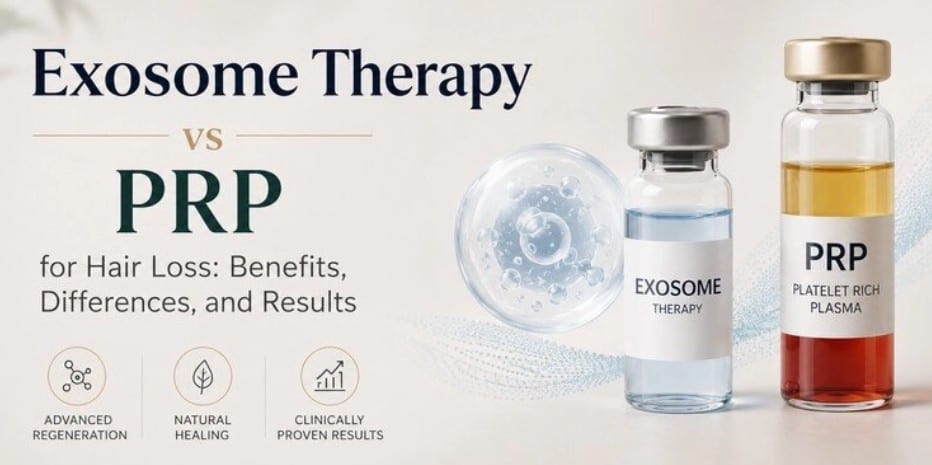
PRP and exosomes after the operation: do they help growth?
Some clinics offer PRP or exosomes as a "boost" after the transplant. Here is what is known.
The idea behind it
Both PRP and exosomes contain growth factors, and the idea is to use them as a "boost" around a transplant. By injecting them into the scalp the hope is to speed up healing, improve the survival of the newly placed grafts and strengthen the surrounding existing hair.
Some clinics offer it as an integrated part of the package, others as an add-on after the procedure. The timing is typically around the operation and during the growth phase.
PRP vs. exosomes, what is the difference?
PRP (platelet-rich plasma) is prepared from your own blood, which is centrifuged to concentrate the platelets and their growth factors. It is well established, autologous and low risk.
Exosomes are far newer: tiny "messenger vesicles", often derived from stem cells, that carry signalling substances. They are marketed as a next generation, but they are less standardised, more expensive and unresolved in regulatory terms in many countries.
What does the evidence say?
For PRP the evidence is promising but moderate: several studies point to a beneficial effect on hair density and healing, but protocols and results vary. For exosomes the evidence is at an even earlier stage and more limited, and much of it rests on theory and small studies rather than robust clinical data.
Neither is documented as necessary for a good transplant result. They are possible enhancers, not the foundation.
Get a free hair analysis
- 1Start
- 2Info
- 3Done
Realistic expectations
The most important thing to hold on to: the basis of a good result is the surgeon's technique, graft survival and your aftercare, not a purchased boost. At best PRP and exosomes can give a marginal advantage; they cannot rescue a poorly executed procedure.
See it as "may help a little", not "decisive". Be sceptical too if a clinic sells expensive exosome treatments as a must, that can be more business than medicine.
How to approach it
If you want to add PRP or exosomes, do it as a deliberate, informed choice, not under sales pressure on the day of surgery. Ask about the price, the evidence and what the clinic has experienced itself. Always prioritise the basic quality factors first.
In any case, follow your clinic's aftercare protocol, which matters far more for the result than any optional extra.
Regulation and safety
There is an important difference in how well tested the two treatments are. PRP is autologous (your own blood) and therefore has a low risk profile and a well established place. Exosomes, by contrast, are a newer, less standardised product whose regulation and safety vary from country to country, and in some places they are not approved for this purpose at all.
Be extra critical, therefore, if a clinic sells expensive exosome treatments as a "must". Ask about the product's origin, approval and evidence. The foundation of your result is still the surgeon's technique and your aftercare, not a purchased boost.
Note as well that an add-on should never be pushed through on the day of surgery, when your negotiating position is weak. Decide in advance, on the basis of evidence and price, not in the chair while you are already half anaesthetised.
© IdealofMeD Research Academy. Republished with permission.
Get a no-obligation assessment against fixed criteria, directly on WhatsApp.