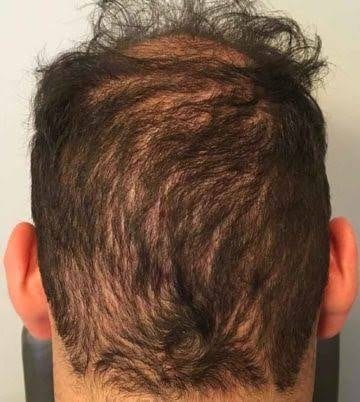
Donor area depletion after multiple sessions
Depletion accumulates across sessions because each one extracts from a zone already reduced by the last.
Depletion accumulates across sessions because each one extracts from a zone already reduced by the last. It is a documented complication of follicular unit excision with no restorative treatment, and it is the long-term cost of reactive rather than planned surgery.
Why does donor depletion matter in long-term hair transplant outcomes?
Donor depletion is the one long-term hair transplant outcome that is irreversible — unlike a thin result or a bad hairline, a depleted donor area cannot be restored. It is listed among the recognised donor-area complications of follicular unit excision, alongside hypopigmentation, hypertrophic scarring and epithelial cysts, yet nobody photographs it because it sits behind you.
Why do later hair transplant sessions deplete the donor area faster than earlier ones?
Sessions are not independent: the first extracts from full donor density, but each later session extracts from an already-reduced zone, so the same graft number represents a larger proportional loss. Illustratively, an area at 70 follicular units per cm² losing 20 twice falls from 50 to 30, visibly thin; a third 20 would leave 10.
The key point is that sessions are not independent transactions.
The first session extracts from a donor zone at its original density. The second extracts from the same zone at a reduced density, so the same absolute graft number represents a larger proportional loss. The third is larger again.
Illustratively: an area at 70 follicular units per cm² that gives up 20 is left at 50 — still viable. Another 20 leaves 30, which reads as visibly thin. A third 20 would leave 10, which is not a donor area at all.
The numbers are illustrative rather than a rule, but the shape is real. The safe margin shrinks faster than the graft count suggests, which is why a plan of three equal sessions is not a plan.
What besides donor density accumulates across multiple hair transplant sessions?
Four things accumulate besides density: dot scars, needing progressively longer hair to hide each session; reduced camouflage as lower density leaves less hair to cover old scars, compounding rather than adding; harvest-area drift toward the crown, nape or temples into less permanent zones as the centre is worked out; and fibrosis, which raises transection.
- Dot scars. Each session adds to the same finite surface area. The hair length at which they become visible rises with every procedure.
- Reduced camouflage. Lower remaining density means less hair to cover the scars from all previous sessions, so the two effects compound rather than add.
- Harvest area drift. Later sessions reach further out — higher toward the crown, lower toward the nape, forward into the temporal region — because the centre is worked out. Those are exactly the areas where grafts are least reliably permanent.
- Fibrosis. Previously harvested tissue can be firmer, making extraction harder and raising transection.
What is the difference between planned and reactive multi-session hair transplant staging?
Planned staging estimates lifetime reserve, projects the worst-case pattern, and allocates grafts across sessions with a number held back, explained before surgery. Reactive staging addresses only the current pattern, then answers each new gap with another session as it appears. Both involve multiple procedures, but only planned staging leaves donor hair available at fifty.
There is a real distinction here, and it decides the long-term outcome.
Planned staging means the lifetime reserve was estimated, the worst-case pattern was projected, grafts were allocated across sessions with a specific number held back, and you were told all of it before the first operation. That is good donor management.
Reactive staging means the first session addressed the pattern as it was, the pattern continued, a gap appeared, and a second session dealt with it. Then a third. Each step was competent; nobody budgeted.
Both produce a patient with multiple procedures. Only one ends with donor hair still available at fifty.
What signals indicate that another hair transplant session is unwise?
Five signals argue against a further session: donor density near or below roughly 50 follicular units per cm², dot scars visible at normal hair length, the harvest needing to leave the defined safe zone, trichoscopy showing donor miniaturisation, or a crown target while the pattern progresses. A surgeon who declines is giving you clinical information.
- Measured donor density near or below roughly 50 follicular units per cm² across the harvested zone.
- Dot scars visible at your normal hair length.
- The harvest would have to leave the previously defined safe zone.
- Trichoscopy shows miniaturisation in the donor area.
- The target is the crown and the pattern is still progressing.
A surgeon who declines is giving you clinical information. A clinic that can always find grafts is telling you something different.
What options remain for patients with a depleted hair transplant donor area?
Depleted patients are left with camouflage rather than restoration: scalp micropigmentation, which costs no donor supply and works well at short hair lengths; beard or body hair if those reserves survive; medical therapy to preserve native hair; and a hair length suited to what remains. None of these restores the reserve itself.
What the donor can support over a lifetime is the subject of donor supply.
Sources
- Romera de Blas C, Vega Díez D, Ricart Vayá JM, Gómez Zubiaur A. Complications in follicular unit excision hair transplantation: current evidence and practical approaches. Frontiers in Medicine, 2026;13:1750989. pubmed.ncbi.nlm.nih.gov/41709896
- Jimenez F, Ruifernández JM. Distribution of human hair in follicular units. A mathematical model for estimating the donor size in follicular unit transplantation. Dermatologic Surgery, 1999;25(4):294-298. pubmed.ncbi.nlm.nih.gov/10417585
- Maas D, et al. Rethinking the occipital scalp as a control in advanced androgenetic alopecia. Journal of the American Academy of Dermatology, 2026 (ahead of print). pubmed.ncbi.nlm.nih.gov/42398778
- Umar S, Khanna R, Maldonado JC, Chouhan K, Gonzales A. Beard and Body Hair Transplantation by Follicular Unit Excision Using a Skin-Responsive Device: A Multicenter Study. Dermatologic Surgery, 2024;50(3):306-308. pubmed.ncbi.nlm.nih.gov/38127669
- Rassman WR, Bernstein RM, McClellan R, Jones R, Worton E, Uyttendaele H. Follicular unit extraction: minimally invasive surgery for hair transplantation. Dermatologic Surgery, 2002;28(8):720-728. pubmed.ncbi.nlm.nih.gov/12174065
This article summarises published research and standard clinical practice. It is general educational information, not medical advice, and it does not replace the instructions your own surgical team gives you. Where their guidance differs from anything here, follow theirs.
Get a no-obligation assessment against fixed criteria, directly on WhatsApp.