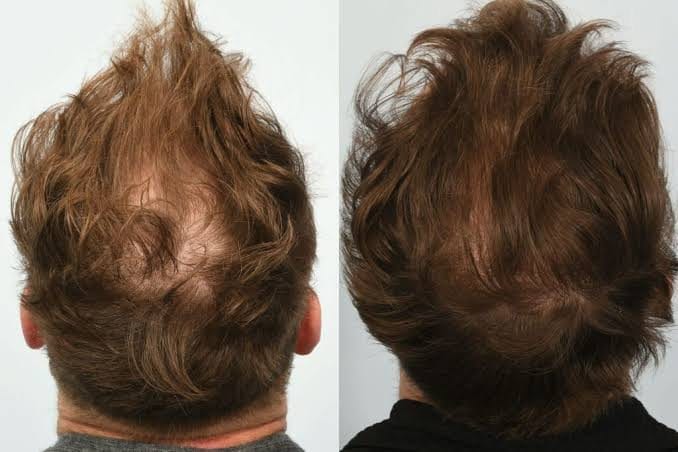
Long-term crown coverage: does it hold
The grafts hold; the crown around them keeps expanding.
The grafts hold; the crown around them keeps expanding. Because crown loss grows radially, transplanted crown coverage in a progressing pattern becomes an island unless the reserve can keep pace — which it usually cannot.
Do transplanted crown grafts fall out as the crown continues to bald?
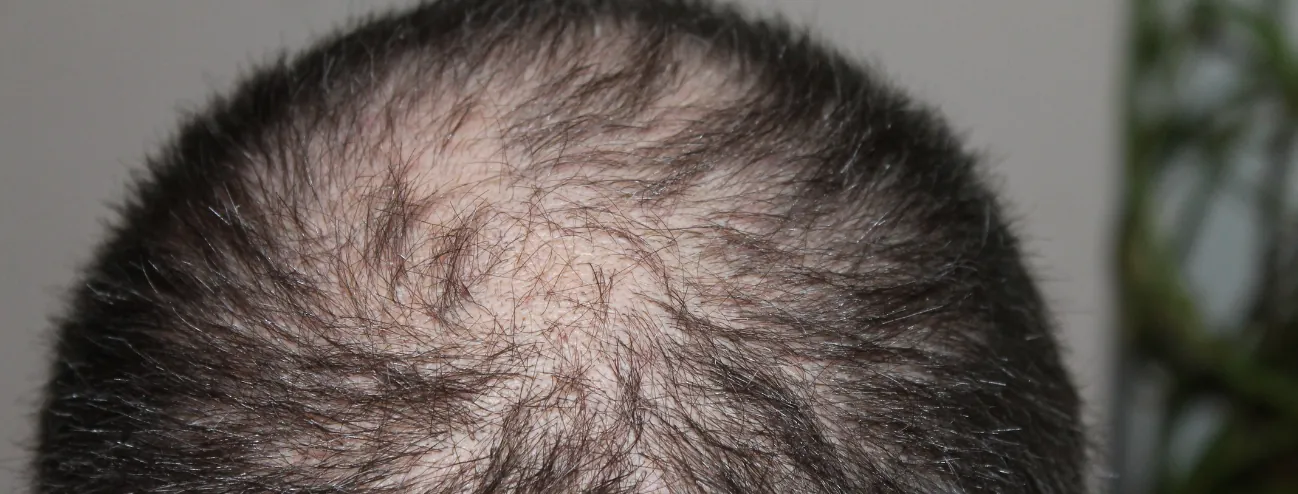
No, the grafts persist and are largely resistant to DHT, just like frontal grafts. What fails is the boundary: as crown loss expands outward, grafts placed at the former edge become surrounded by newly bald scalp within a few years, which is why crown results disappoint more often than frontal ones, typically by year five.
Transplanted crown grafts come from the same safe donor zone as frontal grafts and behave the same way. They are largely resistant to DHT and generally persist.
What does not hold is the boundary. Crown loss expands outward, and grafts placed at the edge of a bald crown find themselves surrounded by newly bald scalp within a few years. The transplanted patch is still there; it is simply no longer the edge of anything.
This is why crown results disappoint more often than frontal ones, and why the disappointment usually arrives at year five rather than year one.
Why is crown coverage more expensive than other areas in a hair transplant?
Crown coverage is expensive because bald area grows with the square of the radius (doubling the radius quadruples grafts needed), the spiral whorl pattern consumes grafts on angle work without adding coverage, and the crown needs higher density than the frontal scalp to read as covered. It competes with the frontal third for limited grafts.
- Radial expansion. A circular bald area whose radius grows means an area growing with the square of the radius. Doubling the radius quadruples the grafts required.
- The whorl. Crown hair grows in a spiral, so recreating a natural appearance requires angle and direction work that consumes grafts without adding coverage.
- High density needed. The crown is viewed from above at an angle that exposes scalp readily, so it needs more grafts per square centimetre than the frontal scalp to read as covered.
- It competes with the front. Grafts spent on the crown are grafts unavailable for the frontal third, which is what frames the face.
Put together: the crown is the most graft-hungry region, in the pattern most likely to keep expanding, in service of the area other people see least.
Why does hair transplant treatment prioritize the frontal third over the crown?
Treatment prioritizes the frontal third because a restored frontal third with a thinning crown reads as ordinary maturing male hair, while the reverse — a covered crown with a receded front — looks odd, since that pattern doesn't occur naturally. With limited reserve, the frontal third gives the most benefit per graft, so crown work is deferred.
When does crown transplant work make sense?
Crown work makes sense once the pattern has settled, typically in older patients whose crown has stopped expanding, when adequate reserve remains after the front is covered, and when the patient is on medical therapy, the only thing that slows expansion. Realistic partial coverage often looks better than a full-density attempt that exhausts the reserve.
- A settled pattern. Older patients whose crown has stopped expanding are the best candidates, because the boundary will hold.
- Adequate reserve after the front is covered. Crown work should be funded from what is left, not from what the front needs.
- Realistic density expectations. Partial coverage that breaks up the contrast often looks better than an attempt at full density that exhausts the reserve.
- Medical therapy in place, which is the only thing that slows the expansion.
- Micropigmentation considered. In the crown specifically, SMP reduces contrast effectively, costs no donor supply, and is frequently a better use of resources than grafts.
What questions should I ask before agreeing to crown hair transplant work?
Before agreeing to crown work, ask how much the crown is likely to expand over the next fifteen years, what happens to these grafts if it expands past them, how many grafts it consumes and what that leaves for the front, and whether micropigmentation would achieve more for the cost.
- How much is my crown likely to expand over the next fifteen years?
- What happens to these grafts if it expands past them?
- How many grafts does this consume, and what does it leave for the front?
- Would micropigmentation achieve more here for what it costs?
- Am I on medical therapy, and if not, why are we operating on an expanding area?
A surgeon who declines crown work in a young progressing patient is not being unhelpful. They are declining to spend your reserve on the region least likely to hold.
Sources
- Maas D, et al. Rethinking the occipital scalp as a control in advanced androgenetic alopecia. Journal of the American Academy of Dermatology, 2026 (ahead of print). pubmed.ncbi.nlm.nih.gov/42398778
- Jimenez F, Ruifernández JM. Distribution of human hair in follicular units. A mathematical model for estimating the donor size in follicular unit transplantation. Dermatologic Surgery, 1999;25(4):294-298. pubmed.ncbi.nlm.nih.gov/10417585
- Gupta AK, Venkataraman M, Talukder M, Bamimore MA. Finasteride for hair loss: a review. Journal of Dermatological Treatment, 2022;33(4):1938-1946. pubmed.ncbi.nlm.nih.gov/34291720
- Romera de Blas C, Vega Díez D, Ricart Vayá JM, Gómez Zubiaur A. Complications in follicular unit excision hair transplantation: current evidence and practical approaches. Frontiers in Medicine, 2026;13:1750989. pubmed.ncbi.nlm.nih.gov/41709896
- Long-term (5-year) multinational experience with Finasteride 1 mg in the treatment of men with androgenetic alopecia. European Journal of Dermatology, 2002. pubmed.ncbi.nlm.nih.gov/11809594
This article summarises published research and standard clinical practice. It is general educational information, not medical advice, and it does not replace the instructions your own surgical team gives you. Where their guidance differs from anything here, follow theirs.
Get a no-obligation assessment against fixed criteria, directly on WhatsApp.