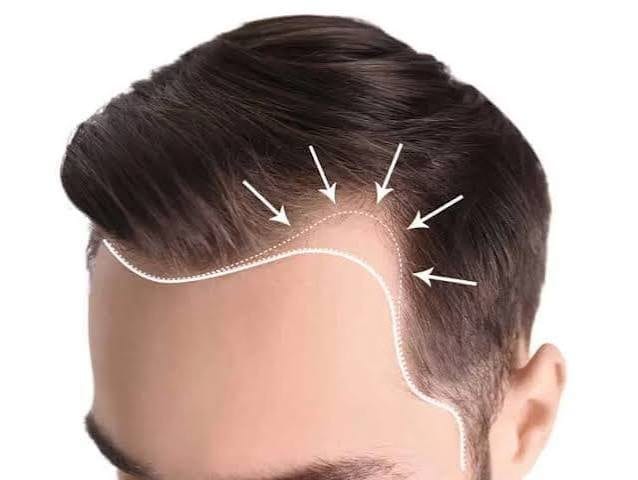
Long-term temple point stability
Rebuilt temple points sit in a region that continues to recede around them.
Rebuilt temple points sit in a region that continues to recede around them. The grafts persist, but the surrounding recession narrows the frontal band and makes an aggressively restored temple look progressively less natural.
What are temple points and why do they matter in a hair transplant?
Temple points are the small triangular projections of hair at the front corners of the hairline, above and in front of the ears. Because they frame the face, losing them changes facial shape more noticeably than equivalent loss elsewhere — which is why patients want them restored and why mistakes are conspicuous.
What happens to temple point grafts in the long term?

Transplanted temple grafts persist because they come from the safe donor zone, but the native hair around them keeps receding as part of the ongoing androgenetic pattern. Over ten to twenty years this isolates the rebuilt temple point, producing a dense frontal band framed by thinning scalp that reads as constructed rather than natural.
Transplanted temple grafts come from the safe donor zone and generally persist. The native hair around them does not.
Temporal recession continues on its own schedule as part of the androgenetic pattern. A rebuilt temple point in a still-receding temporal region becomes progressively more isolated — a projection of hair with thinning scalp behind and above it.
Over ten to twenty years this contributes to the characteristic ageing failure of aggressive hairline work: a dense frontal band, narrowed from both sides by continuing recession, sitting in front of a thinning scalp. Each element persisted exactly as placed; the combination reads as constructed.
Why is temple point transplantation such an unforgiving technique?
Temple point transplants are unforgiving because they demand fine, single hairs placed at almost flat, downward-backward angles that native temple hair naturally follows. Coarse grafts, multi-hair grafts, wrong angles, or over-filled density are permanent and unmistakable errors, and because faces are viewed directly, any asymmetry between the two temple points is easily noticed.
- Hair calibre must be fine. Temple hair is naturally finer than occipital hair. Coarse grafts placed there look wrong permanently. Fine temporal or nape hair is sometimes used specifically for this, in small numbers.
- Angles are almost flat. Temple hair lies close to the scalp and points sharply downward and backward. Recipient sites must be created at that angle, and an error is visible for life.
- Single hairs only. Multi-hair grafts in a temple point are unmistakable.
- Density must be conservative. Natural temple points are not dense. An over-filled temple is one of the more recognisable signs of a transplant.
- Symmetry is scrutinised. Faces are looked at directly, and asymmetric temple points are noticed.
Why do surgeons deliberately leave some temporal recession when designing a hairline?
Surgeons often design in some temporal recession deliberately, creating a mature hairline that reflects an adult man's natural recession, because that design ages well as recession continues. Full juvenile temple points look wrong over time since no older man has them, and resistant patients are usually comparing themselves to photos from their twenties.
The conservative approach is to leave some temporal recession in the design — a mature hairline shape that includes the recession an adult man naturally has.
This ages well because it moves with the process rather than against it. As recession continues, a design that already accommodated it continues to look correct. A design that rebuilt full juvenile temple points does not, because no older man has them.
This is the same argument as hairline height, applied at the corners, and patients resist it for the same reason: they are comparing against photographs of themselves at twenty.
What should you ask a surgeon about temple point restoration before agreeing?
Ask what hair and calibre will be used, how many grafts, whether all are single-hair, how the result will look if temples keep receding for fifteen years, and whether you can see twelve-month healed results. A surgeon recommending minimal temple restoration in a young, still-receding patient is choosing the option that ages best.
- Are you rebuilding temple points, and how far forward?
- What hair are you using for them, and what calibre?
- How many grafts, and are they all single-hair?
- What does this look like if my temples continue to recede for another fifteen years?
- Can I see healed temple work at twelve months in your own patients?
A surgeon proposing minimal or no temple point restoration in a young patient with continuing recession is making the choice that ages best. A clinic offering full juvenile temple points is selling a photograph rather than a twenty-year result.
Sources
- Maas D, et al. Rethinking the occipital scalp as a control in advanced androgenetic alopecia. Journal of the American Academy of Dermatology, 2026 (ahead of print). pubmed.ncbi.nlm.nih.gov/42398778
- Jimenez F, Ruifernández JM. Distribution of human hair in follicular units. A mathematical model for estimating the donor size in follicular unit transplantation. Dermatologic Surgery, 1999;25(4):294-298. pubmed.ncbi.nlm.nih.gov/10417585
- Rassman WR, Bernstein RM, McClellan R, Jones R, Worton E, Uyttendaele H. Follicular unit extraction: minimally invasive surgery for hair transplantation. Dermatologic Surgery, 2002;28(8):720-728. pubmed.ncbi.nlm.nih.gov/12174065
- Xu Y, et al. Case Report: Paired vertex-occipital assessment reveals donor-area involvement in diffuse unpatterned alopecia. Frontiers in Medicine, 2026;13:1797275. pubmed.ncbi.nlm.nih.gov/41982548
- Romera de Blas C, Vega Díez D, Ricart Vayá JM, Gómez Zubiaur A. Complications in follicular unit excision hair transplantation: current evidence and practical approaches. Frontiers in Medicine, 2026;13:1750989. pubmed.ncbi.nlm.nih.gov/41709896
This article summarises published research and standard clinical practice. It is general educational information, not medical advice, and it does not replace the instructions your own surgical team gives you. Where their guidance differs from anything here, follow theirs.
Get a no-obligation assessment against fixed criteria, directly on WhatsApp.