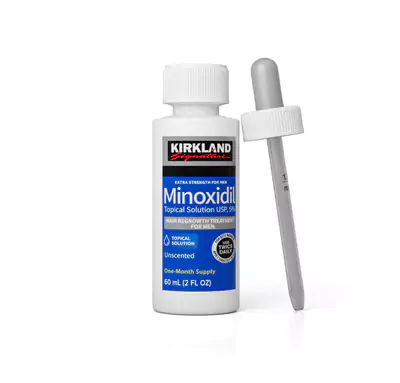
Low-dose oral Minoxidil: the emerging evidence
A drug developed for high blood pressure has become one of the most widely discussed hair-loss treatments in dermatology. This review sets out what the published evidence supports, and where it runs out.
Low-dose oral Minoxidil is prescribed off-label for hair loss and is supported by a growing but still uneven evidence base. Observational data show a dose-dependent effect on hair density, a large multicentre safety study found adverse effects were mostly cosmetic and rarely caused withdrawal, and a 2024 randomised trial found oral Minoxidil was not superior to topical Minoxidil on its primary measure. An international consensus published the same year set out starting doses, contraindications and monitoring.
Why has low-dose oral Minoxidil suddenly become popular?
Minoxidil was developed in the 1970s as an oral hypertension drug; its side effect of unwanted hair growth led to a topical version, the first approved pattern-hair-loss treatment. Dermatologists now prescribe the original tablet at low, off-label doses, called low-dose oral Minoxidil (LDOM); no regulator has approved a Minoxidil tablet for hair loss.
Minoxidil was developed in the 1970s as an oral treatment for severe hypertension. Its most conspicuous side effect, unwanted hair growth, is what eventually made it famous: reformulated as a topical solution, it became the first drug licensed anywhere for pattern hair loss. For four decades that was the only approved way to use it on hair.
What has changed is that dermatologists began prescribing the original tablet again, at doses far below the blood-pressure range, specifically to grow hair. This is low-dose oral Minoxidil, usually abbreviated LDOM. It is prescribed off-label. Only topical Minoxidil and Finasteride 1 mg are formally approved for androgenetic alopecia, and no regulator has approved a Minoxidil tablet for hair loss.
Off-label does not mean unstudied, and it does not mean improper. A great deal of routine medicine is off-label. But it does mean the evidence sits in a different place than it would for an approved drug: assembled from observational series, retrospective cohorts and a small number of trials, rather than from the large registration studies a licence requires. That distinction runs through everything below.
The sections below stick to what has been measured. If you are weighing medical treatment against surgery, our guide to non-surgical treatment of hair loss covers the wider set of options.
What does "low dose" mean for oral Minoxidil?
For hair loss, low-dose oral Minoxidil (LDOM) means any daily dose below 5 mg, typically 0.5-1 mg for women and 2.5-5 mg for men, far under the tens-of-milligrams range used for hypertension. The 2024 international consensus set starting doses of 1.25 mg/day for women and 2.5 mg/day for men.
For hypertension, Minoxidil is given in the tens of milligrams. For hair, the doses are a fraction of that. Conventionally, LDOM refers to any daily dose below 5 mg, and in practice most prescribing sits well under that ceiling.
Typical ranges reported in the literature are roughly 0.5 to 1 mg daily for women and 2.5 to 5 mg daily for men, usually started lower and increased according to tolerance and response. The 2024 international consensus described below settled on starting doses of 1.25 mg/day for adult women and 2.5 mg/day for adult men.
Why the tablet at all, when a solution exists
The argument for the tablet is mostly practical. Topical Minoxidil has to be applied once or twice a day, every day, to a dry scalp; it can leave residue, irritate the skin, and interact badly with styling. Adherence to topical treatment is a well-known weak point. A tablet removes the daily application problem entirely and reaches the whole scalp evenly, including areas people apply badly or forget.
The argument against is equally practical: a systemic drug produces systemic effects, and hair growth is not confined to the scalp.
What does the dose-response research show for oral Minoxidil?
A 2022 meta-regression of six studies found each extra 1 mg/day of low-dose oral Minoxidil was linked to +47.1 hairs/cm² total density, +9.1 hairs/cm² terminal density and +1.4 μm shaft diameter at six months, but side effects rose too; the analysis was ecological, so it shows association, not proof of cause.
The most useful synthesis to date is a systematic review with meta-regression by Gupta and colleagues, published in Skin Appendage Disorders in 2022. It pooled six eligible studies covering doses from 0.25 mg to 5 mg daily and asked a specific question: as the dose rises, does the effect rise with it?
It did. Per additional 1 mg/day, after six months, the analysis found:
- Total hair density: +47.1 hairs/cm² (p = 0.007)
- Terminal hair density: +9.1 hairs/cm² (p = 0.001)
- Hair shaft diameter: +1.4 μm (p = 0.013)
The same analysis found the unwanted effects scaled too: hypertrichosis rose 17.9% (p = 0.006) and cardiovascular adverse events 4.8% (p = 0.004) per additional 1 mg/day. Benefit and burden move together, which is the central trade-off in dosing this drug.
How much weight this deserves
The authors were explicit about the main limitation. The analyses were ecological: they compared group-level averages across studies, not individual patients within a randomised comparison. That design can establish an association and cannot establish cause. The authors themselves wrote that randomised trials would be needed to produce causal evidence.
So the honest reading is: across the studies published so far, higher doses have gone with better measured outcomes, and that pattern is consistent enough to take seriously as a guide to prescribing. It is not the same as proof that raising your dose will raise your hair count.
Is oral Minoxidil more effective than topical Minoxidil?
In a 2024 randomised trial of 90 men, oral Minoxidil 5 mg was not shown superior to topical Minoxidil 5% on terminal hair density at 24 weeks (differences of 3.1 and 23.4 hairs/cm² were not significant). Hypertrichosis affected 49% on oral versus 25% on topical; more people stopped topical treatment for side effects.
The obvious question is whether the tablet beats the solution. In 2024, Penha and colleagues published the most direct answer available, in JAMA Dermatology: a double-blind, placebo-controlled randomised trial comparing oral Minoxidil 5 mg once daily against topical Minoxidil 5% twice daily in men with androgenetic alopecia.
Ninety men were randomised, 45 to each arm, and 68 completed the 24-week study. The primary outcome was terminal hair density.
The result
Oral Minoxidil was not shown to be superior. The between-group differences in terminal hair density were 3.1 hairs/cm² in the frontal area (p = .27) and 23.4 hairs/cm² at the vertex (p = .09). Neither reached statistical significance.
A secondary, photographic assessment did favour the tablet at the vertex: a 24% difference (95% CI, 0 to 48; p = .04). The frontal scalp showed no difference on the same measure (12%; 95% CI, −12 to 36; p = .24). A confidence interval whose lower bound touches zero is a weak result, and it came from a secondary endpoint, so it should be read as a hint rather than a finding.
Side effects in the two arms
Hypertrichosis affected 49% of the oral group and 25% of the topical group. Headache affected 14% of the oral group. The topical group had the problems topical treatment usually causes: scalp eczema in 16% and itching in 11%. More people stopped topical treatment than oral treatment because of side effects: three against one.
In practice, the trial found that at these doses and over 24 weeks, the tablet performed comparably to a treatment you can buy without a prescription, while carrying a systemic side-effect profile. For someone who cannot tolerate the solution or will not keep using it, that comparability is itself the argument for the tablet.
What does the largest safety study of low-dose oral Minoxidil show?
A 2021 retrospective study of 1 404 patients on low-dose oral Minoxidil for at least three months found hypertrichosis in 15.1%, the most common effect, while lightheadedness, fluid retention and tachycardia each affected under 2%. Only 1.7% of patients stopped treatment overall because of an adverse effect.
The largest safety dataset comes from a retrospective multicentre study by Vañó-Galván and colleagues, published in the Journal of the American Academy of Dermatology in 2021. It covered 1 404 patients treated with LDOM for at least three months for any type of alopecia: 943 women (67.2%) and 461 men (32.8%), mean age 43, range 8 to 86.
What was observed
- Hypertrichosis, 15.1%: by far the most common effect, and the one people underestimate. It led to withdrawal in 14 patients (0.5%).
- Lightheadedness, 1.7%
- Fluid retention, 1.3%
- Tachycardia, 0.9%
- Headache, 0.4%
- Periorbital oedema, 0.3%
- Insomnia, 0.2%
Systemic adverse effects led to discontinuation in 29 patients (1.2%). Both withdrawal percentages are calculated on 2 469 cases rather than 1 404 patients, because patients whose dose was changed were analysed once per dose. Across all causes, only 1.7% of the cohort stopped treatment because of an adverse effect.
Reading this honestly
Those are reassuring numbers, and they are the reason prescribing has expanded so quickly. Two caveats belong alongside them. First, the study was retrospective, so it captured what was recorded in notes rather than what was systematically sought; mild effects are almost certainly undercounted. Second, hypertrichosis is described in clinical language as a minor cosmetic effect, but for a patient it can mean noticeable hair on the face, forearms or back. At roughly one in seven, it is common enough that it should be discussed before the first tablet, not after.
What does the 2024 international consensus say about starting low-dose oral Minoxidil?
A November 2024 JAMA Dermatology Delphi consensus of 43 dermatologists across 12 countries agreed on 76 items covering low-dose oral Minoxidil, setting starting doses of 1.25 mg/day for women and 2.5 mg/day for men, listing contraindications such as heart failure and pregnancy, and stating efficacy should be expected within three to six months.
In November 2024, JAMA Dermatology published an international modified Delphi consensus statement on initiating LDOM. Forty-three dermatologists across twelve countries reached agreement on 76 items covering diagnoses, indications, dosing, contraindications, baseline evaluation, monitoring and referral. For an off-label treatment, this is the closest thing to a practice standard currently available.
Dosing
Commonly prescribed starting doses for adults aged 18 and over were 1.25 mg/day for women and 2.5 mg/day for men. For adolescents aged 12 to 17, the panel described 0.625 mg/day for girls and 1.25 mg/day for boys.
Contraindications
The panel listed hypersensitivity to Minoxidil, significant drug-drug interactions, a history of pericardial effusion or tamponade, pericarditis, heart failure, pulmonary hypertension associated with mitral stenosis, phaeochromocytoma, and pregnancy or breastfeeding.
Precautions
A history of tachycardia or arrhythmia, hypotension, renal impairment, and being on dialysis were listed as precautions rather than absolute barriers, meaning they call for assessment rather than automatic exclusion.
Timeframe
The earliest point at which the panel expected LDOM to demonstrate efficacy was three to six months. This matters for expectation-setting: a person who concludes at week six that the drug is not working has not yet given it long enough to judge.
A consensus statement is expert agreement, not experimental evidence. It represents the considered judgement of clinicians who prescribe this drug regularly, which is valuable precisely where trial data is thin, but it does not carry the weight of a randomised comparison.
How does low-dose oral Minoxidil interact with a hair transplant?
Medication and surgery do different jobs: a transplant moves existing hair into thin areas, while Minoxidil works on the hair still there, and because surgery does not stop pattern loss elsewhere, many patients combine the two. Tell your surgeon if you take Minoxidil, since it is a vasodilator; starting it shortly before surgery can make its early shedding hard to tell apart from post-operative shock loss.
Medication and surgery answer different questions. A transplant redistributes hair you still have into areas where it has gone. Medication works on the hair that is still there, aiming to slow or partly reverse miniaturisation. Neither replaces the other, and combining them well takes some planning.
Why the native hair still matters after surgery
A transplant does not stop pattern hair loss in the untouched areas around the graft zone. If native hair continues to thin behind a newly restored hairline, the result can drift out of balance within a few years even though the transplanted hair itself is doing exactly what it should. This is the standard argument for combining surgery with ongoing medical treatment, and it applies to oral and topical Minoxidil alike.
Timing and disclosure
Two practical points follow. First, any hair-loss medication you take belongs on your surgical consultation form, along with everything else you take, because Minoxidil is a vasodilator and your surgeon needs to know. Second, if you start LDOM shortly before surgery, the early shedding phase that Minoxidil can provoke may overlap with post-operative shock loss, which makes both harder to interpret. Our aftercare guide covers the normal post-operative shedding timeline.
If you are still deciding whether surgery is the right route at all, our guide to whether you are a candidate works through the criteria, and women should start with the women's hair loss guide, because both the diagnosis and the drug options differ for women.
What are the unanswered questions about low-dose oral Minoxidil?
The evidence has real gaps: long-term cardiovascular safety beyond a few months is unproven, the optimal dose is unknown though side effects rise with dose, oral Minoxidil has not been shown superior to topical, its combination with Finasteride or a transplant has not been tested in controlled studies, and the course of hair loss after stopping it is not well described.
An honest summary has to include the gaps, because they are substantial.
- Long-term safety is not established. The largest safety dataset is retrospective and covers treatment from three months. Nobody has published a decade of prospective cardiovascular follow-up in healthy people taking this drug for cosmetic reasons.
- The optimal dose is unknown. The dose-response signal points upward, but the same analysis shows side effects rising in step. Where the best balance sits, for a given person, has not been determined by trial.
- Head-to-head superiority is unproven. The one randomised comparison against topical Minoxidil did not demonstrate it.
- Combination effects are under-studied. Most patients in practice take more than one thing. How LDOM performs alongside Finasteride, or alongside a transplant, has not been quantified in a controlled setting.
- Stopping has not been characterised. As with topical Minoxidil, gains are generally understood to depend on continued use, but the trajectory after stopping LDOM specifically has not been well described.
None of this argues against the drug. It argues for taking it as a prescribed treatment with monitoring, from a clinician who knows your cardiovascular history, rather than as a supplement ordered online.
What do people most often ask about low-dose oral Minoxidil?
Key facts: LDOM is prescribed off-label, not formally approved; the 2024 consensus expects results in three to six months; hypertrichosis affects 15.1% of patients and is reversible; anyone with heart or kidney issues needs assessment first; women can take it, unlike Finasteride; and it treats existing hair rather than replacing a transplant.
Is low-dose oral Minoxidil approved for hair loss?
No. It is prescribed off-label. Only topical Minoxidil and Finasteride 1 mg daily hold approval for androgenetic alopecia. Off-label prescribing is lawful and routine, but it places more responsibility on the prescribing clinician and on you.
How long before it works?
The 2024 international consensus put the earliest expected sign of efficacy at three to six months. Hair cycles slowly, and no hair-loss treatment shows its result faster than the follicle can grow.
Will it make hair grow elsewhere on my body?
Often, yes, to some degree. Hypertrichosis was recorded in 15.1% of 1 404 patients and in 49% of the oral arm of the 2024 randomised trial. It is dose-related and reversible on stopping, and it is the single most common reason people find the drug unacceptable.
Do I need my blood pressure or heart monitored?
That is a decision for your prescriber, informed by your history. The consensus statement listed cardiac and renal conditions as contraindications or precautions specifically because they change the calculation. Anyone with a heart condition, low blood pressure or kidney impairment should be assessed before starting.
Can women take it?
Yes, and women made up 67.2% of the largest safety cohort. Doses are typically lower than for men. This is a meaningful difference from Finasteride, which is not prescribed to women.
Should I take it instead of having a transplant?
They do different jobs. Medication acts on hair that is still present; surgery moves hair into areas where it has already gone. Where loss is early and hair is thinning rather than absent, medical treatment alone is often the more sensible first step.
Sources
- Gupta AK, et al. There Is a Positive Dose-Dependent Association between Low-Dose Oral Minoxidil and Its Efficacy for Androgenetic Alopecia: Findings from a Systematic Review with Meta-Regression Analyses. Skin Appendage Disorders, 2022. pmc.ncbi.nlm.nih.gov/articles/PMC9485924
- Vañó-Galván S, et al. Safety of low-dose oral Minoxidil for hair loss: A multicenter study of 1404 patients. Journal of the American Academy of Dermatology, 2021. pubmed.ncbi.nlm.nih.gov/33639244
- Penha MA, Miot HA, Kasprzak M, Müller Ramos P. Oral Minoxidil vs Topical Minoxidil for Male Androgenetic Alopecia: A Randomized Clinical Trial. JAMA Dermatology, 2024. pmc.ncbi.nlm.nih.gov/articles/PMC11007651
- Akiska YM, Mirmirani P, Roseborough I, Mathes E. Low-Dose Oral Minoxidil Initiation for Patients With Hair Loss: An International Modified Delphi Consensus Statement. JAMA Dermatology, 2025;161(1):87-95. pubmed.ncbi.nlm.nih.gov/39565602
This article reviews published research. It is general educational information, not medical advice, and it is not a recommendation to start or stop any medication. Low-dose oral Minoxidil is a prescription drug with cardiovascular contraindications; discuss it with a doctor who knows your medical history.
Get a no-obligation assessment against fixed criteria, directly on WhatsApp.