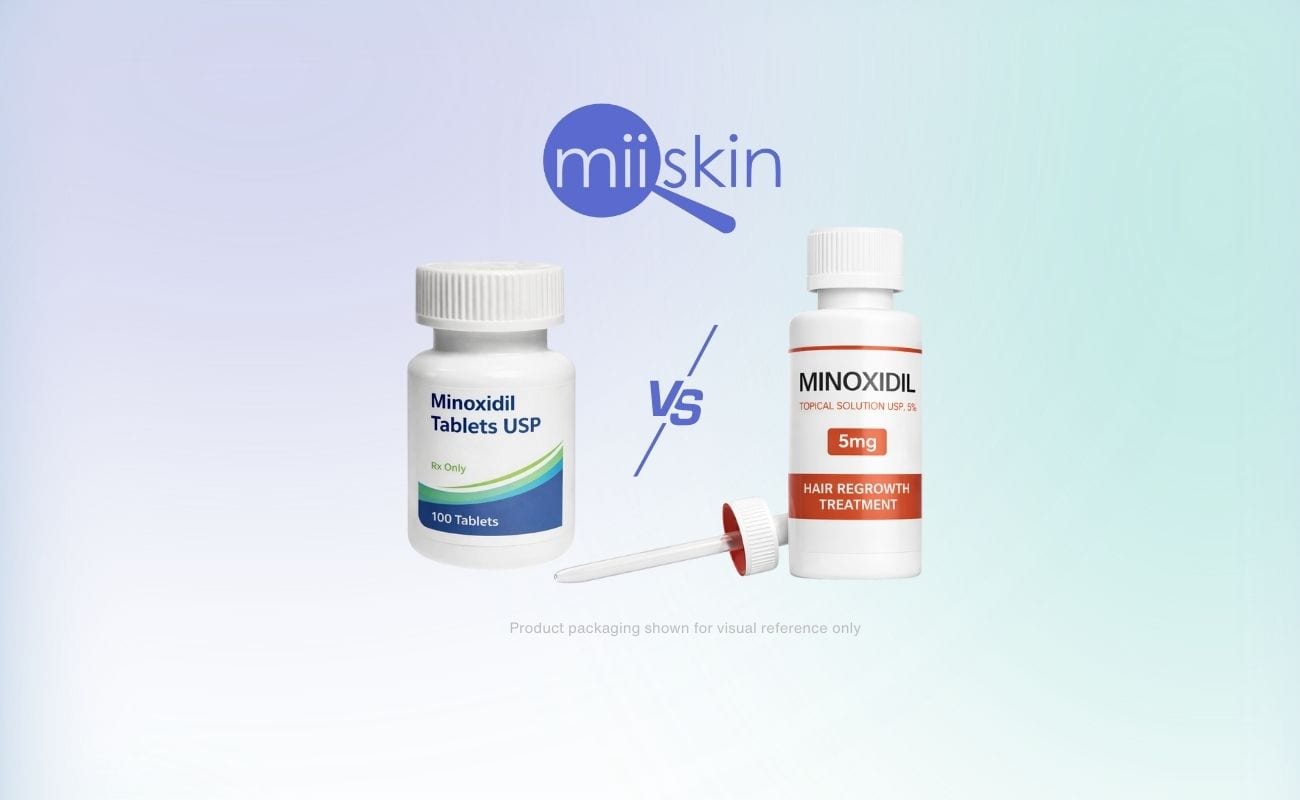
Oral or topical Minoxidil: tablets or liquid for hair loss?
Minoxidil comes both as a liquid/foam and as low dose tablets. I review the difference, the evidence, the side effects and when one makes more sense than the other.
Two forms of the same medicine
Minoxidil is one of the best documented treatments for hair loss, but many people do not know that it comes in two quite different forms. The classic and best known is topical Minoxidil, a liquid or foam applied directly to the scalp, typically in strengths of 2 % and 5 %. The newer but rapidly growing option is oral Minoxidil in the form of low dose tablets taken by mouth under medical supervision.
Both forms contain the same active substance and work through the same basic mechanism: they prolong the hair's growth phase and improve the blood supply around the follicle. But because one works locally and the other throughout the body, they differ markedly in practical terms, in side effect profile and in who they suit. As a surgeon I am asked about oral Minoxidil more and more often as it becomes widespread, and it is worth understanding the difference before you choose.
One thing up front: oral Minoxidil for hair loss is an off-label use at low dose, that is, the use of a medicine (originally a blood pressure drug) outside its officially approved purpose, but on a growing base of experience. That means it should always take place under medical guidance, never on your own initiative.
Topical Minoxidil: advantages and disadvantages
Topical Minoxidil has the longest experience and the widest availability behind it. It is applied directly where you want the effect, and because the action is local you largely avoid the circulatory side effects that can follow when the substance circulates through the whole body. For many it is the safe first choice, because the side effects stay confined to the scalp.
The disadvantages are practical. The liquid can be sticky, dry out the hair and contain propylene glycol, which causes itching and irritation in some people; the foam version partly solves this. The daily application, ideally twice, requires discipline, and many find it awkward to fit into everyday life, especially if they style their hair. Finally, a number of people find the effect on the crown is good but less pronounced at the hairline.
Perhaps the biggest practical disadvantage is the routine itself. A treatment that requires daily, careful application only helps if you actually keep it up, and this is where many give up. The effect disappears if you stop, so consistency is everything. For the disciplined, topical Minoxidil is an excellent, well documented tool; for someone who struggles with routines, the inconvenience can become a real barrier.
Oral Minoxidil: advantages and disadvantages
Low dose oral Minoxidil has become very popular for one obvious reason: it is easy. One small tablet a day replaces the daily, sticky application, and because the substance is distributed through the bloodstream it works on the whole scalp at once, including the areas that are hard to cover evenly with liquid. For patients who have struggled to keep up the topical routine, it can be the difference between a treatment that gets used and one that sits in the cupboard.
Many also report a good, even effect, and some even see benefit in places such as the beard and body hair. But because the substance works systemically, it comes with a different side effect profile. The most discussed are increased body hair (hypertrichosis), often on the face and body, along with possible circulatory effects such as slightly swollen ankles, palpitations or dizziness. These are usually dose dependent and manageable, but they require medical monitoring.
That is exactly why oral Minoxidil is not a do-it-yourself treatment. It requires a doctor's assessment of your cardiovascular health, a sensible starting dose and follow-up. Used correctly and monitored, it has become a convenient and effective tool for many, but it is not without reservations, and the systemic action has to be taken seriously.
What does the evidence say?
Topical Minoxidil has the most solid, approved documentation behind it; it is one of the best studied hair treatments there is and has been in use for decades. Low dose oral Minoxidil is newer in this role, but the evidence base is growing rapidly, and several studies and large clinical experience reports point to an effect at least on a par with the topical form, with the advantage that adherence is often better.
You should remember, though, that oral Minoxidil for hair loss remains an off-label use, which means it does not have the same formal approval status for this particular purpose. That does not make it ineffective (the base of experience is by now considerable), but it does underline that its use should take place under expert medical direction. Overall both forms stand strong; the difference lies less in whether they work and more in practicalities, side effects and suitability.
A comparison at a glance
| Topical | Oral | |
|---|---|---|
| Use | Daily application | One tablet daily |
| Action | Local | Systemic (the whole scalp) |
| Typical side effects | Dry/itchy scalp | Increased body hair, circulatory effects |
| Adherence | Requires discipline | Easy |
| Medical supervision | Rarely necessary | Necessary |
| Status | Approved | Off-label, low dose |
The table captures the essence: the topical form is safe and local, but inconvenient; the oral form is easy and even, but systemic and requires monitoring. There is no universally right answer, only what suits the individual patient's health, daily life and preferences.
Get a free hair analysis
- 1Start
- 2Info
- 3Done
Who does one suit rather than the other?
In my experience topical Minoxidil best suits the patient who wants to keep side effects strictly local, who has no difficulty with a daily routine, and who may be reluctant to take systemic medication. It is often the safe first choice, because the risk is so limited and the track record so long.
Oral Minoxidil, on the other hand, makes particularly good sense for someone who has repeatedly abandoned the topical routine, who wants an even effect across the whole scalp, or who finds the liquid unacceptably awkward or irritating. For this group, switching to a single daily tablet can be exactly what makes the treatment succeed, provided the heart and circulation are healthy and a doctor monitors the process.
Some even choose a combination or switch over time as their needs and tolerance change. The point is that the choice should be made individually and together with a doctor, not on the basis of what is most popular on the internet right now.
Minoxidil and hair transplantation
Whichever form you choose, Minoxidil often plays a role around a hair transplant. Because a transplant does not stop the hereditary loss of your original hair, Minoxidil is used, together with Finasteride, to protect and thicken the untransplanted hair so that the overall result stays natural over the years. Here the convenience of oral Minoxidil can for some make it easier to keep up the long term maintenance.
Some clinics also recommend pausing Minoxidil around the operation itself and resuming it later; this should always be settled with the operating clinic, since protocols vary. The central message is that Minoxidil in both forms belongs in the long term plan, not only in the immediate treatment.
Frequently asked questions
Is oral Minoxidil more dangerous than topical? Not necessarily more dangerous, but it has a different, systemic side effect profile (increased body hair, possible circulatory effects) and therefore requires medical monitoring, which the topical form rarely does.
Can I switch from liquid to tablet? Many people do exactly that because of the convenience, but the switch should be made in consultation with a doctor who can assess your suitability and set a sensible dose.
Does oral Minoxidil cause facial hair? Increased body hair, including on the face, is the most common side effect. It is dose dependent and typically subsides if the dose is adjusted or the treatment stopped.
Which works best? Both work well. For many the choice is less about effect and more about which form they can actually keep up, as well as their health and their tolerance of side effects.
A practical perspective from the consultation
When I talk to patients about Minoxidil, the conversation is rarely about whether the substance works (it does, and that is well documented). The conversation is almost always about which form suits their particular life. And here I have learned that the best treatment is not the one that is theoretically strongest, but the one the patient actually keeps up over months and years. An excellent treatment sitting unused in the bathroom cabinet helps nobody.
That is why I take adherence so seriously. I have seen countless patients start full of enthusiasm on the topical liquid, only to fall away after a few weeks because it was sticky, time consuming or itchy. For them the oral tablet has often been the rescue, not because it is more effective in itself, but because it is easy enough that they actually continue. For others, who are sceptical of systemic medication or have a circulation that argues against it, the local liquid is the safe and right choice.
The point is that the choice between oral and topical Minoxidil is as much a question of psychology and daily life as of pharmacology. An honest conversation about what your everyday life looks like, how disciplined you realistically are with routines, and how you feel about systemic medication leads more often to the right decision than an abstract discussion of which form is 'best'. The best form is the one you use.
Conclusion
Oral and topical Minoxidil are two forms of the same well documented medicine. The topical form is safe and local, but requires an awkward daily routine; the oral form is easy and works evenly across the whole scalp, but is systemic, off-label and requires medical monitoring because of side effects such as increased body hair and possible circulatory effects.
There is no single right choice, only what suits your daily life, your health and your ability to stick with the treatment. Make the decision together with a doctor, and regard Minoxidil, in whichever form, as a central part of the long term effort against hair loss. This article is for general information and does not replace an individual medical assessment.
Where Minoxidil sits against the other options is set out in our guide to slowing hair loss without surgery.
© IdealofMeD Research Academy. Republished with permission.
Get a no-obligation assessment against fixed criteria, directly on WhatsApp.