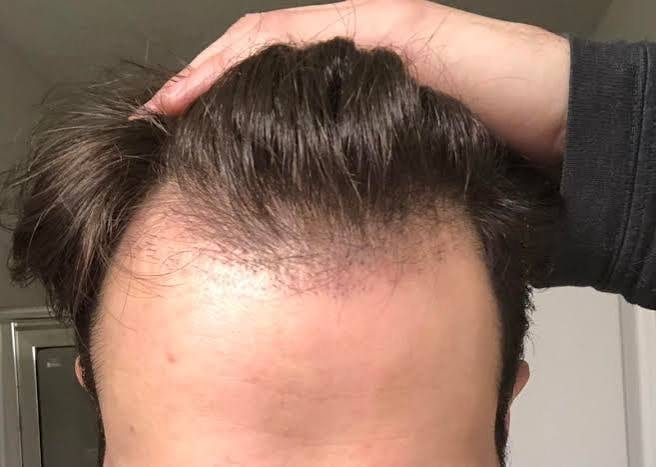
When touch-up procedures become necessary
Touch-ups fall into two categories: correcting something from the first session, and responding to further loss.
Touch-ups fall into two categories: correcting something from the first session, and responding to further loss. The first should be rare with good surgery; the second is expected and should have been budgeted for in advance.
What does 'touch-up' actually mean after a hair transplant?
Touch-up describes two different things: a small refinement of the first result (a few hundred grafts to add density, soften a hairline, or fix a minor irregularity, considered once results have matured) and a response to continued native hair loss (often one to two thousand grafts) which is really a second session, not a touch-up.
The word covers two situations that have almost nothing in common.
A refinement of the first result. Adding density to an area that came in thinner than planned, softening a hairline, adding single hairs at the leading edge, filling a small irregularity. These are typically a few hundred grafts and are considered once the first result has matured.
A response to continued loss. Native hair behind the transplanted zone has thinned, a gap has opened, and grafts are needed to close it. This is a second session in everything but name, often one to two thousand grafts, and calling it a touch-up understates both the cost and the donor consequence.
Clinics use the softer word for both, which is worth noticing when a quote arrives.
When should you assess whether a hair transplant needs a touch-up?
Wait until around twelve months to assess whether a hair transplant needs refinement: transplanted hair sheds at weeks two to three, regrows from months three to four, and reaches final appearance around month twelve, while the donor area's final density and scarring also aren't settled that early.
The conventional point is around twelve months, and the reason is that the result is not finished before then. Transplanted hair sheds at weeks two to three, regrows from around months three to four, and reaches its final appearance at about twelve months.
Assessing at six months means assessing an incomplete result, and patients who book corrective work at that stage frequently find the concern resolved on its own.
The donor area also needs the time. Its final density, dot scar visibility and recovery from any temporary shedding are not settled at six months either.
What actually justifies a hair transplant touch-up?
A refinement is warranted for lower-than-planned density in a defined area at twelve months, a hairline that reads too abrupt or regular, a small irregularity from poor growth, or temple point asymmetry — but not for dissatisfaction at three months, comparisons to another patient's photos, or wanting more density within normal expectations.
- Density lower than planned in a defined area at twelve months, confirmed against pre-operative photographs rather than memory.
- A hairline that reads too abrupt or too regular, correctable with fine single-hair grafts in front of and among the existing ones.
- A small irregularity or gap from an area of poor growth.
- Temple point asymmetry.
What does not warrant one: dissatisfaction at three months, comparison against another patient's photographs, or a general wish for more density in a result that is within normal expectations.
What should you do if a hair transplant touch-up is really about continued hair loss?
If continued native hair loss is driving further surgery, the answer is a full reassessment, not a small top-up: check whether the pattern has progressed beyond plan, what donor reserve remains, whether medical therapy is in place, and whether reserve is better spent on the mid-scalp — skipping this means a third session likely follows.
If the reason for further surgery is that native hair has thinned, the correct response is not a small top-up. It is a reassessment.
- Has the pattern progressed beyond what the original plan assumed?
- What does the donor area now measure, and what reserve remains?
- Is medical therapy in place, and if not, why not? Adding grafts to an untreated progressing pattern commits you to doing it again.
- Would the reserve be better spent on the mid-scalp than on adding density to a zone that is already covered?
A patient who has a second session without addressing the underlying process will need a third.
How often should hair transplant touch-ups happen?
There is no published rate for touch-up frequency after hair transplantation, but a refinement after a well-planned first procedure should be uncommon and small; frequent, large touch-ups across a clinic's patients suggest under-delivering first sessions or poor planning for progression, so it's fair to ask a clinic what proportion of patients need a second procedure.
There is no published rate — revision and touch-up frequency after hair transplantation is not systematically tracked anywhere. What can be said is structural.
A refinement session after a well-planned first procedure should be uncommon and small. Frequent, large 'touch-ups' across a clinic's patient base indicate either first sessions that under-deliver or plans that do not account for progression.
It is a fair question to ask a clinic directly: what proportion of your patients have a second procedure, and for what reason? Very few clinics track it, and the answer to whether they do is informative on its own.
Sources
- Bernstein RM, Rassman WR. Graft Anchoring in Hair Transplantation. Dermatologic Surgery, 2006;32(2):198-204. pubmed.ncbi.nlm.nih.gov/16442039
- Romera de Blas C, Vega Díez D, Ricart Vayá JM, Gómez Zubiaur A. Complications in follicular unit excision hair transplantation: current evidence and practical approaches. Frontiers in Medicine, 2026;13:1750989. pubmed.ncbi.nlm.nih.gov/41709896
- Jimenez F, Ruifernández JM. Distribution of human hair in follicular units. A mathematical model for estimating the donor size in follicular unit transplantation. Dermatologic Surgery, 1999;25(4):294-298. pubmed.ncbi.nlm.nih.gov/10417585
- Gupta AK, Venkataraman M, Talukder M, Bamimore MA. Finasteride for hair loss: a review. Journal of Dermatological Treatment, 2022;33(4):1938-1946. pubmed.ncbi.nlm.nih.gov/34291720
- Maas D, et al. Rethinking the occipital scalp as a control in advanced androgenetic alopecia. Journal of the American Academy of Dermatology, 2026 (ahead of print). pubmed.ncbi.nlm.nih.gov/42398778
This article summarises published research and standard clinical practice. It is general educational information, not medical advice, and it does not replace the instructions your own surgical team gives you. Where their guidance differs from anything here, follow theirs.
Get a no-obligation assessment against fixed criteria, directly on WhatsApp.