Derma rolling (microneedling): does it work against hair loss?
Microneedling is talked about as a cheap home treatment. There is in fact evidence, but mostly in combination.
How it works
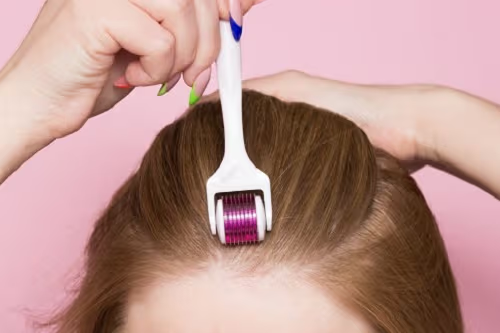
Microneedling is carried out with a derma roller or derma pen with small needles that create microscopic channels in the scalp. The theory has two parts: the controlled micro-trauma triggers a wound healing response with the release of growth factors that can stimulate the follicles, and the channels improve the absorption of topical Minoxidil.
It is one of the few home treatments with real, if limited, evidence behind it.
What does the evidence say?
There are in fact studies pointing to a beneficial effect, but almost always in combination with Minoxidil, not as microneedling alone. One often cited study showed that the group combining microneedling and Minoxidil achieved markedly better hair density than Minoxidil alone.
The conclusion is therefore: microneedling is best documented as an enhancer of Minoxidil, not as a treatment in its own right, and certainly not as a replacement for Finasteride in hereditary hair loss.
How to do it safely
Follow simple rules to avoid harm:
- Needle length: typically 0,5-1,0 mm for home use, longer needles belong with a professional
- Frequency: around once a week, so that the skin has time to heal in between
- A clean scalp: disinfect the roller before and after to avoid infection
- Timing with Minoxidil: do not apply Minoxidil immediately afterwards, wait a few hours, since freshly micro-damaged skin increases both absorption and irritation
Get a free hair analysis
- 1Start
- 2Info
- 3Done
Avoid overdoing it
More is not better. Treatment that is too frequent or too deep causes chronic irritation, redness and in the worst case scarring, which can damage the follicles rather than help them. If you press too hard or roll daily, you are working against yourself.
Share the roller with nobody, and replace it regularly, as blunt needles tear the skin instead of making clean channels.
Put it in the right frame
Microneedling is a cheap, low risk supplement that can add an extra percent on top of a solid treatment plan. But it is precisely a supplement, and the foundation against hereditary hair loss is still Finasteride and Minoxidil.
See microneedling in the context of the other documented options in Slowing hair loss without surgery, so that you prioritise what works most.
Who should (and should not) try it
Microneedling suits best the person who already uses Minoxidil and wants to try to enhance the effect cheaply. It is a low risk supplement, when done correctly. It should, however, be avoided with an active scalp infection, eczema, psoriasis in the area or a tendency to scarring (keloid), where needles can do more harm than good.
And remember the limit: microneedling does not replace Finasteride in hereditary hair loss and does not create hair in completely bald zones. It is an extra percent on top of a solid plan, see the foundation in Slowing hair loss without surgery.
Start carefully if you are new to it: shorter needles, less frequent treatment and good disinfection. You can always step it up, but you cannot undo an irritated or scarred scalp, so err on the cautious side.
© IdealofMeD Research Academy. Republished with permission.
Get a no-obligation assessment against fixed criteria, directly on WhatsApp.