Minoxidil guide: foam vs. oral, and the shedding phase
Minoxidil works for both men and women, but only if you use it correctly and consistently.
What is Minoxidil, and how does it work?
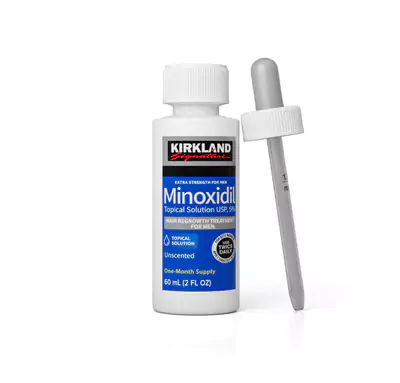
Minoxidil is one of the most widely used and best documented treatments for hair loss. It was originally developed as blood pressure medication, but increased hair growth was discovered as a striking side effect. Today it is used topically on the scalp as a solution or foam (typically in 2% and 5% strengths) and increasingly as low dose tablets under medical supervision.
Minoxidil is thought to widen the blood vessels around the follicles and prolong the anagen phase (the growth phase), so that more hairs grow at the same time and become thicker. Unlike Finasteride, Minoxidil does not affect DHT, so it acts on the symptom rather than the cause, which is why the two are often used together.
Because Minoxidil works locally on the circulation and the growth cycle rather than on hormones, it can be used by both men and women, unlike Finasteride, which is not advised for women of childbearing age. That makes Minoxidil one of the few treatments relevant across the sexes, and a natural first line for women with diffuse hair loss.
What can you expect, and what is “shedding”?
The effect is typically seen after 3-6 months of daily, persistent use and is greatest at the crown. In the first weeks many experience a temporary increase in shedding, called “shedding” or the dread shed. It seems alarming, but it is in fact a normal sign that the treatment is working: resting hairs are pushed out to make room for new, stronger hairs. It subsides after a few weeks.
As with Finasteride, the effect depends on continued use. If you stop Minoxidil, the gains typically disappear over a few months, and the hair loss resumes. Consistency is therefore absolutely decisive, Minoxidil only works for as long as you use it daily.
An important point is that results vary with how long the follicles have been affected. Minoxidil is best at revitalising follicles that still produce a thin hair, and has little to work with if the follicle is already completely inactive. The same principle therefore applies as for all hair treatment: early action gives the best return.
Solution, foam or tablets?
Solution (liquid) is the classic form, but it contains propylene glycol, which in some people causes itching or irritation. Foam often avoids this and dries faster, which many find more comfortable day to day. Low dose tablets (oral Minoxidil) have become more widespread and can be an alternative for those who struggle with the topical routine, but they must be used under medical supervision because of possible cardiovascular side effects.
Whatever the form, the key is the same: daily, correct application to a dry scalp, ideally combined with patience during the first months.
Side effects and practical advice
The most frequent side effects of topical Minoxidil are a dry, itchy or flaking scalp. With oral Minoxidil there can be circulatory effects and increased body hair, which is why it requires medical follow-up. Avoid getting the product on your face, and wash your hands after use. Combining Minoxidil with microneedling has in several studies improved absorption and effect.
Always start a new treatment in consultation with a professional, especially if you have cardiovascular disease or take other medication.
Get a free hair analysis
- 1Start
- 2Info
- 3Done
Minoxidil in the overall plan
Minoxidil is rarely a solution on its own in hereditary hair loss. The most effective strategy typically combines Minoxidil (stimulates growth) with Finasteride (slows the cause) and possibly supplements such as Ketoconazole shampoo or microneedling. See the whole toolbox and how the treatments work together in our guide to slowing hair loss without surgery.
Conclusion
Minoxidil is a well documented, accessible treatment that prolongs the hair's growth phase and increases density. It acts on the symptom, not the cause, requires daily and continuous use, and often produces a temporary extra shedding at the start, which is entirely normal. Used consistently, ideally together with Finasteride, it is a central part of many people's hair strategy. This article is informative and does not replace medical advice.
How to get the most out of Minoxidil
A few practical habits determine whether you get the full benefit. Apply the product to a dry scalp, spread it on the skin itself rather than into the hair, and let it dry completely before you lie down or style. Be consistent, the daily routine is the whole precondition for the effect. Many find it easier to keep going if the treatment is attached to a fixed daily habit, such as the morning or evening routine.
The combination with microneedling has in several studies shown better results than Minoxidil alone, probably because the microscopic punctures both stimulate the follicles and improve the absorption of the product. Ask your practitioner for advice on a safe protocol if you want to combine the two.
© IdealofMeD Research Academy. Republished with permission.
Get a no-obligation assessment against fixed criteria, directly on WhatsApp.