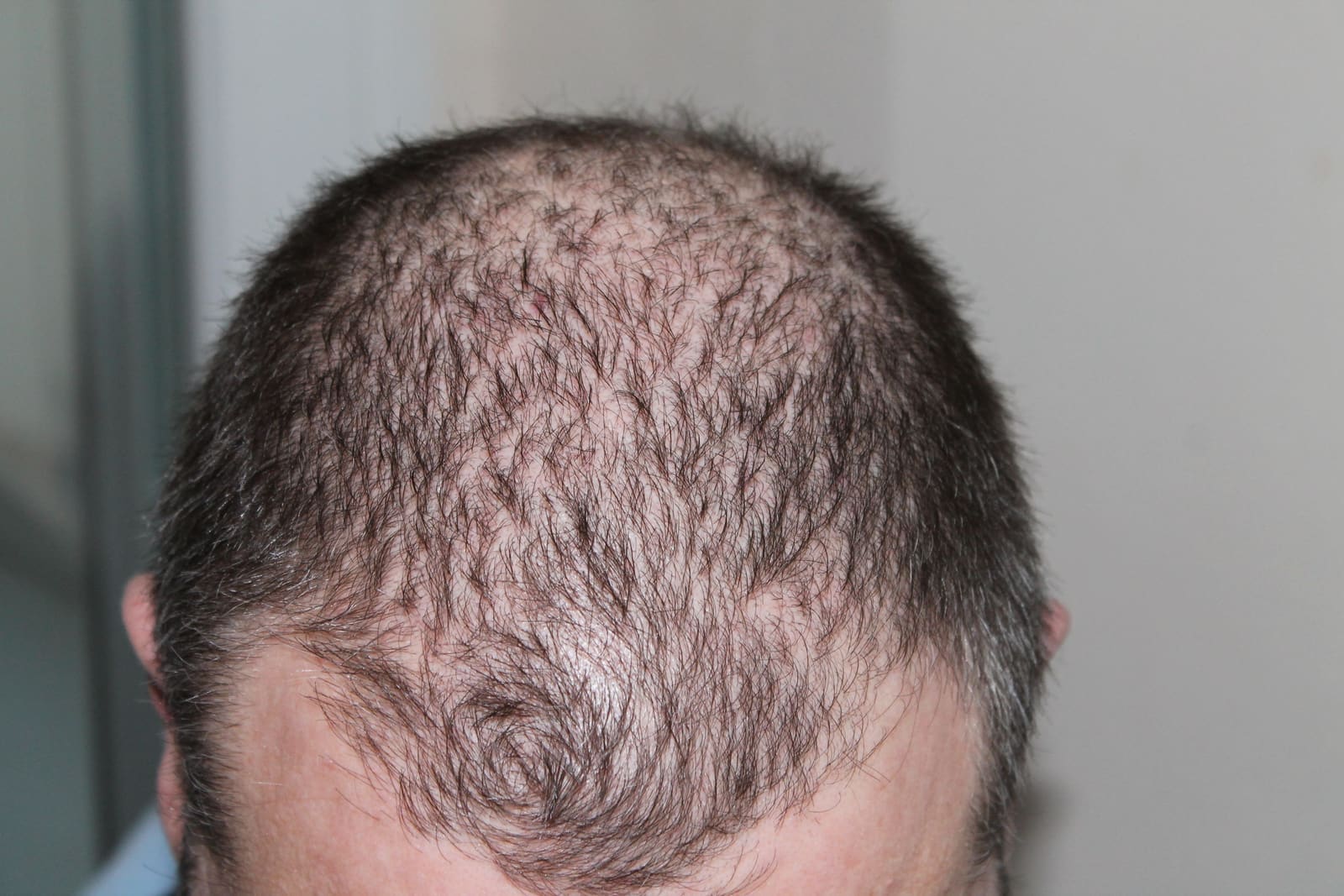
DHT and heredity: why men lose hair
The hormone DHT is the main cause of male hair loss. Here is the mechanism, explained simply.
What is DHT?
DHT stands for dihydrotestosterone, an androgen (male sex hormone) formed from testosterone with the help of the enzyme 5-alpha-reductase. DHT is important and beneficial in many parts of the body, but in the scalp it has an unfortunate side effect in those who are genetically predisposed: it attacks the follicles.
That explains an often overlooked paradox, DHT makes body hair and beard grow more strongly, while at the same time thinning the hair on the crown. It is not the amount of hormone that determines whether you go bald, but how sensitive your follicles are to it.
How DHT miniaturises the hair
In the genetically sensitive follicles, DHT binds to androgen receptors and gradually shortens the hair's growth phase (anagen). The result is miniaturisation: with every growth cycle the hair becomes thinner, shorter and lighter, until the follicle finally produces only an almost invisible vellus hair, and then shuts down completely.
This process does not happen evenly across the head, but precisely in the zones where the follicles are DHT sensitive, the temples, the hairline and the crown. That is why hair loss follows the recognisable Norwood pattern, while the back and sides (the donor area) typically remain unaffected.
The role of heredity
Sensitivity to DHT is strongly hereditary, but it is a widespread myth that you only inherit baldness from your mother's father. The truth is that hair loss is polygenic, it is determined by many genes inherited from both your mother's and your father's side.
A bald father is therefore not a guarantee, and a father with a full head of hair is not an acquittal. Family history gives an indication of the risk, but the final pattern depends on the whole genetic interplay.
Get a free hair analysis
- 1Start
- 2Info
- 3Done
Can it be counteracted?
Yes, partly, and it is precisely the DHT mechanism that makes medical treatment possible. Finasteride inhibits 5-alpha-reductase and lowers the DHT level in the scalp markedly, which slows the miniaturisation and in many people stabilises or improves the hair. Minoxidil works by a different route, by stimulating growth and prolonging the anagen phase.
See the documented options, doses and evidence in Slowing hair loss without surgery.
Why a transplant can last a lifetime
The same DHT mechanics explain why a hair transplant works permanently. The follicles in the donor area (back and sides) are genetically DHT-resistant. When they are moved to the crown, they keep that resistance, they do not suddenly become sensitive merely because they sit in a new place.
That is why transplanted hair is lasting. But the original hair around the new grafts is still vulnerable, and should continue to be protected medically, so that you do not end up with "islands" of transplanted hair in an area that carries on thinning.
Why does DHT affect only certain zones?
One of the most fascinating features of hereditary hair loss is that it follows a fixed geographical pattern. The follicles in the temples, hairline and crown carry a genetically programmed sensitivity to DHT, while the follicles at the back and sides are largely unaffected. It is not random, it is inherited cell behaviour, determined early in foetal development.
This explains both the Norwood pattern and the entire basis of hair transplantation: the stable hair in the donor zone can be moved to the vulnerable zones without losing its resistance. See how the pattern is classified in the Norwood scale.
© IdealofMeD Research Academy. Republished with permission.
Get a no-obligation assessment against fixed criteria, directly on WhatsApp.