Traction alopecia: hair loss from tight hairstyles, and how to stop it
Tight ponytails, braids and extensions can cause permanent hair loss along the hairline. I explain how traction alopecia arises, when it can be reversed, and how it is treated.
What is traction alopecia?
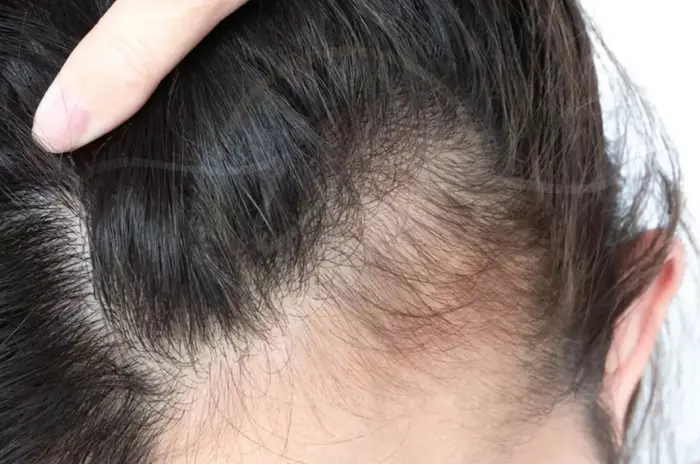
Traction alopecia is hair loss caused by sustained pulling on the hair. It is one of the few forms of hair loss that is neither hereditary nor hormonal, but mechanical. Typical causes are tight ponytails, braids, cornrows, hair extensions, turbans and tight buns. The loss usually appears along the front hairline and above the ears, in other words exactly where the pull is greatest.
How does it arise?
When the hair is pulled tight again and again, the follicle is under constant strain. Over time the sustained strain leads to inflammation around the follicle, and the follicle weakens. At first the hairs fall out, but the follicle is still alive. If the strain continues for years, the follicle can perish and be replaced by scar tissue, and then the loss becomes permanent. That is why timing matters so much in traction alopecia.
Early signs you should know
The early signs are small but important: tenderness or headache after styling, small spots or irritation along the hairline, broken short hairs at the edge, and a gradually receding hairline around the temples. If you see these signs, it is time to change your styling habits immediately. At this stage the damage is usually reversible.
When can it be reversed?
Caught early, while the follicles are still alive, the hair usually grows back of its own accord once the pulling is removed. It can take months, and patience is necessary. Discovered late, when the follicles have been replaced by scar tissue, the loss is permanent and the hair will not grow back whatever the treatment. That is exactly why early attention matters so much.
Get a free hair analysis
- 1Start
- 2Info
- 3Done
Treatment
The first and most important step is to remove the cause: loosen the hairstyle, avoid extensions and tight styling, and give the hairline a rest. Where there is inflammation, a doctor can prescribe a topical treatment. Minoxidil is sometimes used to support regrowth in the reversible phase. With permanent loss, where the follicles have gone, a hair transplant can rebuild the hairline, provided the pulling has stopped and the donor area is intact.
Hair transplantation in traction alopecia
Traction alopecia is in fact one of the situations in which a hair transplant often works very well, especially in women. The pattern is typically confined to the hairline, the donor area at the back of the head is usually unaffected, and the loss is stable once the pulling has been removed. The precondition is that you do not return to the tight hairstyles afterwards, since renewed pulling will damage the transplanted hairs too.
Conclusion
Traction alopecia is hair loss from mechanical pulling, typically along the hairline, and it is one of the few forms of hair loss you can prevent entirely yourself. Caught early it is reversible; caught late it becomes permanent. Loosen the hairstyle at the first signs, and seek an assessment if the hairline has already receded. With permanent loss a hair transplant is often a good solution. This article is for general information and does not replace an individual medical assessment.
© IdealofMeD Research Academy. Republished with permission.
Get a no-obligation assessment against fixed criteria, directly on WhatsApp.