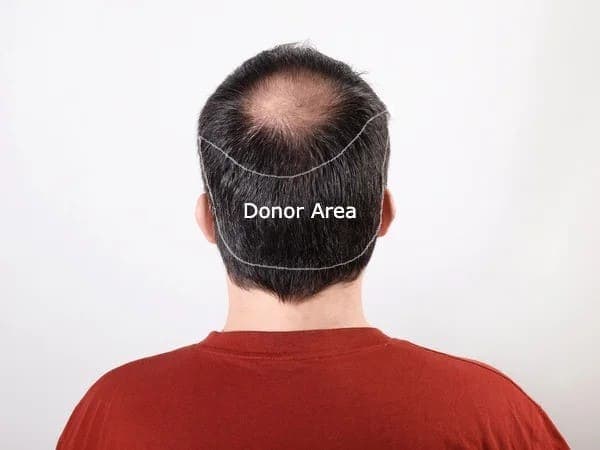
The donor area: the limited resource that should govern your whole hair transplant plan
Your donor area is a lifelong, limited resource, and the most important constraint in any hair transplant. I explain why over-harvesting is the worst mistake, and how a good surgeon thinks ahead.
What the donor area is, and why it is everything
Behind every good hair transplant result lies a simple fact: everything depends on the donor area. The donor area is the band of hair at the back and sides of the head where, for genetic reasons, the follicles are largely resistant to DHT, the hormone that drives hereditary hair loss. No follicle is completely immune, but because these hairs are far less affected by the androgenic process, they can be moved to the thinned areas and keep growing there. That is the entire basis on which a transplant works at all.
But this resource is limited and cannot be renewed. You have a certain, finite number of hairs in your safe donor zone, and every single one that is harvested is gone from there for good. No new donor hairs grow. That makes the donor area the most precious and fragile resource in the whole process, and the factor that should govern every decision about what is possible and wise.
As a surgeon I think of the donor area in the same way a sensible person thinks about savings that have to last a lifetime: it should be managed thoughtfully, not spent in one impulsive decision. Understanding this principle is perhaps the most important thing a patient can take away.
How much can realistically be harvested?
Donor capacity varies from person to person, depending on the density, thickness and colour of the hair and the elasticity of the scalp. As a rough guide, many people have a total donor supply in the order of 6 000-8 000 grafts that can be safely extracted over a lifetime; some have more, others less. That may sound like a lot, but it often has to cover hair loss that keeps progressing for decades.
In a single session you can typically extract a portion of this reserve without it becoming visible, provided the harvest is evenly spread and gentle. But here lies the temptation: a clinic can squeeze out a higher graft count by harvesting more aggressively, for the benefit of an impressive figure today but at the expense of both the appearance of the donor and the future reserve. The line between a sensible and a damaging harvest is exactly what an experienced surgeon respects, and what a production line clinic often ignores.
What matters is that donor capacity sets a real, physical limit on what can be achieved. No technique, no device and no marketing can conjure up more donor hairs than you have. A good surgeon plans within that limit and tells you honestly if your wishes exceed it.
Over-harvesting: the worst and most permanent mistake
Among all the mistakes a clinic can make, over-harvesting of the donor area is one of the most serious, because it is permanent and almost impossible to correct. When harvesting is too aggressive, the donor area can become visibly thin, patchy or 'moth-eaten', which looks bad in itself, especially with short hair. Worse, the reserve that has been used is gone for good and is therefore no longer available when future hair loss demands it.
Unfortunately I regularly see the consequences when patients come to me after an aggressive operation elsewhere: a thinned area at the back of the head and far too little reserve left to keep pace with a progressing loss. It is a situation in which my scope for helping is severely limited, because the basic resource has been spent. No surgeon can restore a ruined donor.
That is why I repeat so often that a hair transplant can in practice only be done properly once. A poor first attempt that exhausts the donor steals not only a good result today, but also options you would have had for the rest of your life.
Why future hair loss has to be part of the plan
One of the clearest differences between a skilled and an unscrupulous surgeon is whether the plan allows for the future. Hereditary hair loss is progressive: it rarely stops of its own accord, and a 30-year-old with early loss will probably have more extensive loss at 45 or 60. A transplant that only solves today's problem without thinking about tomorrow's can end badly.
Imagine using almost the whole donor to give a young man a dense, low hairline today. If his hair loss then progresses behind it, he is left with a well preserved front in an otherwise thinning landscape, and without the reserve to put it right. A forward-looking surgeon therefore deliberately keeps part of the donor in reserve, plans an age-appropriate, conservative hairline, and often recommends medical treatment to slow the future loss.
This forward-looking approach is not caution for caution's sake; it is the only way to secure a result that still looks natural in twenty years. Operating only on the present is planting a problem in the future.
Get a free hair analysis
- 1Start
- 2Info
- 3Done
Alternative donor sources
When the scalp donor is under pressure, there are supplementary sources an experienced surgeon can draw on. Beard hair is the most important: it is strong, grows reliably and can be used to thicken the crown or to stretch a limited scalp donor. Body hair, from the chest or other areas, can in certain cases be used as a last resort, but it is finer, has a shorter growth cycle and is more unpredictable.
These alternative sources widen the options, but they do not change the basic rule: the back of the head is your primary and best donor, and the other sources are supplements, not replacements. In complex planning, for example in extensive loss or repair work, a shrewd combination of sources can nevertheless make a real difference and should form part of a thorough assessment.
Knowing these options also helps to explain why experience matters so much. Managing and combining different donor sources wisely is part of the craft that distinguishes a specialist from a routine operator.
How a good consultation should handle the donor
Because the donor is so central, it is one of the best subjects to raise in a consultation. A reputable surgeon will examine and talk about your donor capacity of his own accord, assess it in relation to your current and expected hair loss, and explain how the plan spares the reserve. He will also be honest if your wishes exceed what the donor can realistically bear.
The warning signs are the opposite: a clinic that talks only about how many grafts it can place, without mentioning the limits of the donor or your future, is putting a sale ahead of your long term result. Ask directly: how do you allow for my future hair loss? How much of my donor are we using, and what are we keeping in reserve? The answer, or the absence of one, tells you a great deal about the clinic's quality.
See the broader framework in our guide to choosing a clinic, where donor management and forward planning feature as central quality markers.
Frequently asked questions
Do new donor hairs grow back after a harvest? No. The donor area is a limited, non-renewable resource. Every graft extracted is gone from there permanently, which is why it has to be managed wisely.
How many grafts do I have in total? It varies, but many people have a total lifetime donor of around 6 000-8 000 grafts. A surgeon assesses your specific capacity from density, hair type and scalp.
What is over-harvesting? It is when too many grafts are extracted too aggressively, so that the donor area becomes visibly thin or moth-eaten. The damage is permanent and limits future options.
Can anything other than hair from the back of the head be used? Yes, beard hair is a good supplementary source, and body hair can be used in certain cases. But the back of the head is the primary and best donor; the others are supplements.
Conclusion
The donor area is the limited, non-renewable resource that underpins every hair transplant, and it should govern the entire plan. Over-harvesting is one of the worst and most permanent mistakes a clinic can make, because it both disfigures the donor and steals the reserve you will need when your hair loss progresses.
A skilled surgeon manages the donor like lifelong savings: he plans ahead, keeps a reserve, designs for your age, and is honest about the limits. Choose a clinic that treats your donor with that respect; it is one of the surest routes to a result that lasts. This article is for general information and does not replace an individual assessment.
© IdealofMeD Research Academy. Republished with permission.
Get a no-obligation assessment against fixed criteria, directly on WhatsApp.