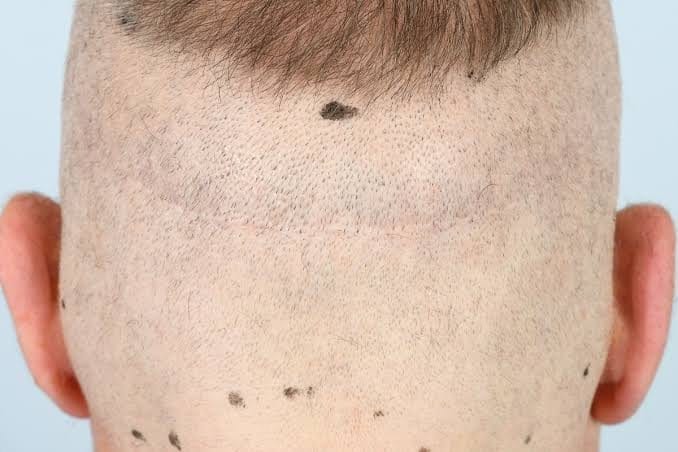
FUE's limits when donor supply is low
When donor density is low, the honest answer is often that surgery cannot deliver what the patient wants.
When donor density is low, the honest answer is often that surgery cannot deliver what the patient wants. Recognising that before operating is the difference between a modest good result and a depleted donor area with a disappointing top.
How is a patient's lifetime donor graft limit calculated?
Lifetime donor capacity is measured donor density across the safe zone, ideally over 50 follicular units per square centimetre, multiplied by the usable area, with a proportion reserved for future loss since pattern baldness usually progresses. What remains is what can be distributed, and when capacity is low, demand routinely exceeds it by a wide margin.
What happens if a hair transplant surgeon over-harvests the donor area?
Taking more than the donor area can support does not produce a fuller top; it produces a thin top plus a visibly depleted back and sides, and that second problem is permanent and harder to hide than the first. The donor area does not regenerate, making this a mistake that cannot be undone.
What are realistic strategies when donor supply is limited?
Realistic strategies include reducing the goal, such as a conservative hairline with an unrestored crown; starting medical treatment first to stabilise what remains; scalp micropigmentation alone or with a small transplant to reduce contrast; using beard or body hair as supplementary sources; or declining surgery altogether, which is sometimes the correct recommendation.
- Reduce the goal. Frame the face with a conservative hairline and accept an unrestored crown.
- Medical treatment first, to stabilise what remains before spending donor supply.
- Scalp micropigmentation, alone or with a small transplant, to reduce contrast.
- Beard or body hair as supplementary sources, with the caveats those carry.
- Declining surgery, which is sometimes the correct recommendation.
What does a good consultation look like when donor supply is limited?
A good consultation involves a surgeon who measures density, states capacity as a specific number, explains what that number can and cannot achieve, and is willing to say a goal is not attainable. A clinic that responds to low donor density by quoting a large graft count anyway is a clear warning sign.
A clinic that responds to low donor density by quoting a large graft count anyway is the clearest warning sign on our red flags list.
Sources
- Parsley WM, Perez-Meza D. Review of factors affecting the growth and survival of follicular grafts. Journal of Cutaneous and Aesthetic Surgery, 2010;3(2). jcasonline.com
This article summarises published research and standard clinical practice. It is general educational information, not medical advice, and it does not replace the instructions your own surgical team gives you. Where their guidance differs from anything here, follow theirs.
Get a no-obligation assessment against fixed criteria, directly on WhatsApp.