FUT: the older method that still has its place
FUE and DHI dominate, but FUT (the strip method) is not obsolete, and in certain cases it is the best choice.
What FUT is
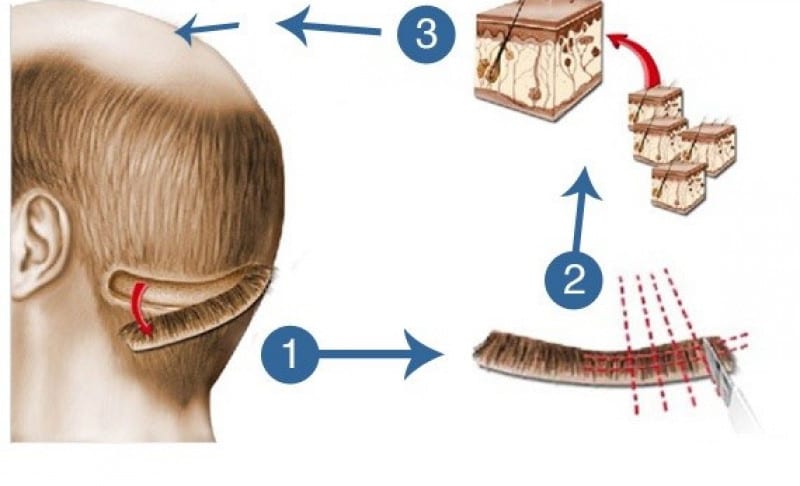
In FUT (Follicular Unit Transplantation), also called the strip method, a thin strip of skin is removed from the donor area at the back of the head. Under a microscope the strip is then divided into the individual follicular units (grafts), which are implanted in the same way as with FUE.
The method is older than FUE, but far from obsolete. The central difference lies in the extraction: FUT takes one strip, FUE takes the follicles one by one.
The advantage: a high graft yield
FUT's great strength is that it can deliver a high number of quality grafts in one session without requiring the whole head to be shaved. Because the follicles are taken from a single, dense strip, the yield per session can be very large, which is relevant in advanced hair loss.
Some surgeons also believe that graft quality from the microscope-dissected strip can be very high, since the follicles are protected by surrounding tissue during extraction.
The drawback: the linear scar
The main drawback is a linear scar across the back of the head where the strip was removed. The scar is covered by the surrounding hair when the hair is worn at a certain length, but it becomes visible if you cut your hair very short (a skinhead cut, for example). For many people, that settles it.
The healing of the strip itself also takes a little longer and can cause more tenderness at the back of the head in the first days than FUE.
Get a free hair analysis
- 1Start
- 2Info
- 3Done
When FUT is preferred
FUT can be the right choice with:
- A need for many grafts in one session in advanced loss
- Limited donor density, where the strip uses the donor zone efficiently
- Patients who wear their hair long and never plan to cut it very short
- People who do not want the whole head shaved before the procedure
Even so, FUE is the more common choice today, because patients want to avoid a visible scar and keep flexibility in hair length.
FUT vs. FUE: the right choice is individual
There is no "better" method in absolute terms, only the best one for your situation, your hair loss and your preferences about future hair length. A skilled surgeon masters both and recommends on the basis of your requirement, not on the basis of what the clinic would rather sell.
Compare the methods in depth in the review of the methods, and see what else you should weigh in choosing a clinic.
The scar in practice
The concern about FUT is almost always the scar, so it deserves some nuance. A well executed FUT scar is a thin, horizontal line at the back of the head, well hidden when the hair is worn at a certain length. Techniques such as trichophytic closure (where hair grows through the scar itself) can make it even less visible.
The problem only arises if you cut your hair very short (a skinhead cut, for example), when the line becomes visible. If you never plan to go very short, the scar is rarely a problem in practice. Weigh the advantage (a high graft yield) against the drawback on the basis of your own preferences, and compare the methods in the review of the methods.
© IdealofMeD Research Academy. Republished with permission.
Get a no-obligation assessment against fixed criteria, directly on WhatsApp.