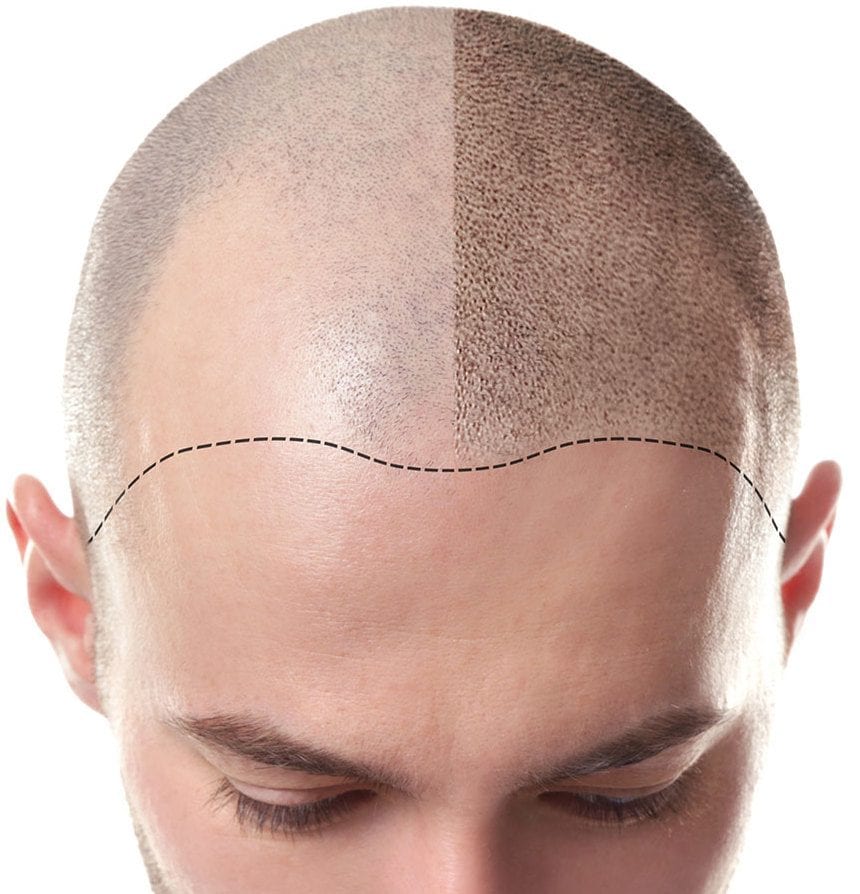
Scalp micropigmentation (SMP), the tattooed illusion of hair: when does it make sense?
SMP tattoos tiny dots into the scalp that imitate follicles. I explain what it can and cannot do, when it is a smart supplement, and where the limits lie.
What is scalp micropigmentation?
Scalp micropigmentation, abbreviated to SMP, is a form of cosmetic tattooing in which fine needles are used to place tiny dots of pigment in the upper layer of the scalp. The dots are designed to imitate the appearance of short, shaved follicles, so that a bald or thinning scalp comes to look as though there is stubble: in other words, the illusion of closely cropped, dense hair.
SMP does not add hair. It creates a visual illusion, not real hair, and it changes nothing about the underlying process behind your hair loss. But as an illusion it can be remarkably effective, and for the right candidates it is one of the most underrated tools in the palette, used either on its own or, more often, as a shrewd supplement to a hair transplant.
As a surgeon I see SMP neither as a competitor to nor a replacement for a transplant, but as a complementary tool that solves particular problems a transplant cannot. Understanding that role is the key to judging whether it is for you.
How does it differ from an ordinary tattoo?
Although SMP is technically a tattoo, it differs markedly from an ordinary body tattoo. The pigment, the technique and the needles are specialised for the purpose: the dots have to be microscopic and uniform, the colour has to match the natural stubble appearance of hair, and the depth has to be exactly right, so that the dots do not spread over time and become smudged patches instead of sharp points.
This is where the quality of the practitioner determines everything. A skilled SMP specialist creates a convincing, natural illusion with the correct dot size, density and colour, matched to your skin tone and your hair. An inexperienced practitioner, by contrast, can leave dots that are too large, too dark or smudged, which look artificial and are hard to correct. As with a transplant, choosing the right practitioner is therefore critical.
SMP also fades gradually over years and typically requires maintenance at regular intervals, which distinguishes it from the permanent nature of an ordinary tattoo. That is both a disadvantage (an ongoing cost) and an advantage (the option to adjust as your hair or your skin tone changes).
When does SMP make sense on its own?
SMP can be used as a standalone solution in several situations. For the man who has accepted a shaved look, SMP can create the illusion of dense, closely cropped hair across the whole scalp, a 'buzz cut' that looks full even though the hair is in reality gone. For men with very advanced hair loss and insufficient donor capacity for a meaningful transplant, this can be an excellent, realistic solution.
SMP can also be used to camouflage scars, for example a linear FUT scar at the back of the head or scars from earlier operations, by pigmenting around the scar so that it becomes less visible. And for men with diffuse thinning, SMP between the existing hairs can reduce the contrast between hair and scalp, so that the hair appears denser without a single new strand being added.
What these applications have in common is that SMP solves a problem of appearance without surgery, without a donor limitation and with a short recovery. For the right candidate with the right expectations it is an effective and often surprisingly satisfying solution.
SMP as a supplement to a transplant
In my experience SMP is at its strongest as a supplement to a hair transplant. The two techniques solve different problems and reinforce one another. A common application is to use SMP between the transplanted hairs to create an impression of even greater density, particularly useful in patients with a limited donor where the transplant alone cannot give full density.
SMP can also be used to camouflage the donor area after harvesting, so that any thinned area or FUT scar becomes less visible. And for the patient whose hair loss continues over the years, SMP can be added later to preserve the impression of density without further surgery. The combination of real hair from the transplant and the illusion of density from SMP often gives a better overall result than either technique can alone.
This complementary way of thinking is worth knowing, because it widens the options considerably, especially for patients with limited donor capacity who would otherwise have to accept a thinner result.
Advantages of SMP
- No donor limitation: The illusion of density does not consume your limited donor hair.
- Non-surgical: No operation, a short recovery, low risk.
- Effective camouflage: It can hide scars and reduce contrast in diffuse thinning.
- Flexible: It can be used alone or as a supplement, and adjusted over time.
- A good solution where the donor is insufficient: A realistic choice where a transplant does not go far enough.
Get a free hair analysis
- 1Start
- 2Info
- 3Done
Disadvantages and reservations
- Not real hair: It is an illusion; the hair is no longer there, and you cannot style it.
- Best for a short/shaved look: The illusion of stubble works poorly if you want long hair.
- It requires maintenance: It fades over years and has to be refreshed.
- The quality depends entirely on the practitioner: Poorly executed SMP looks artificial and is hard to correct.
- It changes nothing about the hair loss: The underlying process continues, and existing hair can thin further.
Frequently asked questions
Is SMP the same as a hair transplant? No. A transplant adds real, growing hair; SMP creates an illusion of stubble with pigment. They solve different problems and are often used together.
Can I have long hair with SMP? Not really. SMP imitates short, shaved stubble and works best for a closely cropped look or as filler between existing hairs, not for long hair.
Does it last forever? No, it fades gradually over years and requires maintenance. That is both a disadvantage and an advantage, since it can be adjusted over time.
Can SMP hide a FUT scar? Yes, that is a common and effective application. Pigmenting around the scar makes it less visible, especially with short hair.
Realistic expectations of SMP
As with any treatment, the key to satisfaction is realistic expectations. SMP is an illusion, and although it can be astonishingly convincing, you need to understand what it is: you do not get hair you can style, lift or feel through, you get a visual impression of density or stubble. For someone who understands and accepts that, satisfaction is often high; for someone who hoped for real hair, the disappointment can be great however well the work is done.
I always encourage people to look at many examples of a practitioner's work, ideally on people with the same skin tone and hair type as themselves, and to talk thoroughly about what they want to achieve before beginning. A skilled practitioner will be honest of their own accord about when SMP is the right choice and when a transplant or a combination would serve you better. That honesty is, as everywhere in this field, a sign of quality.
Finally, SMP and transplantation do not exclude one another. Many of the best results combine the two, and a clinic that masters both can advise you on the optimal blend for your particular situation, your budget and your wishes regarding future hair length.
Conclusion
Scalp micropigmentation is an effective, non-surgical tool that creates the illusion of stubble or increased density, but it does not add real hair. It is at its strongest for someone who accepts a shaved look, for camouflaging scars, and especially as a supplement to a transplant, where it can reinforce the impression of density without drawing on the limited donor.
With the right expectations and a skilled practitioner, SMP is an underrated and flexible tool in the overall palette against hair loss. Judge it on what you want to achieve, and ideally in consultation with a clinic that masters both surgery and SMP. This article is for general information and does not replace an individual assessment.
© IdealofMeD Research Academy. Republished with permission.
Get a no-obligation assessment against fixed criteria, directly on WhatsApp.