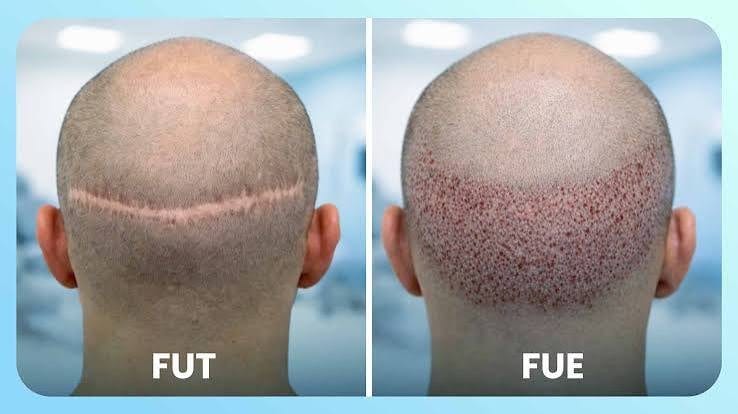
FUT strip scars vs FUE dot scars
FUT leaves one linear scar across the donor area; FUE leaves hundreds or thousands of small round ones.
FUT leaves one linear scar across the donor area; FUE leaves hundreds or thousands of small round ones. Neither is scarless, and which is preferable depends almost entirely on how short you intend to wear your hair.
How do FUT and FUE differ in how they remove donor hair?
FUT (strip harvesting) removes a horizontal ellipse of scalp from the occipital region, closed with sutures or staples into one linear scar. FUE removes units individually with a small punch, per Rassman, Bernstein and colleagues (2002); with no closure, each site heals into a small round scar — many scars spread across the donor zone.
Both techniques remove follicular units from the same safe donor zone. They differ in how.
Follicular unit transplantation (FUT), or strip harvesting, removes a horizontal ellipse of scalp from the occipital region. The edges are closed with sutures or staples, and the strip is dissected under magnification into individual follicular units. The result is one linear scar running across the back of the head.
Follicular unit excision (FUE) removes units individually with a small punch, as described by Rassman, Bernstein and colleagues in 2002. There is no closure; each site heals by secondary intention into a small round scar. The result is many small scars spread across the donor zone.
How do FUT strip scars and FUE dot scars behave differently over time?
A well-executed FUT line is invisible under moderate-length hair but is one continuous feature that can stretch into a wider band, limiting how short the back is worn. FUE dots are individually invisible at moderate density, but spread across the whole zone, so heavy harvesting shows as diffuse lightening at a shaved or number-one length.
The FUT line
A well-executed strip scar is a fine line, typically a few millimetres wide, and it is completely invisible under hair of moderate length. Its weakness is that it is a single continuous feature: if it stretches — which depends on scalp laxity, closure technique, tension and individual healing — it becomes a wider band that longer hair is still needed to cover.
The practical constraint is that a strip patient generally cannot wear their hair very short at the back, and this is a lifetime constraint rather than a temporary one.
The FUE dots
FUE distributes the scarring. Each dot is small, and at moderate extraction density under hair of any reasonable length they are invisible. Their weakness is the opposite of the strip's: the scarring covers the whole donor zone rather than one line, so when it does become visible there is nowhere it is not.
At a shaved head or a number one, a heavily harvested FUE donor area reads as a diffuse lightening across the back and sides. This is why the common claim that FUE lets you shave your head is only conditionally true — it depends on how much was taken.
What single question actually decides whether to choose FUT or FUE?
How short you intend to wear your hair over the next twenty years. If you may clip very short, conservative-density FUE fits better and FUT is a poor choice. If you'll always keep moderate length, both work and FUT's concealed strip scar is a genuine advantage. For very large lifetime yields, surgeons often combine both.
Ask yourself how short you intend to wear your hair over the next twenty years.
- If you may shave or clip very short: FUE at conservative extraction density is the better fit, and the graft number should be constrained accordingly. FUT is a poor choice.
- If you keep your hair at moderate length and always will: both work, and the strip scar is fully concealed. FUT then carries some genuine advantages.
- If you need a very large lifetime graft yield: many surgeons combine both across sessions, taking a strip and using FUE for later work or vice versa.
What genuine advantages does FUT have that get overlooked in the scar debate?
Two rarely mentioned points favour FUT: it takes a defined ellipse from the densest area rather than scattering extraction, which some surgeons argue better preserves donor appearance for very large graft needs; and its follicles are dissected under direct vision rather than punched blind. Against that: closure, longer recovery, stretch risk, numbness, permanent length constraint.
FUE has become dominant commercially, and the reasons are partly genuine and partly marketing. Two points about FUT are worth stating because they are rarely mentioned to patients.
First, strip harvesting does not scatter extraction across the donor zone. It takes a defined ellipse from the densest area and leaves the rest untouched, which some surgeons argue preserves overall donor appearance better in patients needing very large numbers.
Second, follicles dissected from a strip under microscopy are cut out under direct vision rather than punched blind, which affects the transection picture.
Against that, FUT requires a closure, has a longer and more uncomfortable recovery, carries a risk of scar stretching and of donor-area numbness, and imposes the permanent hair-length constraint.
What marketing claims about FUT and FUE scarring should you be sceptical of?
FUE is not 'scarless' — it produces more individual scars than FUT, just smaller and spread out. FUT is not obsolete either; experienced clinics still use it for patients needing maximum lifetime yield. The real question is which failure mode you can live with: a line to keep covered, or lightening if you go very short.
The claim that FUE is 'scarless' is the most common misdescription in this field. FUE produces more individual scars than FUT, not fewer — they are simply smaller and spread out.
The claim that FUT is obsolete is also not accurate. It remains in use at experienced clinics, particularly for patients needing maximum lifetime yield who keep their hair long.
The useful question is not which technique is better in the abstract, but which failure mode you can live with — a line you must keep covered, or a diffuse lightening that appears if you go very short.
Scar type follows from technique, which our guide to transplant methods compares.
Sources
- Rassman WR, Bernstein RM, McClellan R, Jones R, Worton E, Uyttendaele H. Follicular unit extraction: minimally invasive surgery for hair transplantation. Dermatologic Surgery, 2002;28(8):720-728. pubmed.ncbi.nlm.nih.gov/12174065
- Romera de Blas C, Vega Díez D, Ricart Vayá JM, Gómez Zubiaur A. Complications in follicular unit excision hair transplantation: current evidence and practical approaches. Frontiers in Medicine, 2026;13:1750989. pubmed.ncbi.nlm.nih.gov/41709896
- Chauhan K, Tandon M, Kumar A, Taneja N, Hamid SAT. A comprehensive review of evolution of advanced follicular unit excision systems. Journal of Cutaneous and Aesthetic Surgery, 2025;18(2):69-77. pubmed.ncbi.nlm.nih.gov/40212421
- Jimenez F, Ruifernández JM. Distribution of human hair in follicular units. A mathematical model for estimating the donor size in follicular unit transplantation. Dermatologic Surgery, 1999;25(4):294-298. pubmed.ncbi.nlm.nih.gov/10417585
This article summarises published research and standard clinical practice. It is general educational information, not medical advice, and it does not replace the instructions your own surgical team gives you. Where their guidance differs from anything here, follow theirs.
Get a no-obligation assessment against fixed criteria, directly on WhatsApp.