
Hair loss in women: causes and options
Women lose hair differently from men, and often need a more thorough assessment.
A different pattern from men's
Female hair loss rarely looks like men's. Where men typically lose hair at the temples and crown (the Norwood pattern), women most often experience a diffuse thinning across the crown, while the frontal hairline is usually preserved. This pattern is described with the Ludwig scale (grade I-III) rather than Norwood.
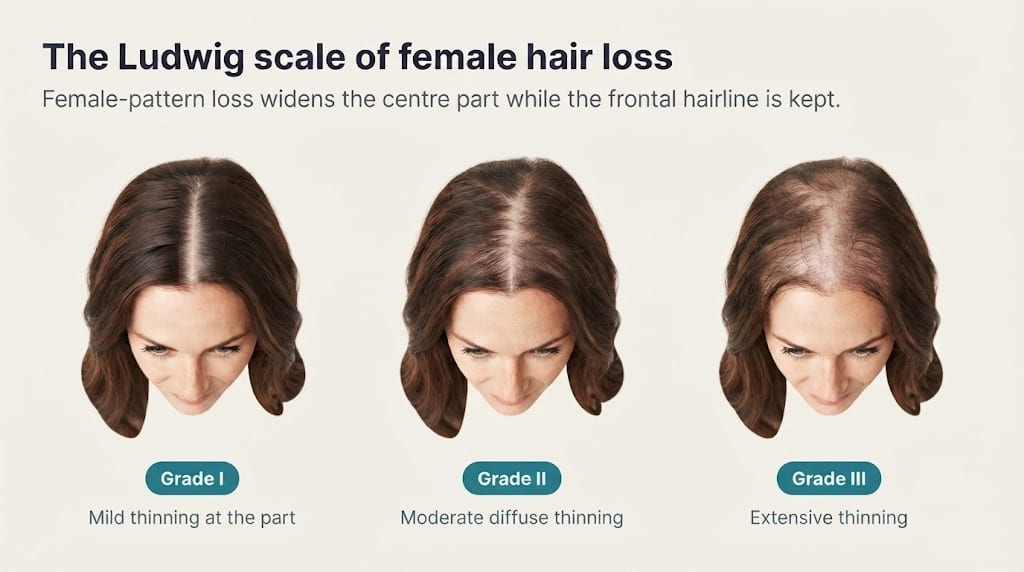
Because the hairline remains, female hair loss is often noticed later: it appears as a wider parting or visible scalp in strong light, not as an obviously receding forehead.
The most frequent causes
Female hair loss more often has several simultaneous causes than men's, which makes assessment more important:
- Hormonal changes: the menopause, pregnancy, the contraceptive pill, PCOS
- Low ferritin (iron deficiency): very widespread in women, especially with heavy periods
- Thyroid disorders: both an underactive and an overactive thyroid
- Telogen effluvium after stress, illness, childbirth or severe weight loss
- Androgenetic (hereditary) hair loss (FPHL): sensitivity to androgens
Start with a thorough assessment
Because there are often several causes at once, a medical assessment is the first step, not self-treatment. Have ferritin measured (aim for > 70 ng/mL), along with vitamin D, thyroid function (TSH) and possibly a hormone profile. The tests often reveal a correctable cause, and simply correcting the deficiency can give a noticeable improvement.
A dermatologist can also distinguish FPHL from other conditions such as alopecia areata or scarring alopecia, which require completely different treatment.
Get a free hair analysis
- 1Start
- 2Info
- 3Done
Treatment options
Minoxidil is the best documented and approved treatment for women (typically 2% or 5%). Finasteride is normally not used for women of childbearing age. In diffuse, early thinning, PRP can be a supplement, and hormonal causes can be treated specifically.
See the different types and their treatment in the overview of types of hair loss and the documented options in Slowing hair loss without surgery.
Is a transplant an option?
Yes, but on stricter conditions than in men. A hair transplant requires a stable, densely covered donor area, and the very diffuse nature of female hair loss means that the donor zone at the back of the head is often thinner as well. So not every woman is a candidate; it depends on the type of hair loss.
Women with a defined pattern (for example a high forehead, scarring or stable FPHL) can achieve good results. It takes a thorough, individual assessment: write to us for a no-obligation assessment of whether you are a suitable candidate.
The psychological aspect
Hair loss often affects women harder socially and emotionally, because in many cultures full hair is closely tied to female identity. At the same time female hair loss is spoken about less openly than men's, which can create a feeling of isolation. The concern is real, not vanity.
That is exactly why a thorough, respectful assessment matters: getting a concrete cause and a plan often brings considerable peace of mind. Many forms of female hair loss are also reversible or treatable once the cause is found. See the documented options in Slowing hair loss without surgery.
© IdealofMeD Research Academy. Republished with permission.
Get a no-obligation assessment against fixed criteria, directly on WhatsApp.