
FPHL vs. male hair loss: why they are not the same
Female hair loss (FPHL) follows a different pattern from men's, and therefore requires a different approach.
Different patterns
FPHL (female pattern hair loss) typically produces a diffuse thinning across the crown, while the frontal hairline is usually preserved. That stands in sharp contrast to men's classic course with receding temples and loss at the crown.
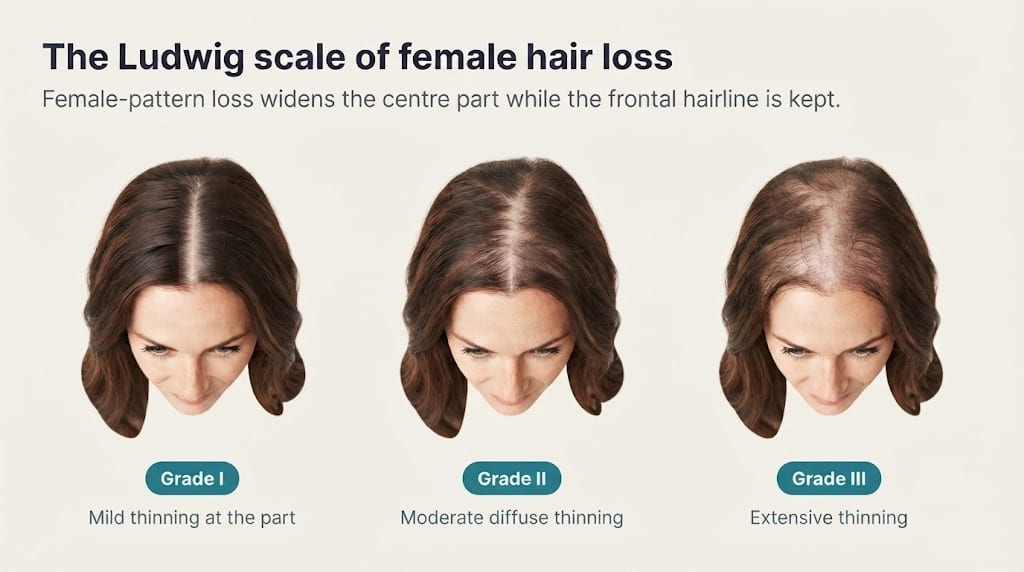
Different measurement scales are therefore used as well: men are classified with the Norwood scale, women with the Ludwig scale (grade I-III), which describes the degree of diffuse thinning at the crown.
The same hormone, a different expression
Both men's and women's hereditary hair loss involves sensitivity to androgens (including DHT), but the expression differs. In women the picture is more complex, because oestrogen, hormonal fluctuations and other factors play a part. That is why a hormonal shift (the menopause, pregnancy or the contraceptive pill) can trigger or worsen FPHL.
It also explains why women more rarely go completely bald: the pattern is seldom as "purely" androgenic as men's.
Why a thorough assessment matters
Female hair loss more often has several simultaneous causes: hormones, iron deficiency (low ferritin), thyroid disorders, stress and telogen effluvium. That makes a thorough medical assessment essential before choosing a treatment.
Starting treatment without knowing the cause is a waste of time. A blood test (ferritin, vitamin D, TSH, possibly a hormone profile) and a dermatological assessment often uncover a correctable factor.
Get a free hair analysis
- 1Start
- 2Info
- 3Done
A different approach to treatment
The treatment differs too. Finasteride, a cornerstone in men, is normally not used for women of childbearing age. Minoxidil, by contrast, is documented and approved for both sexes and is often the first choice in FPHL, possibly supplemented with PRP.
Read more in the overview of types of hair loss and about the treatments that work.
Consequences for surgery
The difference has direct significance for whether a transplant is possible. In men the donor zone at the back of the head is usually dense and stable. In FPHL the loss is diffuse, which means the donor zone can be thinner as well, and then the patient is not necessarily a good candidate.
Women with a defined pattern (a high forehead, scarring, stable FPHL with a dense donor area) can nevertheless achieve good results. It takes an individual assessment: write to us to get one.
Common misunderstandings
Because male hair loss is so well known, its "rules" are often wrongly transferred to women. Two misunderstandings are particularly harmful: that women can simply take Finasteride (it is normally not used for women of childbearing age), and that a hair transplant is always an option (it requires a stable, dense donor area, which the diffuse nature of FPHL often undermines).
So female hair loss needs its own approach: a thorough assessment before treatment, and realistic expectations about what is possible. See the different types in the overview of types of hair loss.
Another misunderstanding is that female hair loss is "just" a milder version of men's. In reality it is a different condition with its own causes and its own treatment, and it should therefore be assessed and treated on its own terms, not as an exception to a male norm.
© IdealofMeD Research Academy. Republished with permission.
Get a no-obligation assessment against fixed criteria, directly on WhatsApp.