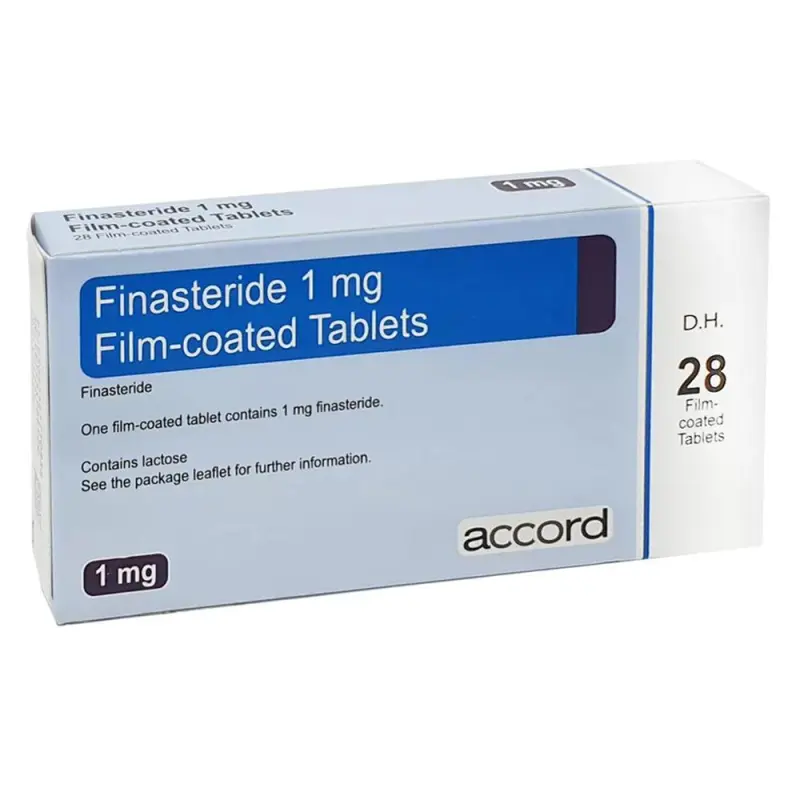
Finasteride: effect, dose and side effects explained
The best documented tablet for male hair loss, how it is used, and what you should know.
What is Finasteride, and how does it work?
Finasteride is one of the best documented treatments for male, hereditary hair loss. It is what is known as a 5-alpha-reductase inhibitor, which works by blocking the enzyme that converts testosterone into dihydrotestosterone (DHT), the hormone that miniaturises genetically sensitive follicles. By lowering the DHT level in the scalp, Finasteride acts on the cause of the hair loss itself, not merely the symptom.
That distinguishes Finasteride from Minoxidil, which stimulates growth without affecting DHT. Because the two work through different mechanisms, they are often combined to achieve the best effect. Finasteride is typically taken as a 1 mg tablet daily and requires a prescription.
Because Finasteride works at hormone level, it has a systemic effect throughout the body, not only in the scalp. That is both its strength, a genuine effect on the cause, and the reason side effects must be taken seriously and discussed with a doctor. DHT also plays a role elsewhere in the body, and a general reduction affects more than just the follicles.
What can you realistically expect?
Studies show that a large majority of men who take Finasteride either preserve their hair or achieve some thickening over several years. The treatment is best at stopping or slowing the loss, it is far better at preserving existing hair than at restoring hair from follicles that have already been completely destroyed.
The effect comes slowly. Allow 3-6 months before you see a clear effect, and up to 12 months for the full result. As with all medical hair treatment, the effect depends on continued use: if you stop, the hereditary hair loss typically resumes within 6-12 months, and the gains are gradually lost.
It is also worth understanding that Finasteride does not work the same way for everyone. Some experience a clear thickening, others “only” a stabilisation, but a stabilisation is often a great victory, because the alternative is a continued, inevitable loss. Regular photographs over time are the best way to judge your own response, since slow changes are hard to see in the mirror from day to day.
Side effects, what you need to know
A minority of men experience sexual side effects such as reduced libido or erectile difficulty. For most people these are reversible on stopping, but they should be discussed thoroughly with a doctor before starting, so that you can make an informed choice. Some also report effects on mood. It is important to be honest with yourself and your doctor about how you feel on the treatment.
Finasteride is not for women of childbearing age because of the risk of harm to a foetus, and pregnant women should not even handle crushed tablets. Female hair loss is therefore typically treated with other agents. The decision to start, continue or stop should always be made in consultation with a doctor, never on the basis of something you read online.
Finasteride, Dutasteride and combination treatment
Dutasteride is a related, more powerful DHT blocker that blocks both types of the enzyme and is used off label in some places when Finasteride does not give a sufficient effect. The stronger action can be accompanied by a correspondingly greater risk of side effects. For most people Finasteride is the first choice.
The most effective strategy for many is a combination: Finasteride to slow the cause and Minoxidil to stimulate growth. Read more about the whole toolbox in our guide to slowing hair loss without surgery.
Get a free hair analysis
- 1Start
- 2Info
- 3Done
Finasteride and hair transplantation
If you are considering, or have already had, a hair transplant, Finasteride often plays an important role. A transplant moves DHT-resistant hairs, but it does not stop the hereditary loss of your original hair. Continued medical treatment protects the non transplanted hair, so that the result stays natural and dense over the years, see more under longevity.
Conclusion
Finasteride is a well documented cornerstone in the treatment of male hair loss, because it acts on the cause by lowering DHT. It preserves hair better than it restores it, works slowly and requires continuous use. Side effects affect a minority and should be discussed with a doctor. Regard Finasteride as one, often the most important, element in an overall, long term plan. This article is informative and does not replace medical advice.
Who is Finasteride a good idea for?
Finasteride is primarily relevant for men with early to moderate hereditary hair loss, where there is still hair to preserve. The earlier in the process you start, the more the treatment has to work with. In very advanced loss, where the follicles have already been destroyed, the effect is limited, and here surgery combined with maintenance plays a larger role.
The decision is personal and should be made with a doctor who knows your medical history. Some choose to accept a small risk of side effects in order to preserve their hair; others prioritise differently. There is no single right answer, only what is right for you once you are fully informed about both the benefits and the drawbacks.
Patience and realistic expectations
The most common mistake with Finasteride is giving up too early. Because the effect comes slowly over 6-12 months, and because it is about preventing a future loss, it can be hard to “feel” that the treatment is working. But precisely what you do not see, the loss that fails to happen, is often the treatment's greatest contribution. Give it time, document it with photographs, and evaluate together with your doctor rather than judging too quickly.
© IdealofMeD Research Academy. Republished with permission.
Get a no-obligation assessment against fixed criteria, directly on WhatsApp.