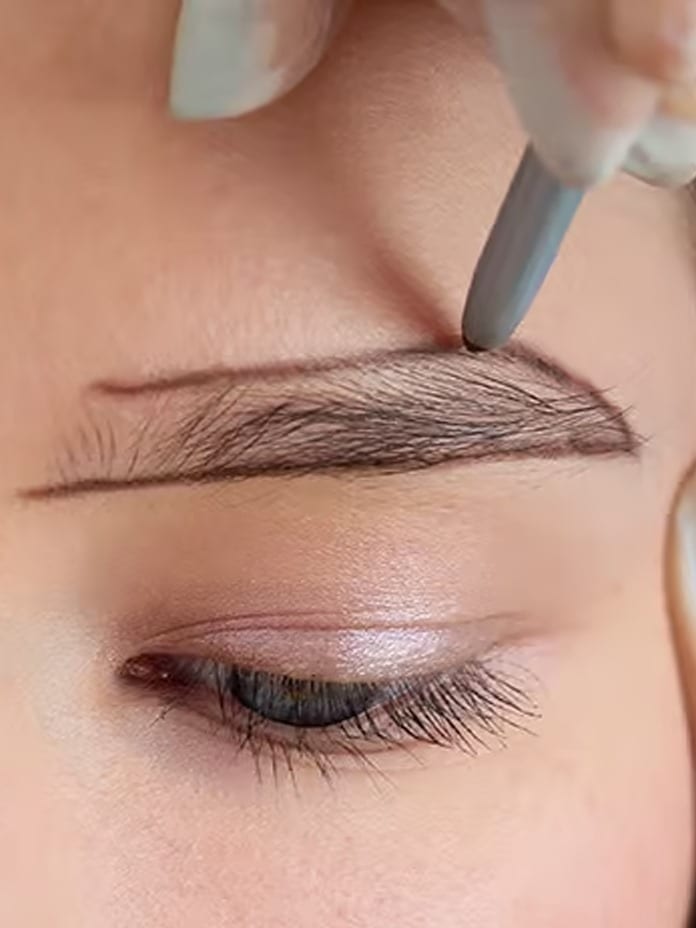
Eyebrow transplantation: precision work for lasting, natural brows
Eyebrow transplantation is among the most demanding precision procedures in the field. I explain who it suits, why angles are everything, and what you need to know.
What is an eyebrow transplant?
An eyebrow transplant is a procedure in which individual follicles, typically from the back of the head, are moved to the eyebrow area in order to restore or thicken brows that are thin, patchy or entirely absent. It uses the same basic FUE technique as scalp hair transplantation, but it is considered one of the most demanding precision procedures in the whole field because of the visibility of the eyebrows and their very specific growth patterns.
The demand comes from several sources: people who have over-plucked their brows over the years, people with naturally thin brows, people who have lost brows because of scars, burns or illness, and people with conditions such as alopecia. For all of them a transplant can provide near-permanent, real brows, something no make-up or temporary treatment can.
Because brows sit so centrally in the expression of the face, there is no margin for error. A poorly performed brow procedure is impossible to hide, and so choosing a surgeon with specific experience in this area is essential.
Why angles and direction are everything
Eyebrow hair grows in a remarkably complex pattern. In the innermost part of the brow the hairs grow almost vertically upwards, across the middle they lie flat and at an angle, and in the outermost part they point downwards and outwards. This shifting direction is exactly what makes a natural brow look the way it does, and recreating it is an exercise in extreme precision.
On top of that, brow hairs have to be placed at a very low, almost flat angle to the skin, so that they lie down rather than stick out. Even a small error in angle or direction is clearly visible in the middle of the face. The surgeon must therefore place every single hair with a considered orientation that follows the natural pattern, work that requires both anatomical knowledge and an artistic eye.
There is also the challenge that you are transplanting scalp hair to a place where the hairs are by nature shorter and grow differently. Transplanted brow hairs keep the growth properties of scalp hair, which means they keep on growing and have to be trimmed regularly: an important thing to know in advance.
Who is a candidate?
Candidates for eyebrow transplantation include people with permanently thin or absent brows, whether because of over-plucking, genetics, scars, burns or certain illnesses. An important precondition is that the cause is stable: for example, an active autoimmune condition such as alopecia areata in the brow area should be quiet before surgery is considered, since the immune attack could otherwise also strike the new hairs.
As with all transplants a sufficient donor area is required, but since a brow needs only relatively few grafts compared with scalp hair, the burden on the donor is modest. The greatest precondition is rather finding the right surgeon with specific brow experience and having realistic expectations of the process and the maintenance.
A thorough consultation in which you draw the shape of the brow together and discuss growth patterns and maintenance is an important part of the process. Shaping the brow is just as important as the technique itself.
The process and maintenance
The procedure is carried out under local anaesthetic and is relatively short because of the limited number of grafts. After the operation small crusts form and fall off over about a week, and the transplanted hairs go through shock loss before growing back over the following months. The final result typically appears over 6-12 months.
The most important maintenance is trimming. Because the transplanted hairs are scalp hairs, they grow longer than natural brow hairs do and therefore have to be cut regularly to preserve the natural brow length. Some people also find that the hairs need 'training' in the right direction at first. This is a normal and manageable part of having transplanted brows.
With correct care the result is near-permanent and natural, but it requires that small, ongoing effort of trimming, which you have to accept before choosing the procedure.
Get a free hair analysis
- 1Start
- 2Info
- 3Done
Advantages and disadvantages
Advantages:
- Long-lasting, real brows; no daily make-up needed.
- It restores brows lost to over-plucking, scars or illness.
- A modest burden on the donor.
- A natural result when performed by a specialist.
Disadvantages:
- It requires extreme precision; no margin for error in the visible face.
- Transplanted hairs have to be trimmed regularly.
- It requires a surgeon with specific brow experience.
- Active disease in the area has to be quiet first.
Frequently asked questions
Do I have to cut my transplanted brows? Yes, regularly. Since the hairs are scalp hairs, they grow longer than natural brow hairs and have to be trimmed to preserve the natural length.
Is the result permanent? Near-permanent, yes. The hairs are taken from the DHT-resistant donor area and typically stay in the brow.
Does it hurt? The procedure is carried out under local anaesthetic and is relatively short. There may be slight tenderness and small crusts for the first few days.
Can over-plucked brows be restored? Yes, that is one of the most frequent reasons for the procedure. Permanent over-plucking can be remedied with a transplant, provided the cause is stable.
Shaping the brow: a shared decision
One part of eyebrow transplantation that deserves particular attention is the shaping of the brow itself. The shape of the brow has an enormous influence on the expression of the face, and it is a decision that should be taken in close dialogue between patient and surgeon, ideally by drawing the desired shape before the procedure and assessing it against the proportions of the face and the patient's wishes.
Here men and women often differ in what they want: some want a full, striking brow, others something more restrained and natural. Whatever the case, the goal is a brow that suits this particular face and looks natural, not a template. A skilled surgeon listens to your wishes but also advises honestly on what will suit the face and look natural in the long run.
Because the result is near-permanent, this planning phase is just as important as the surgical execution. Take your time over it, ask questions, and make sure you and your surgeon share the same vision before you proceed. A well shaped brow, executed with precision, can be life-changing; a badly shaped one is hard to correct.
Conclusion
Eyebrow transplantation can give lasting, natural brows where over-plucking, genetics, scars or illness have left them thin or absent. It is one of the field's most demanding precision procedures, because the complex growth patterns of the brows and their central position in the face allow no errors, and because the transplanted hairs require regular trimming.
For the right candidate with a specialised surgeon and realistic expectations of the maintenance it is an effective, lasting solution. Choose a surgeon with documented brow experience specifically. This article is for general information and does not replace an individual assessment.
© IdealofMeD Research Academy. Republished with permission.
Get a no-obligation assessment against fixed criteria, directly on WhatsApp.