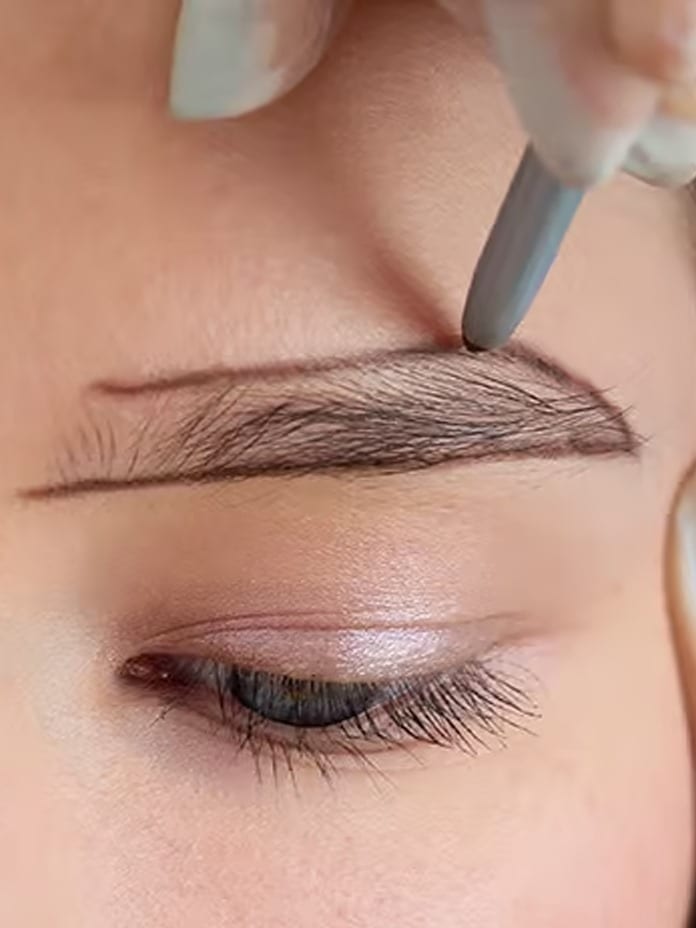
FUE for eyebrow restoration
Eyebrow restoration uses the same extraction technique but demands far more of the placement: single-hair grafts, very shallow angles, and a direction that changes across the brow.
Eyebrow restoration uses the same extraction technique but demands far more of the placement: single-hair grafts, very shallow angles, and a direction that changes across the brow. It is a small procedure that is disproportionately difficult to do well.
What makes eyebrow restoration different from scalp FUE?
Eyebrow restoration differs because scalp hair emerges at a steep angle, while eyebrow hair lies almost flat and rotates direction along the brow, upward at the inner end, then sweeping outward. Reproducing that means placing each graft individually at a shallow angle that changes every few millimetres; density matters less than direction.
What grafts and donor hair are used for eyebrow restoration?
Eyebrow restoration uses single-hair grafts almost exclusively, since multi-hair units look tufted, with typically a few hundred grafts placed per brow. Donor hair is usually taken from finer hair, often above the ears or at the nape, because colour and calibre matching matters more here than it does on the scalp.
- Single-hair grafts almost exclusively; multi-hair units look tufted
- Typically a few hundred grafts per brow
- Usually taken from finer hair, often above the ears or the nape
- Colour and calibre matching matters more than on the scalp
What should you expect after an eyebrow transplant?
Transplanted eyebrow hair sheds and regrows on the normal timeline, with visible growth from months three to four and a settled result around twelve months. Because it is scalp hair, it keeps scalp growth behaviour: it grows longer than native brow hair and needs trimming every couple of weeks indefinitely, which some find tedious.
Who is a good candidate for eyebrow transplant?
Good candidates for eyebrow transplant include people with loss from over-plucking, scarring or trauma, and those with congenitally sparse brows. Alopecia areata patients qualify only once the condition has been quiet for a sustained period; the procedure is not appropriate during active inflammatory disease.
- Loss from over-plucking, scarring or trauma
- Congenitally sparse brows
- Alopecia areata only when the condition has been quiet for a sustained period
- Not appropriate during active inflammatory disease
Our eyebrow transplant guide covers candidacy and results.
Sources
- Parsley WM, Perez-Meza D. Review of factors affecting the growth and survival of follicular grafts. Journal of Cutaneous and Aesthetic Surgery, 2010;3(2). jcasonline.com
This article summarises published research and standard clinical practice. It is general educational information, not medical advice, and it does not replace the instructions your own surgical team gives you. Where their guidance differs from anything here, follow theirs.
Get a no-obligation assessment against fixed criteria, directly on WhatsApp.