Hyperbaric oxygen therapy and hair transplantation: does it help graft survival?
Hyperbaric oxygen therapy (HBOT) is increasingly marketed as a 'boost' for hair transplantation. I go through the mechanism, the real evidence and the pros and cons as I honestly see them.
What is hyperbaric oxygen therapy?

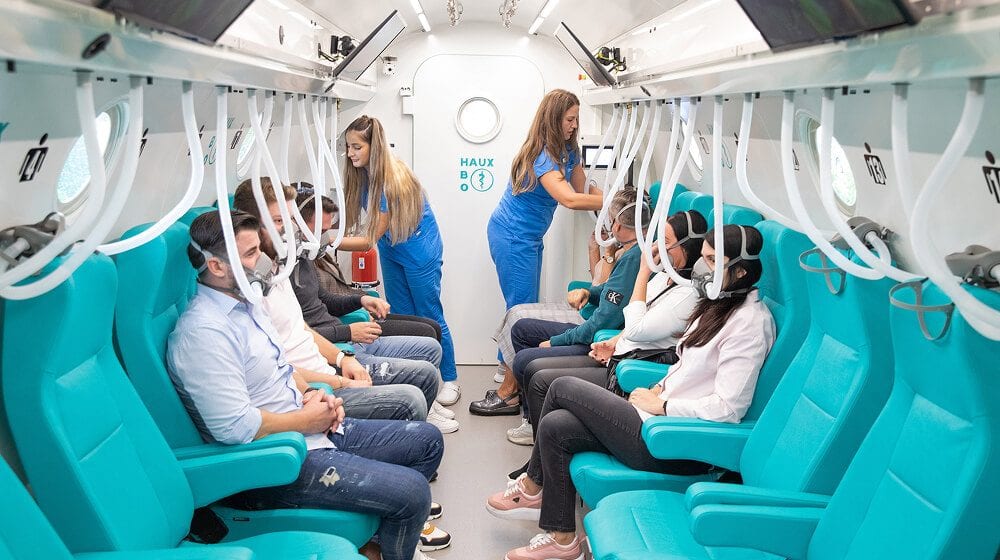
Hyperbaric oxygen therapy, abbreviated HBOT, is a treatment in which you stay in a pressure chamber and breathe 100% oxygen at a pressure higher than normal atmospheric pressure. The idea is simple: by raising the pressure, the blood can take up far more oxygen than usual, not only bound to the red blood cells, but also dissolved directly in the blood plasma. The result is that oxygen can reach tissue that is otherwise poorly supplied.
HBOT has well established, documented uses in medicine: treating decompression sickness, carbon monoxide poisoning, poorly healing wounds in people with diabetes and certain infections. More recently the treatment has appeared in the marketing of hair transplant clinics as something that should improve graft survival and speed up healing. As a surgeon I have followed this development closely, and in this article I will try to give you a balanced, honest picture: neither a dismissal nor a celebration.
The biological logic: why oxygen at all?
To understand why anyone connects HBOT with hair transplantation at all, you have to understand what happens to a graft after placement. When we move a follicle from the donor area to the recipient area, we temporarily cut it off from its blood supply. In the first 24 to 72 hours the graft survives on oxygen and nutrition seeping in from the surrounding tissue (a process called imbibition), until the body has grown new, small blood vessels into the graft, a process we call revascularisation.
This oxygen-poor period is the graft's most vulnerable phase. The theory behind HBOT is that if you can saturate the surrounding tissue with extra oxygen during precisely this window, you can keep more grafts alive until the new blood supply is in place. It is a biologically plausible idea, and that is exactly why it is worth taking seriously rather than dismissing by reflex. But a plausible mechanism and a proven effect are two different things, and that is where the nuances begin.
What does the evidence actually say?
I'll be straight with you here, as I am with my patients: the scientific documentation specifically for HBOT in hair transplantation is still young, and it is not equally strong on the two questions patients ask. On the early recovery, meaning crusting, redness and discomfort, there is now real data. On whether HBOT raises the final number of surviving grafts, there is not.
The largest piece of work so far is a prospective cohort study from the IdealofMeD Research Academy. Two hundred and twenty men, all operated on by the same surgeon with the same technique, the same medication and the same aftercare, followed from April 2025 to June 2026. What makes it worth reading is the design: patients scored their own healing, pain, sleep and redness on day 11, and independently of them a medical team with no part in the surgeries, blinded to who had been in the chamber, scored standardised photographs from day 10. Both methods came out in favour of HBOT, and they landed close together: the blinded photographic scores were 5.3 out of 10 with no HBOT, 8.6 after one session and 9.7 after two. The largest single difference the patients themselves reported was sleep quality in the first days.
One caveat matters here: patients chose their own group rather than being assigned at random, so this is a strong association and not proof of cause. Two smaller pieces of work point the same way. A randomised trial by Fan and colleagues found markedly less early shedding and less folliculitis, and a case report of five patients described scabs that were gone in three to five days.
So the absence of evidence is not what it was a few years ago, but it is still there on the question of graft survival. Anyone who promises you a guaranteed, dramatic improvement in your final result through HBOT is speaking beyond what the science supports. What the research does support, and by now reasonably well, is that the first two weeks are easier.
Advantages: what HBOT can realistically contribute
- Better oxygen supply in the critical window: The most plausible advantage: extra oxygen to the grafts while the new blood supply is being established.
- Faster wound healing: HBOT's well documented effect on general wound healing can mean less crusting and a faster, cleaner healing of the donor and recipient areas.
- Less inflammation and better comfort: This is where the evidence is strongest. In the cohort of 220 patients redness settled faster, pain scores were better, and sleep in the first days was what improved most of all.
- Potentially beneficial in large sessions: With very high graft numbers, where the recipient area is densely packed and the oxygen supply is under extra pressure, the theoretical gain is greatest.
- Can benefit smokers and patients with poor circulation: In people whose tissue supply is already compromised there is a logical case for extra oxygen, although the best measure here is to stop smoking.
Note that several of these advantages concern healing and comfort rather than a dramatic increase in the final number of surviving grafts. That is an important distinction, which the marketing often blurs.
Disadvantages: what you need to be aware of
- Cost: HBOT is expensive. Several sessions in a pressure chamber often cost thousands on top of the operation, money that might do more good elsewhere.
- Time: Each session typically takes 60-90 minutes, and several are usually needed. That is a considerable extra investment of time in an already busy period.
- Evidence for the comfort, not for the final result: The documentation on the early recovery has become solid enough to take seriously. What is still missing is a study designed to measure density at twelve months. So you are paying for an easier recovery rather than a proven better result.
- Side effects: Although HBOT is safe for most people, pressure changes can cause ear problems (barotrauma), temporary short-sightedness and in rare cases oxygen toxicity. People with certain lung conditions should not receive the treatment.
- Marketing risk: HBOT is sometimes used as an expensive add-on that makes a package look more exclusive, without the real gain matching the price.
My clinical position after many years
After around two decades in the field my position on HBOT is measured and positive, but not uncritical. I regard it as a potentially useful supplement in selected cases, not as a necessity for a good result. The factors that really determine your graft survival are far more down to earth: an atraumatic extraction technique, short times outside the body, correct placement at the right depth and angle, and careful aftercare on the patient's part.
In other words: a skilled surgeon with a solid technique gives you a far greater gain in graft survival than any pressure chamber can. If your clinic has the fundamentals in order, HBOT can be a sensible extra margin in particular situations. If, on the other hand, a clinic highlights HBOT as its big selling point while being vague about who performs the operation itself, that is a warning sign: they are selling you an add-on to divert attention from what actually matters.
Get a free hair analysis
- 1Start
- 2Info
- 3Done
Who does it make most sense for?
If I had to point to the patients where HBOT theoretically offers most value, it would be: patients with very large sessions and dense packing, where the oxygen supply is under extra pressure; patients with compromised circulation (for example some people with diabetes); and patients undergoing repair surgery in an already scarred area with poor tissue quality. For the average, healthy patient with a normal session the extra gain is probably small.
Whatever the case, the decision should be made in dialogue with your surgeon and on the basis of your specific situation, not on the basis of a brochure. And if you want to improve your graft survival for free, the answer is simple and well documented: stop smoking before and after the operation, follow the aftercare closely, and avoid alcohol in the early phase. That makes a larger, more certain difference than most optional extras.
HBOT compared with other 'boosts'
To put HBOT in perspective it is useful to compare it with the other add-on treatments clinics offer around a transplant. In practice they all compete for the same place in the patient's budget, and it is worth knowing where the evidence is strongest.
| Add-on | Purpose | Level of evidence | Typical cost |
|---|---|---|---|
| Hyperbaric oxygen (HBOT) | Oxygen supply, healing | Good for early healing, open for graft survival | High |
| PRP | Growth factors, healing | Moderate | Medium |
| LLLT (red light) | Stimulation | Mild to moderate | Medium (one-off purchase) |
| Good aftercare | Graft survival | Solid (in practice) | Free |
Note the bottom row. The most effective 'treatment' for your graft survival costs nothing: following the aftercare closely, keeping away from smoking and alcohol, and protecting the grafts during the critical first days. Any paid add-on should be judged in the light of the fact that the foundation has to be in place first.
A realistic patient example
Let me give a concrete example from my daily practice. A patient with a large requirement, say 4 500 grafts across the front and crown, asks whether he should add a series of HBOT sessions costing several thousand. Here I would answer: if we can pack densely in a large area where the oxygen supply comes under pressure, there is a theoretical advantage that you can choose to invest in. But I would never promise him that it changes his result decisively.
Conversely: a healthy non-smoker with a moderate requirement of 2 000 grafts will probably get an excellent result entirely without HBOT. For him the money would be better spent on continued medical maintenance of the rest of his hair, which protects the whole in the long term. The point is that the right answer depends on the individual, and that a clinic offering every patient the same expensive add-on is not advising individually.
Frequently asked questions about HBOT and hair transplantation
Is HBOT necessary for a good result? No. By far the majority of hair transplants around the world are performed with excellent results entirely without hyperbaric oxygen. It is a possible supplement, not a precondition, and nobody should persuade you that a good result depends on it.
How many sessions are we talking about? Protocols vary, but a series of sessions in the days around the operation is typically recommended, each of 60-90 minutes. It is an investment of both time and money that you should count on from the outset if you are considering it.
Are there patients who should not have HBOT? Yes. People with certain lung diseases, an untreated pneumothorax or particular ear problems should not be treated, and any HBOT must take place under expert supervision. That is another reason the treatment is not simply a harmless 'extra' you add without thought.
Would you choose it yourself? As a patient with a normal session and healthy circulation I would prioritise an excellent surgeon and disciplined aftercare over spending the budget on HBOT. In large, complex cases I would consider it as an extra margin, but never as a substitute for what really counts.
Conclusion
Hyperbaric oxygen therapy in hair transplantation rests on a plausible biological logic and is supported by HBOT's well documented effect on wound healing in general. On the early recovery (crusting, redness, pain and sleep), the evidence has become good. What is still missing is a study designed to show that the treatment raises the final number of surviving grafts. Regard it as a supplement that buys you two easier weeks in selected cases, not as a necessity or a guarantee for the result itself.
What really determines your result is the surgeon's skill, a gentle technique and your own aftercare. If you spend money and time on HBOT, do so with open eyes and realistic expectations, and never as a substitute for choosing the right clinic in the first place. This article is for general information and does not replace an individual medical assessment.
© IdealofMeD Research Academy. Republished with permission.
Get a no-obligation assessment against fixed criteria, directly on WhatsApp.