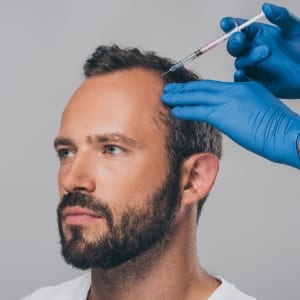
Stem cell treatment for hair loss: revolution, or marketing ahead of the science?
Stem cells sound like tomorrow's answer to hair loss. I explain what is actually on offer today, what the research shows, and why as a surgeon I am both hopeful and very cautious.
What does 'stem cell treatment' actually mean?
Few words in the hair industry create so much hope, and so much confusion, as 'stem cells'. The term sounds futuristic and scientific, and for exactly that reason it is used liberally in the marketing of everything from injections to expensive courses of treatment. But when you ask what is concretely on offer under the heading of stem cell treatment for hair loss, you quickly discover that this is not one well defined treatment but a broad range of widely differing things with very different levels of evidence.
Genuine stem cells are cells with the remarkable ability to develop into other cell types and to renew themselves. In the hair context the idea is that by supplying or activating stem cells you can regenerate weakened or lost follicles. It is a scientifically fascinating idea, and serious research into it is under way around the world. The problem is that what is marketed to patients today is rarely the same as what the research has actually documented.
In practice, 'stem cell treatment' in clinics often covers things such as stem cell derived products, fat tissue based injections, exosomes (which come from stem cells) or even simply treatments loosely claimed to 'activate' the scalp's own stem cells. This confusion of terms is in itself an important warning sign: when a word can mean almost anything, you should be extra critical about what you are actually buying.
The scientific promise, and the commercial reality
Let me first acknowledge the hopeful part. Regenerative medicine and stem cell research are among the most exciting fields in modern medicine, and there is genuine, serious research into how we might one day grow new follicles or multiply a patient's own follicles in the laboratory. If that research succeeds, it could fundamentally change how we treat hair loss, potentially without the limit that the size of the donor area imposes today. It is a future I look forward to as a surgeon.
But between the promising research and the commercial reality there is a chasm. What is offered in clinics today under the stem cell heading is a long way from the breakthroughs the laboratories are working towards. Much of it is based on extrapolation, theory and small observations rather than on solid, documented effect in humans. There is a world of difference between 'research shows promising results in the laboratory' and 'this treatment will give you more hair', and that difference is unfortunately exploited commercially.
As a responsible surgeon I have to keep the two apart. I can be sincerely enthusiastic about the direction of the research and at the same time very sceptical of the treatments sold to patients today under the same name. Confusing the two is exactly the mistake the marketing wants you to make.
What do the evidence and the regulation say?
On the evidence side the picture is clear: there is today no stem cell treatment for hair loss with a solid, well documented effect on a par with Finasteride or Minoxidil. There are small studies, animal experiments and early observations pointing in promising directions, but the large randomised trials that would be needed to establish a real, lasting effect in humans are still missing. The field is promising, but immature.
The regulation reinforces the caution. In many countries commercial stem cell products for this type of use are not approved, and health authorities have repeatedly warned consumers against unproven stem cell treatments, both because of the lack of documented effect and because of safety concerns. There have been reports of harm following unregulated stem cell treatments in other areas, and the lack of standardisation means that as a patient you rarely know exactly what is being injected into you.
The combination of weak evidence and weak regulation should give anyone reason for considerable caution. When a treatment is neither proven nor properly regulated, yet is sold at a high price with large promises, the patient has in practice become a paying test subject in an immature market, often without realising it.
Advantages: the case in favour (and with what reservations)
- Great theoretical potential: If the research succeeds, stem cell therapy could one day overcome the current limitation of donor area size: the really big prize.
- A regenerative approach: Instead of merely stimulating existing follicles, the idea aims to regenerate or create new ones, a more ambitious route in principle.
- Non-surgical: The treatments on offer are typically injection based and require no appreciable recovery.
- Active research: The field attracts serious scientific attention, which increases the likelihood of real progress over time.
Note that almost all of these advantages belong to the future. They concern what stem cell therapy might become, not what the treatments sold today can demonstrably deliver. That is an important distinction to hold on to.
Disadvantages: the case against today
- No documented effect: There is as yet no stem cell treatment with solid evidence for treating hair loss in humans.
- Regulatory reservations: In many places the products are not approved, and regulators have warned about both effect and safety.
- Safety concerns: Unregulated stem cell treatments have been linked to harm in other fields; the lack of standardisation makes the contents opaque.
- A very high price: Among the most expensive offerings on the market: you pay for a promise, not a documented treatment.
- Confusion of terms: 'Stem cell' is used so broadly that you rarely know exactly what you are buying.
Get a free hair analysis
- 1Start
- 2Info
- 3Done
How I tell them apart as a surgeon
| Category | Status today |
|---|---|
| Basic research in the lab | Promising, serious, exciting |
| Commercial 'stem cell' injections | Undocumented, often unregulated |
| Well documented medication (Finasteride/Minoxidil) | Proven, available, safe |
| Hair transplantation | Proven, effective in permanent loss |
This simple division helps me advise honestly. I am enthusiastic about the top row and sceptical of the second, and I always anchor my patients' actual treatment in the two bottom, documented rows. That is not pessimism; it is distinguishing between hope and proof, which is the very core of responsible medical practice.
My clinical position
My position can be summed up like this: hopeful about the research, sceptical about the market. I sincerely believe regenerative medicine may one day play a large part in the treatment of hair loss, perhaps even revolutionise it. But that day has not yet come, and until it does I regard the stem cell treatments sold to patients today as undocumented and often overpriced.
I become particularly concerned when I meet patients who have spent large sums on stem cell injections instead of well documented treatment, sometimes advised by clinics with a clear financial interest in the expensive offering. When somebody presents an unproven, unregulated treatment as a 'breakthrough you must not miss', that is in my experience one of the clearest signs that the marketing has run ahead of the science.
So my advice is simple: follow the field with interest, but anchor your treatment in what is documented. Build your foundation on well documented medication, consider a hair transplant for permanent loss, and let the stem cells mature from promise to proof before you pay for them.
Frequently asked questions about stem cell treatment
Can stem cells restore my lost hair today? No. There is today no stem cell treatment with a documented ability to restore lost hair in humans. What is offered commercially is undocumented.
Is it safe? Not sufficiently established. Many products are not approved, and unregulated stem cell treatments have been linked to harm in other fields. Safety cannot be guaranteed.
Are exosomes the same as stem cells? No, but they are related. Exosomes are small vesicles released by cells (often stem cells). Exosome therapy for hair loss is also early and unregulated, as described in our separate article on the subject.
When will it become a real option? Nobody knows for certain. The research is promising, but there is no guarantee about the timescale. Until solid evidence and regulation are in place, your treatment should be built on what is documented.
Why patience is the wise strategy
I understand the impatience perfectly well. When you watch your hair thinning, the thought of a regenerative treatment that could solve the problem at its root is deeply appealing, far more so than the slow, sustained effort of tablets and foam. And the marketing knows it. It speaks directly to that hope and that impatience, and it sells tomorrow's promise at today's price. It is an effective, but also an unfair, business model.
Seen from a long term perspective, though, patience is the wisest strategy here. Stem cell research is moving forward, and if it delivers on its promise, the treatments that become available one day will be properly documented, regulated and probably more effective than what is sold today. By waiting for that rather than paying dearly for the immature forerunners, you protect both your wallet and your health, and you miss nothing that demonstrably works.
In the meantime the documented tools are available: well documented medication that demonstrably slows hair loss, and a hair transplant that reliably rebuilds lost areas. These are not tomorrow's promises but today's proven options. A sensible plan uses them now and keeps an eye on stem cell research as a possible future addition, not as a substitute you rush into before it is ready.
It is the same advice I give to those closest to me: build on what is proven today, and let the promising prove itself before you pay for it. In a field so marked by hope and marketing, sober patience is one of the most valuable qualities a patient can have.
Conclusion
Stem cell treatment for hair loss is one of the most promising fields in long term research, and one of the most problematic in short term marketing. There is today no commercial stem cell treatment with a documented effect in humans, the products are often unregulated, and the prices are high.
Be hopeful on behalf of the research, but careful with your wallet and your expectations. Anchor your treatment in what is documented (medication and possibly surgery), and let the stem cells prove themselves before you pay for them. This article is for general information and does not replace an individual medical assessment.
© IdealofMeD Research Academy. Republished with permission.
Get a no-obligation assessment against fixed criteria, directly on WhatsApp.