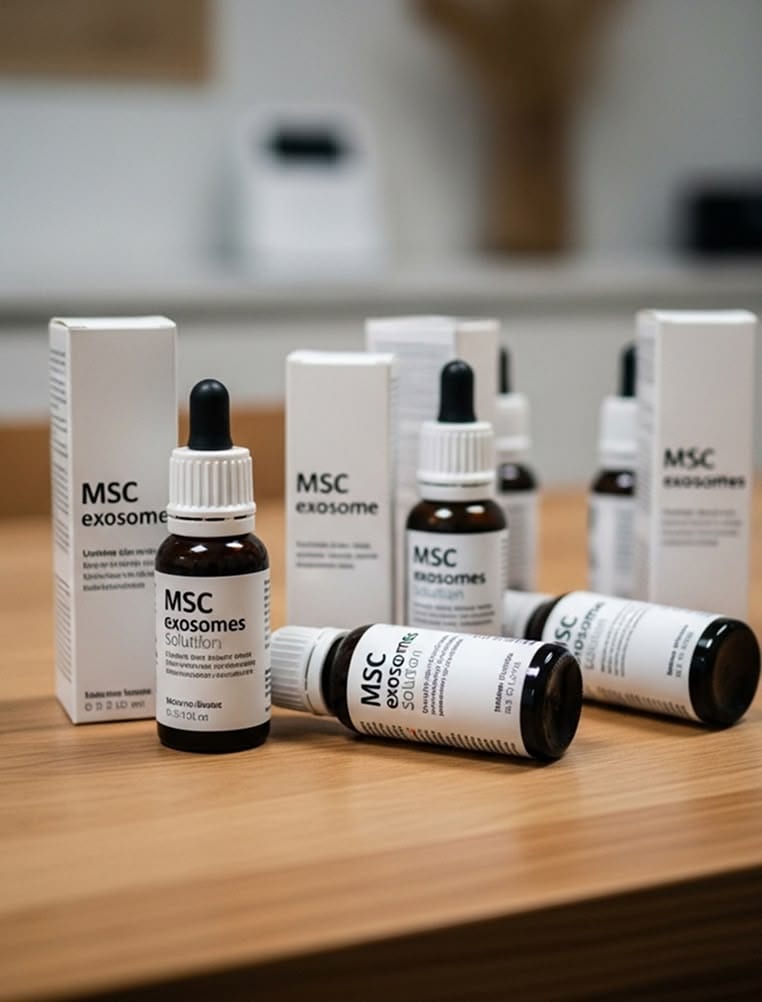
Exosome therapy for hair loss: tomorrow's breakthrough or expensive hype?
Exosomes are one of the most talked about, and most expensive, new offerings for hair loss. I explain what they are, what we actually know, and the pros and cons.
What are exosomes?
Exosomes are extremely small vesicles (nanoparticles) that cells release to communicate with one another. They contain proteins, growth factors, lipids and genetic material (such as micro-RNA), and in practice they act as the cells' 'messengers', carrying signals from one cell to another. In the hair context the interest is directed at exosomes derived from stem cells, because they carry a cocktail of growth factors that could in theory stimulate the follicles.
Exosome therapy for hair loss typically involves a preparation containing exosomes being injected into or applied to the scalp, often combined with microneedling to improve uptake. The treatment is often presented as the 'next generation' after PRP: more potent, more targeted. It is one of the most talked about new offerings in the industry, and also one of the most expensive. That alone is reason enough to take a critical, sober look at it.
The theoretical appeal
The logic behind exosomes is seductive. Where PRP (platelet rich plasma) delivers your own growth factors in a relatively unstandardised concentration, exosome preparations are claimed to deliver a far higher and more uniform dose of exactly the signals that promote hair growth, without having to draw and centrifuge the patient's own blood. The growth factors are supposed to prolong the growth phase, wake resting follicles and improve the environment around the follicle.
On paper it sounds like a logical next step. And there are genuine laboratory experiments and early clinical observations pointing in a promising direction. But here I have to draw a sharp distinction, as always, between what is theoretically promising and what is proven and regulated, because on this point the exosome field is still immature, and that has consequences for you as a patient.
What do the evidence and the regulation say?
I want to be very clear about this. The evidence for exosome therapy against hair loss is still early and limited: small studies, short follow-ups and no large randomised trials establishing a lasting effect. The treatment is promising, but it is far from proven at the level of, say, Finasteride or Minoxidil.
More important still is the regulatory picture. In several countries, including under both American and European authorities, commercial exosome products for this type of use are not approved, and regulators have issued warnings about safety, sterility and the lack of standardisation. There is no uniform definition of what an 'exosome preparation' contains, and products from different suppliers can vary enormously in content and quality. This is a market without a fixed standard, and that should give any patient reason for caution.
Advantages: the case in favour
- High theoretical potency: A concentrated, targeted dose of growth factors, potentially stronger than PRP.
- No blood draw: Unlike PRP it does not require the patient's own blood to be taken and processed.
- Promising early signals: A few studies and clinical experience point to increased density and improved healing, especially combined with microneedling.
- A possible supplement after a transplant: Some clinics use it to support healing and the start of growth after an operation.
- Non-surgical and quick: The treatment is an outpatient procedure and requires no appreciable recovery.
Disadvantages: the case against
- Immature evidence: The effect is not proven at a solid level. You are paying for a promise, not for a documented treatment.
- Regulatory reservations: In many places the products are not approved for this use, and regulators have warned about safety and sterility.
- A lack of standardisation: There is no guarantee of what a given exosome preparation actually contains, and quality can vary dramatically between providers.
- A high price: Exosome treatments are among the most expensive offerings on the market, often several times dearer than PRP, without correspondingly stronger documentation.
- Marketing ahead of science: The field is marked by aggressive marketing that runs far ahead of what the evidence can support.
My clinical position
I am curious by nature about new technology, and I believe exosomes may well come to have a place in hair treatment in the future. But as a responsible surgeon I distinguish between what I hope for and what I recommend to my patients today. And right now I cannot recommend exosome therapy as a documented, standardised part of a treatment plan: the evidence and the regulation are simply not in place yet.
I am particularly sceptical when exosomes are sold as an expensive add-on with large promises, often by clinics with a financial interest in it. When somebody presents an immature, unregulated treatment as a 'breakthrough' you 'must not miss', alarm bells should ring. If you want to spend money supporting your hair, it is better spent on well documented medication, and possibly PRP, where the evidence is at least a little further along.
What you should ask if you are considering it
If you are considering exosome therapy anyway, ask sharp questions: where does the preparation come from, and is it approved by the authorities for this use in your own country? What documentation can the clinic present beyond its own experience? What is the full price, and what is the alternative for the same money? A reputable provider will answer honestly, including about the uncertainty, rather than wrapping the treatment in irresistible promises.
No single injection treatment can stop hereditary, DHT-driven hair loss. However promising exosomes may be, they do not change the underlying hormonal process behind your thinning. Well documented medication does, and that should be your foundation.
Get a free hair analysis
- 1Start
- 2Info
- 3Done
Exosomes vs. PRP: what is the difference?
Because exosomes are often marketed as 'the next generation after PRP', a direct comparison is useful. Both aim to deliver growth factors to the follicles, but they differ in important ways:
| PRP | Exosomes | |
|---|---|---|
| Source | Your own blood | External (often stem cell derived) |
| Standardisation | Variable | Highly variable between providers |
| Regulation | Own blood, well established | Often not approved for the use |
| Evidence | Moderate | Early, limited |
| Price | Medium | High |
The most important difference is the regulation and the origin. With PRP you use the patient's own blood, which is well established and safe. With exosomes you introduce an external product whose content and quality are not standardised, and which in many places is not approved for the purpose. That is a substantial difference in patient safety, and one the price rarely reflects.
Why I am extra careful with 'breakthroughs'
Over the years I have seen numerous treatments marketed as the great breakthrough against hair loss, from assorted serums and supplements to devices and injections. Most disappeared as quickly as they arrived, once the evidence failed to follow the marketing. That experience makes me healthily sceptical, not dismissive, but sceptical.
Exosomes may very well prove the exception that keeps its promises; the research is genuinely exciting. But until there are solid, independent studies and a clear regulatory framework, the early patients are in practice paying to be test subjects in an undocumented market, often at a very high price. That is a role you should choose with open eyes, not because a brochure calls it indispensable.
A sober piece of advice for the curious patient
If you are fascinated by the potential of exosomes, which is entirely understandable, my advice is to follow the field with interest but keep your actual treatment anchored in what is documented. Build your foundation on well documented medication, consider PRP rather than exosomes if you want an injection treatment, and save the exosomes for the day when the evidence and the regulation have matured.
If you choose to try it anyway, do so at a reputable clinic that is honest about the uncertainty, can document the preparation's origin and approval, and does not sell it with guarantees that nobody in this field can give. Your scepticism is your best protection here, not against new science, but against premature, overpriced marketing of it.
Frequently asked questions about exosome therapy
Are exosomes approved for hair treatment? In many countries, including under American and European authorities, commercial exosome products for this use are not approved, and safety warnings have been issued. You should know that and take a view on it before considering the treatment.
Is it better than PRP? Theoretically perhaps, but that is not proven. PRP uses your own blood and is well established; exosomes are an external, unstandardised and more expensive product with earlier stage evidence. On patient safety PRP stands stronger today.
Can exosomes replace medication? No. No injection treatment stops the hormonal, DHT-driven process behind hereditary hair loss. Even if exosomes were to prove beneficial, they would be a supplement, not a foundation that can replace Finasteride and Minoxidil.
Should I wait? In my assessment: yes. The field is promising but immature. Waiting for solid evidence and clear regulation costs you nothing, and protects you from paying a high price for an undocumented treatment whose real value we do not yet know.
The price in perspective
One of the most tangible arguments against exosome therapy is the economics. The treatments are among the most expensive on the market, often several times dearer than PRP, and they usually require repeated sessions to maintain any effect. When you add up the total cost, we are quickly talking about sums that could fund several years of well documented medical treatment.
I always ask my patients to ask themselves a simple question: what gives me the most certain value for the same money? When the answer on one side is an undocumented, unregulated treatment with a promising theory, and on the other well documented medication that demonstrably slows hair loss, the priority often becomes clear. Money spent on what is proven to work is rarely regretted; money spent on the untested is a wager.
Conclusion
Exosome therapy for hair loss is theoretically exciting and possibly part of tomorrow's toolbox, but today it is marked by early, limited evidence, regulatory reservations, a lack of standardisation and a very high price. It is promising research, not a proven treatment.
My recommendation is patience: let the science and the regulation mature, build your treatment on well documented foundations, and be sceptical of expensive promises of a breakthrough. This article is for general information and does not replace an individual medical assessment.
© IdealofMeD Research Academy. Republished with permission.
Get a no-obligation assessment against fixed criteria, directly on WhatsApp.