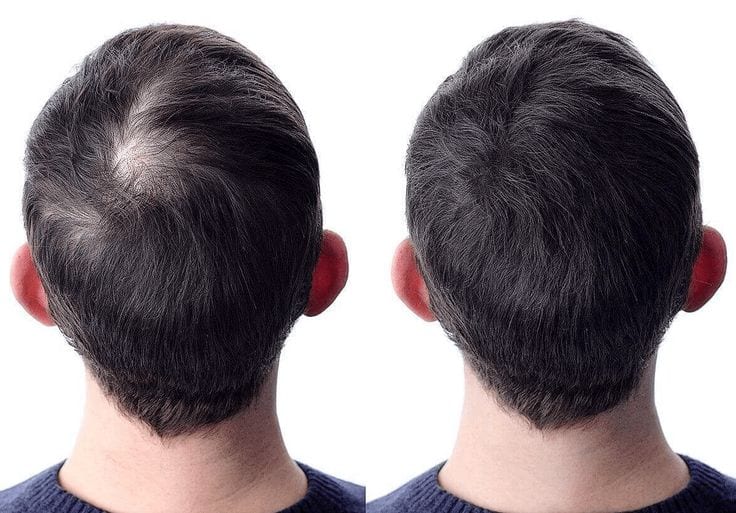
Density: how dense does a hair transplant actually get?
Many people expect teenage density. I explain what can realistically be achieved, why even moderate density looks full, and why the donor sets the limit.
A question of realism
One of the most important subjects on which to set expectations is density. Many patients dream of getting back the thick mane of their teens, but that is rarely realistic, and fortunately it is not necessary for a good, natural result either.
The numbers behind density
Natural hair stands at roughly 80-100 follicular units per square centimetre. In a transplant you typically place 35-50 per square centimetre, that is, about half. That sounds like little, but it is experienced as far denser, because even moderate coverage catches the light and hides the scalp. The eye perceives fullness long before full natural density.
Why not simply pack more densely?
You might be tempted to place grafts very densely in order to approach natural density, but that has a price. Packed too closely, the grafts compete for the same limited oxygen supply, and survival can fall. On top of that, your donor is limited: if you spend it on extreme density in one place, it is missing elsewhere and in the future. Moderate, safe density often gives a better overall result.
What determines your density?
The density you can achieve depends on donor capacity, the thickness of the hair (coarse hairs cover more per graft), the colour of the hair relative to the skin (low contrast looks denser), and the size of the area to be covered. A skilled surgeon distributes the density strategically (most at the front, where it is seen) to maximise the aesthetic impression.
Get a free hair analysis
- 1Start
- 2Info
- 3Done
Strategic distribution of density
An experienced surgeon does not distribute density evenly but strategically. At the front, in and just behind the hairline where the eye catches most, the highest density is placed to give an impression of fullness. Further back and in the crown the density can be a little lower without it showing, which saves the precious donor. This art (placing the limited grafts where they give the greatest aesthetic effect) is a large part of what separates a well considered result from a random distribution, and why experience matters so much for the finished impression.
Realistic expectations protect your satisfaction
The most frequent source of disappointment after an otherwise successful transplant is unrealistic expectations of density. If you go in dreaming of the full density of a teenage mane across the whole head, even an excellent result can feel inadequate. If, on the other hand, you go in with a realistic understanding that the goal is a natural, full and age-appropriate appearance, you will usually be pleased. An honest surgeon sets expectations thoroughly in advance, and a clinic that promises you extreme density over large areas is selling rather than advising.
Conclusion
A hair transplant rarely restores teenage density, but it can give a natural, age-appropriate and full appearance, because even moderate coverage hides the scalp. The limit is set by your donor and by the need to protect graft survival. Be sceptical of promises of extreme density over large areas; that is neither achievable nor wise. This article is for general information and does not replace an individual assessment.
© IdealofMeD Research Academy. Republished with permission.
Get a no-obligation assessment against fixed criteria, directly on WhatsApp.