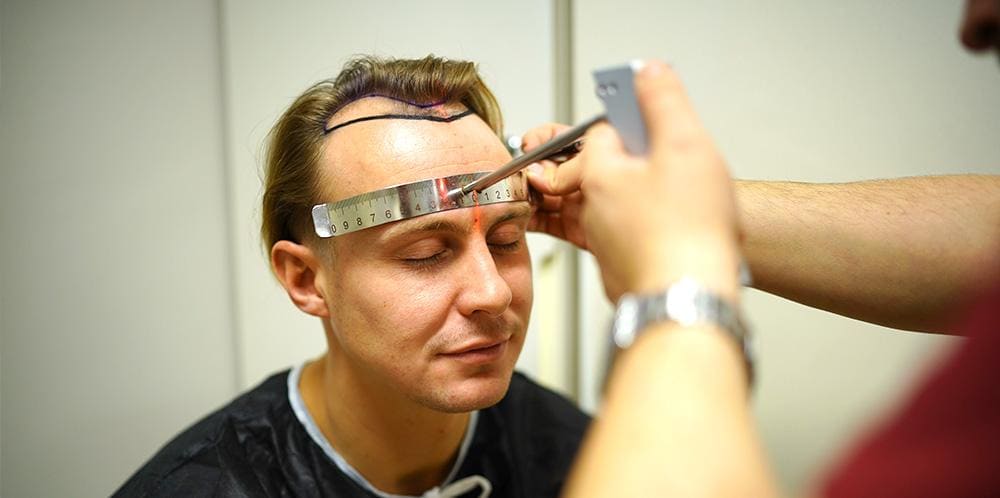
Hairline design: what makes a transplanted hairline natural, or a giveaway?
The hairline is what everyone sees first, and what most often gives away a poor transplant. I explain the principles behind a natural hairline, and why design is the hardest art in this surgery.
Why the hairline is everything
If there is one place where a hair transplant succeeds or fails in the eyes of others, it is the hairline. It is what people see first, and it is what either makes the result look entirely natural or immediately reveals that something has been done. You can execute everything else perfectly, but a poorly designed hairline ruins the whole, and conversely an excellent hairline can carry a result even when the rest is modest.
That is exactly why I regard hairline design as one of the hardest and most important parts of the whole discipline. It is not a question of drawing a line and filling it in; it is an art that requires anatomical understanding, aesthetic judgement, experience and a deep respect for how a person looks today, and will look in twenty years. This is where the difference between a technician and an artist shows most clearly.
In this article I will explain the principles behind a natural hairline, and the classic mistakes that reveal a poor one. The aim is to help you assess a clinic's work with a critical eye, because the hairline is one of the best guides to the quality of a surgeon's results.
A hairline is not a line
The most fundamental mistake you can make is to think of the hairline as a sharp, straight line. A natural hairline is the exact opposite: it is soft, irregular and gradual. If you look closely at a person with natural hair, the transition from forehead to hair is not a clear border but a zone in which individual fine hairs stand scattered and a little randomly, and where the density gradually increases the further back you go.
Recreating this natural irregularity is the art. A skilled surgeon places single hair grafts at the very front of the hairline (the smallest, finest units, with only one hair) to create the soft, feathered transition. Behind them, gradually larger grafts with more hairs are used to build density. And the whole line is given microscopic irregularities (small advances and recesses) so that it does not look like an artificial, drawn edge.
This is exactly where many poor transplants give themselves away: a hairline that is too straight, too dense, too sharp, often with grafts that are too large at the front, giving the notorious 'doll's hair' or 'toothbrush' appearance. That mistake is almost impossible to hide and very hard to correct. Naturalness lives in the irregularity.
Angles and directions
Beyond the shape of the line itself, every individual hair has to be placed at the right angle and in the right direction. Natural hair in the hairline does not grow straight up but at a very low, acute angle forwards, and it points in particular directions that vary across the forehead and change naturally as you move towards the temples and the crown.
A skilled surgeon opens every single channel so that the transplanted hair will grow at exactly the angle and in the direction it would have done naturally. It is an enormous amount of detailed work: hundreds or thousands of small channels, each with its own considered orientation. Get the angles wrong and the hair stands up unnaturally or points in random directions, and the result looks artificial however good the line otherwise is.
This is one of the reasons why opening the channels is one of the critical steps that should be performed by an experienced specialist. It is fine motor craftsmanship in which experience and concentration determine whether the finished hair falls naturally, and it is not something that can be rushed or mass-produced without it showing.
Age and placement: the most important decision
Perhaps the most important, and most overlooked, decision in hairline design is where the hairline should sit. Here the temptation is great, both for the patient and for an unscrupulous clinic: to place the hairline low, as it was in youth, for an immediately impressive result. But that is often a serious mistake with long term consequences.
A natural hairline moves slightly upwards and becomes more mature with age; that applies even to men who never lose their hair. A hairline that is too low and youthful on a middle-aged or older man looks unnatural, and becomes more so as the face ages and the hair behind it thins. On top of that, a low hairline requires many grafts, which draw on your limited donor reserve, which you may badly need later.
A responsible surgeon therefore designs an age-appropriate, conservative hairline that looks natural not only today but also in twenty years, and that spares the donor resource. That can mean saying no to a patient's wish to get 'his old hairline back', and that honesty is one of the clearest signs of a reputable surgeon rather than one who simply sells what the patient asks for.
Get a free hair analysis
- 1Start
- 2Info
- 3Done
Classic mistakes that give away a poor hairline
- Placement that is too low: A youthful hairline on a mature face: the most frequent and most revealing problem.
- A line that is too straight and sharp: The absence of natural irregularity gives an artificial, drawn appearance.
- Grafts that are too large at the front: Multi-hair grafts in the front row give 'doll's hair' instead of a soft transition.
- Wrong angles: Hair that stands up or points in random directions looks unnatural.
- No regard for the future: A hairline that does not allow for continued hair loss behind it.
Knowing these mistakes makes you a far better judge of a clinic's before and after photographs. Look closely at the hairlines: are they soft, irregular and age-appropriate, or straight, sharp and suspiciously low?
Why design separates the artist from the technician
All the knowledge I have described points to the same conclusion: hairline design is where the difference between a skilled surgeon and a routine technician becomes most visible. Placing grafts can be learned; designing a hairline that is natural, age-appropriate, correctly angled and future-proof requires experience, aesthetic judgement and the ability to see the individual person in front of you.
It is also why I believe design and channel creation should always be performed or led by an experienced doctor, not left to a rotating team of technicians. These are the steps where the art lives, and where the mistakes that cannot be corrected arise. A clinic that is vague about who designs and opens the hairline is telling you indirectly how little it values that art.
When you assess a clinic, ask to see their hairlines specifically, in several cases. A surgeon who consistently creates soft, natural, age-appropriate hairlines is demonstrating the single most important skill in the field, and that is a far better indicator of quality than any marketing message.
Frequently asked questions
Can I get my old, low hairline back? Often you should not. A hairline that is too low looks unnatural on a mature face and becomes more so with age, and it draws on your limited donor reserve. A good surgeon designs an age-appropriate hairline that lasts over time.
Why do some transplants look so artificial at the hairline? Typically because of a line that is too low, too straight or too sharp, grafts that are too large at the front, or wrong angles. Naturalness requires soft irregularities, single hair grafts at the front and correct angulation.
Who should design the hairline? An experienced specialist doctor. Design and channel creation are the critical, artistic steps that determine naturalness, and they should not be left to a rotating team of technicians.
Can a poor hairline be corrected? Partly. A hairline that is too low or artificial can often be improved by redesign and thinning out, but it is difficult repair work. That underlines why it is so important to get it right the first time.
Conclusion
The hairline is what everyone sees first, and what most often gives away a poor transplant. A natural hairline is soft, irregular and gradual, built with single hair grafts at the front, correct angles and directions, and, most important of all, placed at an age-appropriate, conservative height that allows for future hair loss and spares the donor reserve.
Design is the hardest art in this surgery and the clearest sign of the difference between an artist and a technician. When you assess a clinic, study their hairlines closely; it is one of the best ways to judge real quality. This article is for general information and does not replace an individual medical assessment.
© IdealofMeD Research Academy. Republished with permission.
Get a no-obligation assessment against fixed criteria, directly on WhatsApp.