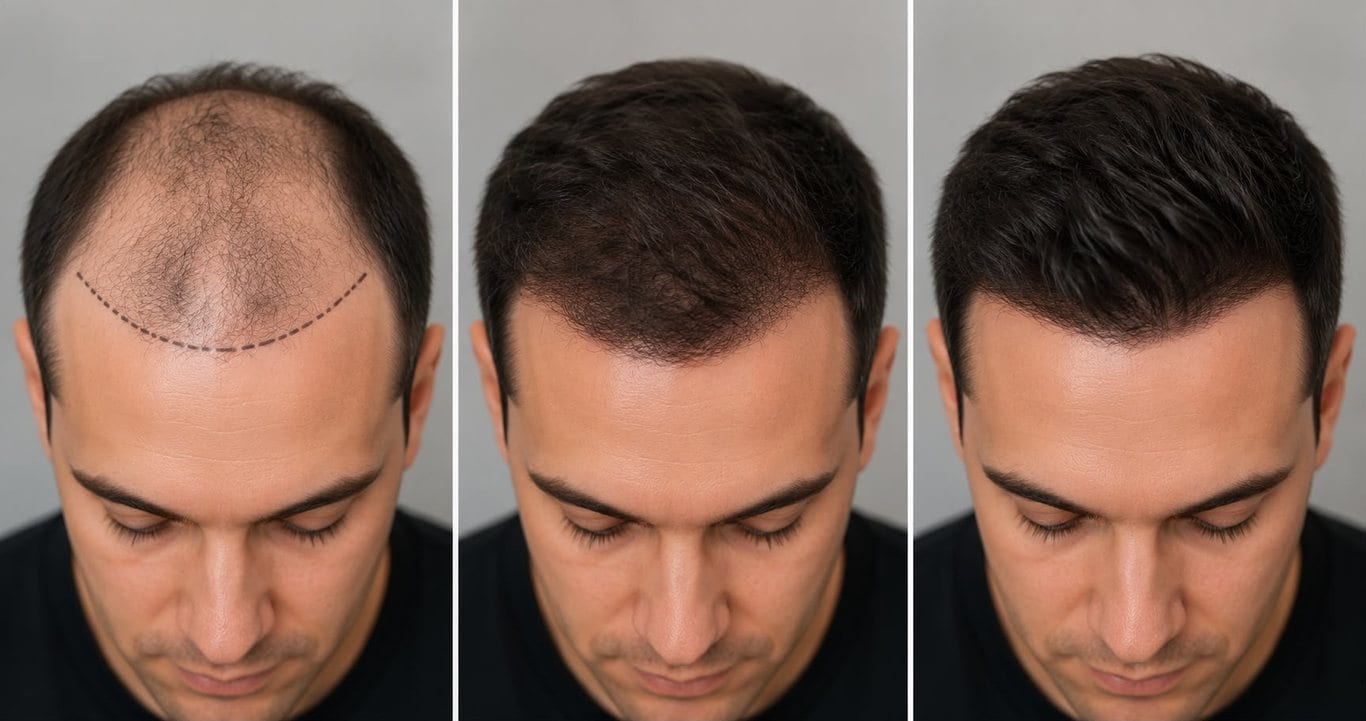
5-year results: what holds up
At five years the grafts themselves usually persist, because they came from a largely DHT-resistant zone.
At five years the grafts themselves usually persist, because they came from a largely DHT-resistant zone. What changes is the hair around them. Published follow-up in hair transplantation rarely extends this far, so most of what is known is clinical experience rather than data.
How much published evidence exists on five-year hair transplant results?
Very little published data covers five-year hair transplant results; outcome literature is dominated by twelve-month endpoints, and even recent quality-of-life studies by Maletic and colleagues and Nilforoushzadeh and colleagues stop before five years. What follows combines well-understood biology with consistent clinical experience, which is not the same as published evidence.
Anyone writing honestly about five-year hair transplant results has to open with the same admission: there is very little published data. The outcome literature in this field is dominated by twelve-month endpoints. Studies of adjuncts, techniques and devices routinely report satisfaction and density at one year and then stop.
Recent quality-of-life work follows the same pattern. Maletic and colleagues reported improvement in SF-36 scores after hair transplantation; Nilforoushzadeh and colleagues found statistically significant improvement in quality of life and self-esteem before versus after surgery. Both are useful and neither follows patients for five years.
So the material below is a synthesis of the biology, which is well understood, and clinical experience, which is consistent but not the same thing as evidence. Where a claim rests on experience rather than published follow-up, this series says so.
What generally holds up in a hair transplant result at five years?
Four elements generally hold up at five years: the grafts, since donor-zone follicles are largely resistant to DHT and usually still growing; hairline position, fixed permanently at surgery; donor scarring, settled within the first year; and graft angle and direction, which persist exactly as originally placed.
- The grafts. Follicles taken from the safe donor zone are largely resistant to DHT, and they behave the same way in their new position. In most patients the transplanted hair is still growing at five years.
- Hairline position. Where the hairline was drawn does not move. This is why the design decision made at surgery matters so much — it is the one element that is fixed for the rest of your life.
- Donor scarring. Dot scars and strip scars reach their final appearance within the first year and change little afterwards, other than the effect of surrounding density.
- Graft angle and direction. These persist as they were placed. A poorly angled result at year one is a poorly angled result at year five.
What changes in a hair transplant result over five years?
The dominant variable is native hair around and behind the grafts, which keeps miniaturising unless androgenetic alopecia is treated. The crown often opens further if untreated, overall density can look thinner even with no graft loss, donor density thins slowly with age, and hair colour and texture change with ordinary ageing.
- Native hair around and behind the grafts. This is the dominant variable. Androgenetic alopecia continues unless it is treated, and the hair in the recipient area that was not transplanted keeps miniaturising.
- The crown. If the crown was thinning at surgery and was not treated, it is usually more open at five years.
- Overall density perception. A result can look thinner at five years without a single graft having been lost, simply because the native hair between the grafts has gone.
- Donor density. Age-related thinning affects the donor area too, though slowly.
- Hair colour and texture, with ordinary ageing.
Why do patients feel disappointed with hair transplant results at five years?
The classic five-year disappointment is not graft failure but that the transplanted zone looks fine while native hair behind it has thinned, because the plan did not account for continuing hair loss. This is why a twelve-month photograph poorly predicts the five-year result, and why discussing only the first year misses what determines later satisfaction.
The classic five-year complaint is not that the transplant failed. It is that the transplanted zone looks fine and everything behind it does not.
A patient who had a dense frontal restoration at thirty-two, took no medical therapy, and returns at thirty-seven often has exactly the grafts he paid for and a visible gap behind them where native hair used to be. Nothing went wrong surgically. The plan simply did not account for the pattern continuing.
This is why the twelve-month photograph is a poor predictor of the five-year one, and why a surgeon who discusses only the first-year result has left out the part that determines whether you are satisfied later.
What predicts a good five-year hair transplant outcome?
Five predictors stand out: a conservative, age-appropriate hairline that ages well; medical therapy for native hair, since finasteride has five-year multinational follow-up data; donor reserve held back for future loss; older age at surgery with a settled pattern; and moderate rather than maximal first-session density spread over a sensible area.
- A conservative, age-appropriate hairline. High-placed hairlines age well; low ones do not.
- Medical therapy for the native hair, discussed with a doctor who knows your history. Finasteride has long-term multinational follow-up data at five years; this is one of the few places in the field where five-year evidence actually exists.
- Donor reserve held back so further loss can be addressed.
- Age at surgery. Older patients with settled patterns have more predictable five-year results than younger ones.
- Moderate rather than maximal first-session density, spread over a sensible area.
How should you use the five-year mark to judge a hair transplant clinic?
Five years is roughly when the difference between a well-planned and badly planned transplant becomes visible to others, since most competent surgery looks acceptable before then. When assessing a clinic, ask for five-year before-and-afters of the whole scalp rather than twelve-month ones — very few clinics can provide them.
Sources
- Maletic A, et al. Impact of Hair Transplantation on Quality of Life. Aesthetic Plastic Surgery, 2024;48(9):1825-1830. pubmed.ncbi.nlm.nih.gov/38123846
- Nilforoushzadeh MA, et al. Assessment of quality of life and self-esteem in male patients with androgenetic alopecia before and after hair transplantation. Journal of Cosmetic Dermatology, 2023;22(8):2283-2287. pubmed.ncbi.nlm.nih.gov/36912697
- Long-term (5-year) multinational experience with Finasteride 1 mg in the treatment of men with androgenetic alopecia. European Journal of Dermatology, 2002. pubmed.ncbi.nlm.nih.gov/11809594
- Maas D, et al. Rethinking the occipital scalp as a control in advanced androgenetic alopecia. Journal of the American Academy of Dermatology, 2026 (ahead of print). pubmed.ncbi.nlm.nih.gov/42398778
- Jimenez F, Ruifernández JM. Distribution of human hair in follicular units. A mathematical model for estimating the donor size in follicular unit transplantation. Dermatologic Surgery, 1999;25(4):294-298. pubmed.ncbi.nlm.nih.gov/10417585
This article summarises published research and standard clinical practice. It is general educational information, not medical advice, and it does not replace the instructions your own surgical team gives you. Where their guidance differs from anything here, follow theirs.
Get a no-obligation assessment against fixed criteria, directly on WhatsApp.