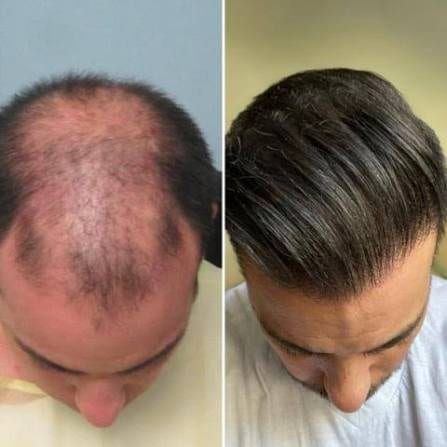
10-year results: what changes
At ten years the transplanted hair is usually still present and the surrounding scalp has changed considerably.
At ten years the transplanted hair is usually still present and the surrounding scalp has changed considerably. There is essentially no published ten-year outcome data in hair transplantation, so this is clinical experience rather than evidence.
Is there published ten-year outcome data for hair transplants?
No meaningful published ten-year outcome literature exists in hair transplantation — no registry, no standardised cohort, no long-term comparative trial. Any clinic quoting a ten-year survival percentage is not citing published follow-up; the gap exists because long-term tracking is expensive, patients disperse, there is no regulatory requirement, and no sponsor funds it, unlike with drugs.
There is no meaningful published ten-year outcome literature in hair transplantation. No registry, no cohort followed with standardised hair counts, no long-term comparative trial.
This is not a gap this article can fill with reasoning. What follows is what the biology predicts and what surgeons consistently report, labelled as such. Any clinic quoting a ten-year survival percentage is quoting a number that does not come from published follow-up.
It is worth pausing on why the gap exists. Long-term follow-up is expensive, patients disperse, there is no regulatory requirement, and — unlike a drug — there is no sponsor with an interest in funding it. The absence reflects the economics of the field rather than a settled question.
What is expected to persist in a hair transplant result at ten years?
Three things are expected to persist at ten years: the grafts, since donor-zone follicles are largely resistant to DHT and generally still growing; hairline position and design, fixed permanently at surgery; and scarring, settled within the first year. The word 'largely' matters, though — Maas and colleagues (2026) questioned how reliably occipital hair stays unaffected.
- The grafts. Donor-zone follicles are largely resistant to DHT and are generally reported as still growing at ten years and beyond.
- Hairline position and design. Fixed at surgery, permanently.
- Scarring. Settled within the first year.
The important qualifier on the first point is the word 'largely'. Recent literature has questioned how reliably occipital hair can be treated as unaffected — Maas and colleagues published in 2026 on rethinking the occipital scalp as a control in advanced androgenetic alopecia. Over a ten- or twenty-year horizon that qualifier matters more than it does at one year.
What changes in a hair transplant result by ten years?
By ten years, untreated native hair has mostly gone even though grafts remain, a thinning crown often becomes bald, many patients have had further sessions, hair ages with greying and reduced calibre, facial ageing can make a hairline sit differently, and scalp skin changes affect how grafts and scarring appear.
- Native hair. A decade of untreated androgenetic alopecia removes most of what was miniaturising at the time of surgery. The grafts remain; their surroundings do not.
- The crown, in most patients with crown involvement. Ten years is long enough for a thinning crown to become a bald one.
- Further sessions. Many patients have had a second or third procedure by this point, and the donor area reflects the cumulative extraction.
- Ageing of the hair itself. Greying, reduced calibre, reduced density with age — all of which affect transplanted and native hair alike.
- Facial ageing. A hairline that suited a thirty-year-old face may sit differently on a forty-year-old one, and low hairlines age worse than high ones.
- Skin. Scalp skin changes with age, which affects how grafts sit and how scarring appears.
What are the two possible outcomes of a hair transplant at ten years?
Clinical experience describes two endings: the good version — conservative hairline, moderate density, native hair preserved with medical therapy, reserve held back — looks like ordinary maturing hair by ten years; the poor version — low aggressive hairline, maximal density, no medical therapy, exhausted donor area — is not correctable. The gap is planning, not surgical skill.
Clinical experience describes two broadly different endings, and which one a patient reaches is largely determined by decisions made before the first operation.
The good version: a conservative, age-appropriate hairline, moderate density, native hair preserved with medical therapy, donor reserve held back, one or at most two sessions. At ten years this patient has hair that looks like ordinary maturing male hair. Nobody can tell.
The poor version: a low aggressive hairline placed young, maximal first-session density, no medical therapy, native hair gone. At ten years this patient has a dense band of hair at the front, a bald or thin zone behind it, and a donor area that has been harvested across three sessions with nothing left. This is not correctable.
The gap between them is not surgical skill. It is planning.
What questions should you ask a clinic about ten-year hair transplant results?
Ask whether the clinic has ten-year photographs of its own patients showing the whole scalp, how the design would look if the crown opens up, what remains in your donor area as a number, and what the plan is for native hair. Very few clinics can answer the photograph question.
- Do you have ten-year photographs of your own patients, showing the whole scalp?
- What does this design look like if my crown opens up over the next decade?
- What is left in my donor area after this session, as a number?
- What is the plan for my native hair?
Very few clinics can answer the first question. That is a fact about the field rather than about any individual clinic, but the ones that can produce ten-year images are demonstrating something meaningful — that they have kept patients that long and are willing to show the result.
Sources
- Maas D, et al. Rethinking the occipital scalp as a control in advanced androgenetic alopecia. Journal of the American Academy of Dermatology, 2026 (ahead of print). pubmed.ncbi.nlm.nih.gov/42398778
- Long-term (5-year) multinational experience with Finasteride 1 mg in the treatment of men with androgenetic alopecia. European Journal of Dermatology, 2002. pubmed.ncbi.nlm.nih.gov/11809594
- Maletic A, et al. Impact of Hair Transplantation on Quality of Life. Aesthetic Plastic Surgery, 2024;48(9):1825-1830. pubmed.ncbi.nlm.nih.gov/38123846
- Jimenez F, Ruifernández JM. Distribution of human hair in follicular units. A mathematical model for estimating the donor size in follicular unit transplantation. Dermatologic Surgery, 1999;25(4):294-298. pubmed.ncbi.nlm.nih.gov/10417585
- Romera de Blas C, Vega Díez D, Ricart Vayá JM, Gómez Zubiaur A. Complications in follicular unit excision hair transplantation: current evidence and practical approaches. Frontiers in Medicine, 2026;13:1750989. pubmed.ncbi.nlm.nih.gov/41709896
This article summarises published research and standard clinical practice. It is general educational information, not medical advice, and it does not replace the instructions your own surgical team gives you. Where their guidance differs from anything here, follow theirs.
Get a no-obligation assessment against fixed criteria, directly on WhatsApp.