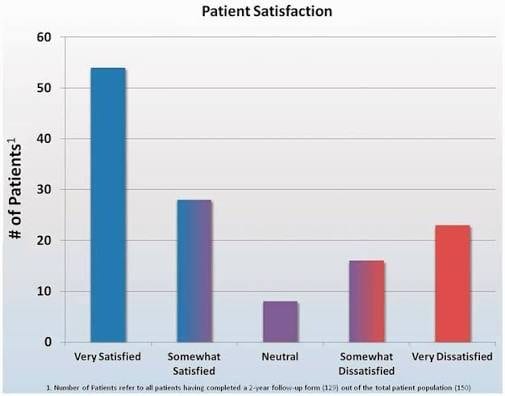
Long-term patient satisfaction data
Satisfaction after hair transplantation is well documented at twelve months and essentially undocumented beyond it.
Satisfaction after hair transplantation is well documented at twelve months and essentially undocumented beyond it. Published studies consistently show improved quality of life and self-esteem; none of them follows patients for years.
What do published studies show about hair transplant patient satisfaction?
Published studies consistently show improved satisfaction after hair transplantation: Maletic and colleagues (2024) reported significant SF-36 score improvement, Nilforoushzadeh and colleagues found a statistically significant pre- versus post-operative difference in quality of life and self-esteem, and one technique study reported 96.7% patient satisfaction at twelve months — all measuring around the one-year mark.
Satisfaction and quality-of-life research in hair transplantation is reasonably consistent and reasonably positive.
Maletic and colleagues published in Aesthetic Plastic Surgery in 2024 on the impact of hair transplantation on quality of life, reporting significant improvement in SF-36 scores after surgery.
Nilforoushzadeh and colleagues assessed quality of life and self-esteem in male patients with androgenetic alopecia before and after hair transplantation, reporting a statistically significant difference between pre- and post-operative scores.
Individual technique studies routinely report high satisfaction at twelve months — a prospective comparative study of an adjunct reported 96.7% patient satisfaction at twelve-month assessment, for instance.
Taken together, these support a straightforward claim: patients are substantially more satisfied after surgery than before, measured at around a year.
Why is there no long-term data on hair transplant satisfaction?
No substantial published research follows hair transplant satisfaction beyond twelve months — no studies exist at five, ten, or twenty years — which matters because continued native hair loss, the main thing that changes a result over time, happens on exactly the timescale nobody measures, so patients delighted at a year but disappointed at eight go uncaptured.
Every one of those studies reports at or around twelve months. There is no substantial published follow-up of satisfaction at five, ten or twenty years.
That gap matters more than it would in most surgical fields, because the thing that changes a hair transplant result over time — continued native hair loss — happens on exactly the timescale nobody measures.
A patient who is delighted at twelve months and disappointed at eight years is a well-recognised clinical pattern. Nothing in the published literature captures him, because he is measured once and then leaves the dataset.
Why is twelve-month satisfaction after a hair transplant easy to achieve?
Twelve-month satisfaction is genuinely high because most competent transplants show visible improvement within a year while the comparison point — the pre-operative state — is still fresh: transplanted hair has grown in dense, native hair hasn't thinned further, the donor area has healed normally, and expectations are still anchored to the before photograph.
This is worth stating without cynicism. Twelve-month satisfaction is genuinely high because most competent hair transplants produce a visible improvement within a year, and because the comparison point — the patient's pre-operative state — is fresh.
- The transplanted hair has grown in and looks dense.
- Native hair around it has not yet had time to thin further.
- The donor area has healed and, at the patient's usual hair length, usually looks normal.
- Expectations are anchored to the before photograph.
None of these conditions holds at eight years, which is why a twelve-month satisfaction figure should not be read as a durable outcome measure.
What long-term outcomes are not measured in hair transplant research?
Hair transplant research does not measure satisfaction beyond about a year, regret (no published rates exist), revision rates over a decade, donor-area satisfaction separately from recipient-area results, or patients who never returned for follow-up — the last of which biases single-clinic satisfaction figures upward, since dissatisfied patients disproportionately go elsewhere.
- Satisfaction beyond about a year.
- Regret. No published regret rates exist for hair transplantation.
- Revision rates over a decade. Not systematically tracked.
- Donor-area satisfaction as a separate outcome from recipient-area satisfaction.
- Patients who do not return. Follow-up studies measure the patients who came back, which is a selected group.
The last point is a general problem with cosmetic outcome data: dissatisfied patients disproportionately go elsewhere, so single-clinic satisfaction figures are systematically optimistic.
How should patients use hair transplant satisfaction data when choosing a clinic?
Since hair transplantation reliably improves quality of life at twelve months but nobody has published what happens after, patients should focus on factors that predict a durable result — a conservative hairline, medical therapy, donor reserve held back, planning for a worst-case pattern — rather than on clinic satisfaction statistics.
The honest summary is that hair transplantation reliably improves quality of life at twelve months, and that nobody has published what happens after that.
Practically, that shifts the weight onto the factors that predict a durable result rather than onto satisfaction statistics: a conservative age-appropriate hairline, medical therapy for the native hair, donor reserve held back, and a plan built against a worst-case pattern rather than a current one.
And when a clinic quotes a satisfaction percentage, the useful question is: measured when, by whom, in how many patients, and how many did not respond.
What satisfaction depends on over time is covered under longevity.
Sources
- Maletic A, et al. Impact of Hair Transplantation on Quality of Life. Aesthetic Plastic Surgery, 2024;48(9):1825-1830. pubmed.ncbi.nlm.nih.gov/38123846
- Nilforoushzadeh MA, et al. Assessment of quality of life and self-esteem in male patients with androgenetic alopecia before and after hair transplantation. Journal of Cosmetic Dermatology, 2023;22(8):2283-2287. pubmed.ncbi.nlm.nih.gov/36912697
- Tan IJ, Jafferany M. Psychological Dimensions of Hair Transplantation: A Narrative Review of Current Evidence. Journal of Cosmetic Dermatology, 2025;24(10):e70475. pubmed.ncbi.nlm.nih.gov/40990054
- Romera de Blas C, Vega Díez D, Ricart Vayá JM, Gómez Zubiaur A. Complications in follicular unit excision hair transplantation: current evidence and practical approaches. Frontiers in Medicine, 2026;13:1750989. pubmed.ncbi.nlm.nih.gov/41709896
- Maas D, et al. Rethinking the occipital scalp as a control in advanced androgenetic alopecia. Journal of the American Academy of Dermatology, 2026 (ahead of print). pubmed.ncbi.nlm.nih.gov/42398778
This article summarises published research and standard clinical practice. It is general educational information, not medical advice, and it does not replace the instructions your own surgical team gives you. Where their guidance differs from anything here, follow theirs.
Get a no-obligation assessment against fixed criteria, directly on WhatsApp.