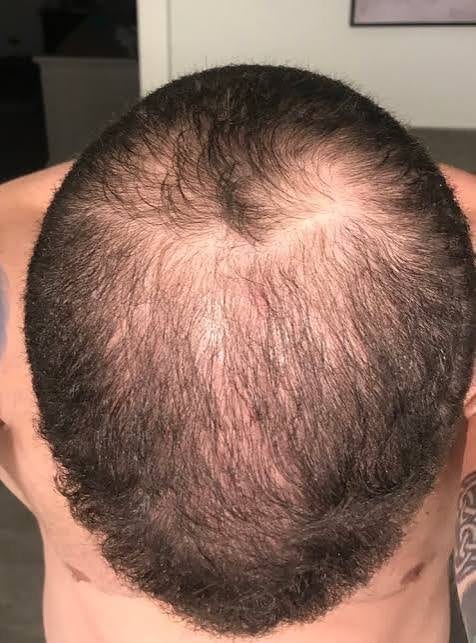
Diffuse thinning patients: long-term transplant results
Diffuse thinning is the presentation where long-term results most often disappoint, because the donor zone may be involved.
Diffuse thinning is the presentation where long-term results most often disappoint, because the donor zone may be involved. In diffuse unpatterned alopecia, grafts continue to miniaturise after transfer and the reserve is spent for nothing.
Why is diffuse thinning the hardest case for long-term hair transplant results?
Diffuse thinning is the hardest case because hair transplantation relies on a contrast between an affected recipient area and a stable donor area, which patterned loss guarantees but diffuse thinning may not. Grafts from a donor zone that is itself thinning continue thinning after transfer, so the result fades over the following years.
Hair transplantation depends on a contrast: an affected recipient area and an unaffected donor area. Patterned loss provides that contrast by definition.
Diffuse thinning may not. When hair is thinning across the whole scalp rather than in a defined pattern, the assumption that the back and sides are stable has to be demonstrated rather than presumed — and in a proportion of these patients it is not true.
This is the presentation in which long-term results most often fail, and the failure is not surgical. Grafts taken from a donor zone that is itself thinning continue to thin in their new position. The result looks acceptable at twelve months and fades over the following years, with the donor reserve already spent and dot scars in a donor area that was never stable.
What is diffuse unpatterned alopecia (DUPA) and why does it matter for hair transplants?
Diffuse unpatterned alopecia (DUPA) is miniaturisation affecting the entire scalp, including the occipital and lateral donor regions, and DUPA patients are generally regarded as poor transplant candidates. Xu and colleagues' 2026 case report argues occipital sparing is often assumed rather than verified, so the donor area must be actively examined, not assumed stable.
The clearest version of this is diffuse unpatterned alopecia, in which miniaturisation affects the entire scalp including the occipital and lateral regions.
Patients with DUPA are generally regarded as poor transplant candidates, and identifying them before surgery is one of the most consequential things donor assessment does.
Xu and colleagues published a 2026 case report using paired vertex-occipital assessment, arguing that occipital sparing is assumed rather than verified and that donor-area involvement may be overlooked in diffuse unpatterned alopecia. Maas and colleagues published in the same period on rethinking the occipital scalp as a control in advanced androgenetic alopecia.
Together these support a straightforward practical conclusion: in a diffuse presentation, the donor area must be examined, not assumed.
What conditions must be excluded before treating diffuse thinning as androgenetic alopecia?
Before treating diffuse thinning as androgenetic alopecia, clinicians must exclude telogen effluvium (which recovers), iron deficiency, thyroid disease, nutritional or medication causes, scarring alopecias (transplantable only once quiet for at least six months), and diffuse unpatterned alopecia, where surgery is generally inadvisable. Operating on an undiagnosed case wastes donor reserve without fixing the real problem.
Diffuse thinning has causes other than androgenetic alopecia, and several are treatable without surgery. Operating on an undiagnosed diffuse presentation is how patients end up with a spent donor area and an unresolved underlying problem.
- Telogen effluvium, which recovers.
- Iron deficiency and thyroid disease.
- Nutritional and medication causes.
- Scarring alopecias, where transplantation is considered only once the condition has been quiet for at least six months.
- Diffuse unpatterned alopecia, in which surgery is generally inadvisable.
What should a donor area assessment include for diffuse thinning patients?
A proper assessment includes trichoscopic examination of the donor zone at multiple points including the periphery, documentation of shaft diameter diversity as a miniaturisation marker, comparison of donor versus recipient miniaturisation, and recorded images for future comparison. A density count alone is insufficient, since follicle count can be adequate while hair is progressively finer.
- Trichoscopic examination of the donor zone at multiple points, including the periphery — nape, above and behind the ears.
- Specific documentation of shaft diameter diversity, which is the marker of miniaturisation.
- Comparison between donor and recipient miniaturisation, since the contrast between them is what establishes patterning.
- A dermatological workup where a non-androgenetic cause is plausible.
- Recorded images, so the donor area can be compared against itself in future.
A density count alone does not answer the question. A diffusely thinning donor area can still have an adequate follicular unit count while producing progressively finer hair.
Can a hair transplant work if the donor zone is diffusely thin but stable?
Yes, if trichoscopy shows a genuinely stable donor zone, a conservative plan can work, though the reserve is usually smaller and the margin for error narrower than in a clearly patterned case. Medical therapy matters more here than anywhere, and the result depends on an assumption tested as far as current methods allow, not certainty.
Not every diffuse presentation rules out surgery. Where trichoscopy shows a genuinely stable donor zone, a conservative plan can work.
It should be conservative. The reserve is usually smaller, the recipient area contains native hair that may continue to thin, and the margin for error is narrower than in a clearly patterned case. Medical therapy, discussed with a doctor, matters more here than anywhere.
And the honest framing to a patient is that the long-term result depends on an assumption about the donor area that has been tested as far as current methods allow — which is not the same as certainty.
Sources
- Xu Y, et al. Case Report: Paired vertex-occipital assessment reveals donor-area involvement in diffuse unpatterned alopecia. Frontiers in Medicine, 2026;13:1797275. pubmed.ncbi.nlm.nih.gov/41982548
- Maas D, et al. Rethinking the occipital scalp as a control in advanced androgenetic alopecia. Journal of the American Academy of Dermatology, 2026 (ahead of print). pubmed.ncbi.nlm.nih.gov/42398778
- Jimenez F, Ruifernández JM. Distribution of human hair in follicular units. A mathematical model for estimating the donor size in follicular unit transplantation. Dermatologic Surgery, 1999;25(4):294-298. pubmed.ncbi.nlm.nih.gov/10417585
- Gupta AK, Venkataraman M, Talukder M, Bamimore MA. Finasteride for hair loss: a review. Journal of Dermatological Treatment, 2022;33(4):1938-1946. pubmed.ncbi.nlm.nih.gov/34291720
- Romera de Blas C, Vega Díez D, Ricart Vayá JM, Gómez Zubiaur A. Complications in follicular unit excision hair transplantation: current evidence and practical approaches. Frontiers in Medicine, 2026;13:1750989. pubmed.ncbi.nlm.nih.gov/41709896
This article summarises published research and standard clinical practice. It is general educational information, not medical advice, and it does not replace the instructions your own surgical team gives you. Where their guidance differs from anything here, follow theirs.
Get a no-obligation assessment against fixed criteria, directly on WhatsApp.