
Graft longevity and DHT resistance
Transplanted follicles persist because they came from a zone that is largely resistant to DHT.
Transplanted follicles persist because they came from a zone that is largely resistant to DHT. Resistance is relative rather than absolute, and recent literature has begun questioning how reliably the occipital scalp can be assumed unaffected.
What is donor dominance and why does it make hair transplants work?
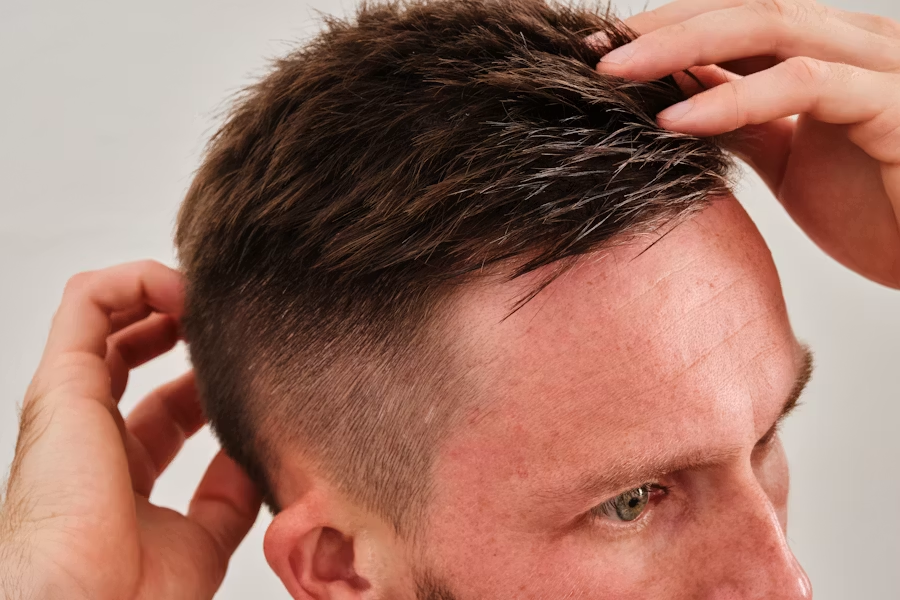
Donor dominance means a follicle carries its characteristics with it, so an occipital follicle keeps behaving like one after transfer — responding far less to DHT than frontal or crown follicles do. Donor hair is accurately described as largely resistant to DHT, a strong effect, but not immunity, and that distinction matters over a twenty-year horizon.
The reason a hair transplant works at all is donor dominance: a follicle carries its characteristics with it, so a follicle taken from the occipital scalp keeps behaving like an occipital follicle after transfer.
The characteristic that matters is responsiveness to dihydrotestosterone. Frontal and crown follicles in androgenetic alopecia miniaturise under DHT; occipital follicles respond far less. Move the latter to the former's position and it keeps growing.
The accurate description of that property is that donor hair is largely resistant to DHT. It is a strong effect and it is why the operation is reliable. It is not immunity, and over a twenty-year horizon the difference between 'resistant' and 'immune' is not academic.
Why does the claim that hair transplants are 'permanent' overstate the truth?
Three things complicate the 'permanent' claim: resistance to DHT is relative, not absolute; safe-zone boundaries are inferred rather than tested, so grafts near the margin may be less resistant; and ageing reduces hair density and calibre regardless of androgenetic alopecia. Most properly harvested grafts persist for decades, but the honest claim is durable, not guaranteed.
Three things complicate the simple claim.
- Resistance is relative. Donor follicles are much less responsive to DHT, not unresponsive.
- Safe zone boundaries are inferred. Nobody draws a line on a scalp and tests it. Grafts taken near the margin of a judged safe zone may be less resistant than those from the centre — and in a patient whose pattern was still expressing itself at surgery, the margin may have been drawn optimistically.
- Ageing happens anyway. Hair density and calibre decline with age independently of androgenetic alopecia. Transplanted hair ages with the rest of you.
None of this means transplants fail. Most properly harvested grafts persist for decades. It means the honest claim is durable and expected to last, not permanent and guaranteed.
What recent research questions whether occipital donor hair is truly unaffected by balding?
Two 2026 publications question this directly: Maas and colleagues questioned treating occipital hair as an unaffected reference in advanced androgenetic alopecia; Xu and colleagues, using paired vertex-occipital assessment, argued occipital sparing is assumed rather than verified, especially in diffuse unpatterned alopecia. Together they justify examining donor areas under magnification.
Two 2026 publications question the underlying assumption directly rather than at the margins.
Maas and colleagues published in the Journal of the American Academy of Dermatology on rethinking the occipital scalp as a control in advanced androgenetic alopecia. Treating occipital hair as an unaffected reference is a convention that underpins both research design and clinical donor assessment; questioning it goes to the foundation.
Xu and colleagues reported a case using paired vertex-occipital assessment, arguing that occipital sparing is assumed rather than verified and that donor-area involvement may be overlooked, particularly in diffuse unpatterned alopecia.
A commentary and a case report do not overturn practice. They do justify the more careful formulation, and they justify insisting that a donor area be examined under magnification rather than assumed to be fine.
Why do some hair transplant grafts fail to last long term?
Grafts that fail usually have an identifiable cause: harvesting outside the safe zone, diffuse unpatterned alopecia affecting the whole scalp including the donor area, unrecognised donor miniaturisation, scarring alopecia destroying grafts in the recipient area, or poor handling and high transection causing early failure. The first three are donor-assessment failures, which magnified examination can catch.
Grafts that do not last usually have an identifiable reason, and none of them is that transplantation does not work.
- Harvested outside the safe zone — from the nape, high toward the crown, or from the temporal region. These grafts carry the surrounding tissue's susceptibility with them.
- Diffuse unpatterned alopecia, where the whole scalp including the donor area is affected. Grafts from a thinning donor zone continue to thin.
- Unrecognised donor miniaturisation. The same problem in milder form.
- Scarring alopecia in the recipient area, where an active inflammatory process destroys grafts placed into it.
- Poor graft handling or high transection, which cause failure in the first year rather than gradual loss.
The first three are all donor-assessment failures, which is why magnified examination before surgery is the step that most determines whether a result lasts.
What should you realistically expect about how long your hair transplant grafts will last?
Expect your grafts to last, but not to be immortal, and do not accept 'permanent' as a clinical claim. The practical questions are whether your donor area was examined under magnification, whether miniaturisation was found, and where the harvest boundaries were drawn — these determine longevity far more than anything after surgery.
Sources
- Maas D, et al. Rethinking the occipital scalp as a control in advanced androgenetic alopecia. Journal of the American Academy of Dermatology, 2026 (ahead of print). pubmed.ncbi.nlm.nih.gov/42398778
- Xu Y, et al. Case Report: Paired vertex-occipital assessment reveals donor-area involvement in diffuse unpatterned alopecia. Frontiers in Medicine, 2026;13:1797275. pubmed.ncbi.nlm.nih.gov/41982548
- Jimenez F, Ruifernández JM. Distribution of human hair in follicular units. A mathematical model for estimating the donor size in follicular unit transplantation. Dermatologic Surgery, 1999;25(4):294-298. pubmed.ncbi.nlm.nih.gov/10417585
- Rassman WR, Bernstein RM, McClellan R, Jones R, Worton E, Uyttendaele H. Follicular unit extraction: minimally invasive surgery for hair transplantation. Dermatologic Surgery, 2002;28(8):720-728. pubmed.ncbi.nlm.nih.gov/12174065
- Gupta AK, Venkataraman M, Talukder M, Bamimore MA. Finasteride for hair loss: a review. Journal of Dermatological Treatment, 2022;33(4):1938-1946. pubmed.ncbi.nlm.nih.gov/34291720
This article summarises published research and standard clinical practice. It is general educational information, not medical advice, and it does not replace the instructions your own surgical team gives you. Where their guidance differs from anything here, follow theirs.
Get a no-obligation assessment against fixed criteria, directly on WhatsApp.