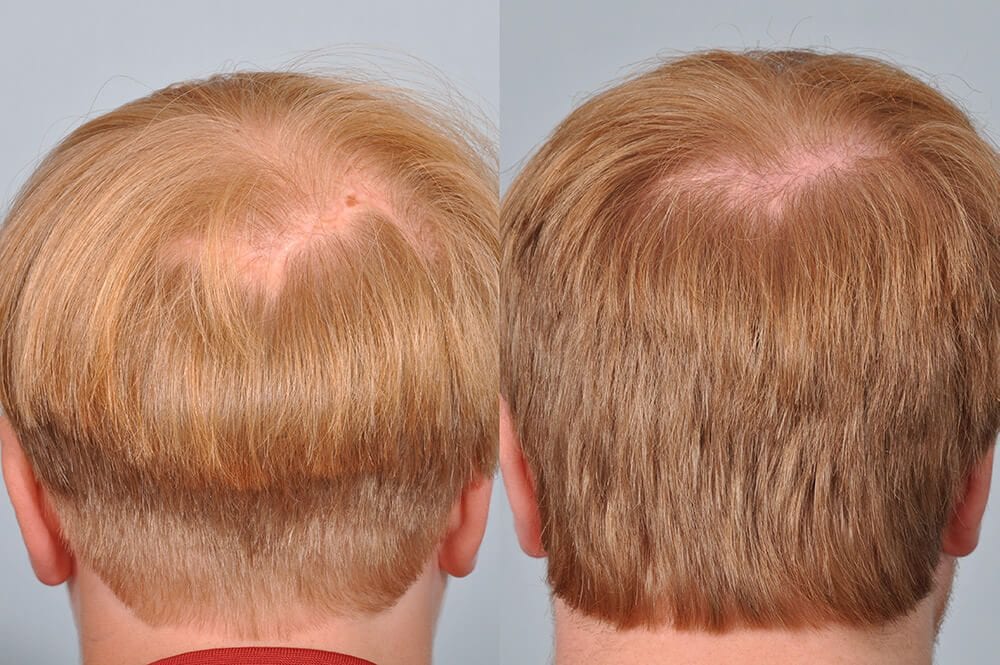
Long-term outcomes after scarring alopecia transplants
Transplantation into a burnt-out scarring alopecia can work, but graft survival in scarred tissue is lower and disease reactivation is a real risk.
Transplantation into a burnt-out scarring alopecia can work, but graft survival in scarred tissue is lower and disease reactivation is a real risk. Published experience is limited to small case series with follow-up in months to a couple of years.
What is scarring alopecia, and when can it be treated with a transplant?
Scarring (cicatricial) alopecias — including lichen planopilaris, frontal fibrosing alopecia, discoid lupus erythematosus and folliculitis decalvans — destroy follicles and replace them with fibrous tissue. Transplantation is only considered once the condition has been quiet for at least six months, often longer, because active inflammation attacks grafts and surgical trauma can reactivate disease.
Scarring (cicatricial) alopecias destroy follicles and replace them with fibrous tissue. The group includes lichen planopilaris, frontal fibrosing alopecia, discoid lupus erythematosus, folliculitis decalvans and central centrifugal cicatricial alopecia, among others.
For transplantation the standard requirement is that the condition must have been quiet for at least six months before surgery is considered, and many clinicians want considerably longer. Grafts placed into an active inflammatory process are attacked by it, and the surgical trauma itself can reactivate disease.
Establishing quiescence is a dermatological judgement requiring diagnosis, usually biopsy, and follow-up over time. It is not a cosmetic assessment.
What does published research show about transplants for scarring alopecia?
The published evidence is small: Osipowicz and colleagues reported a 2025 case series of five lichen planopilaris patients, with over twelve months' follow-up and all patients satisfied. That is a useful signal for quiescent lichen planopilaris but not a basis for predicting ten-year outcomes, and for most other scarring alopecias the evidence is thinner still.
The literature is small. Osipowicz and colleagues published a case series of five patients with lichen planopilaris in the Journal of Clinical Medicine in 2025, with extended follow-up beyond twelve months, in which all patients declared satisfaction.
Five patients, one condition, follow-up measured in months to a couple of years. That is a useful signal that transplantation into quiescent lichen planopilaris can produce satisfied patients. It is not a basis for predicting what happens at ten years, and it should not be presented as one.
For most other scarring alopecias the published transplant experience is thinner still.
Why are long-term results less predictable for transplants into scarring alopecia?
Results are less predictable because scarred tissue is poorly vascularised, lowering graft survival, and the underlying disease can reactivate even after years of quiet, destroying grafts. The donor area itself may be affected — folliculitis decalvans often involves the occipital and vertex regions — and surgical trauma can trigger disease at the wound site (koebnerisation).
- Graft survival in scarred tissue is lower. Scar tissue is poorly vascularised, and grafts depend on the recipient bed for their first days. Expect reduced yield.
- Reactivation. These conditions relapse. A patient quiet for two years can flare, and a flare after transplantation can destroy the grafts.
- The donor area may be involved. Lichen planopilaris can appear anywhere on the scalp; folliculitis decalvans often affects the occipital and vertex regions specifically. Grafts from an affected donor zone carry the problem with them.
- Surgical trauma as a trigger. Some cicatricial alopecias exhibit koebnerisation, where injury provokes disease at the injured site — which is a specific concern in a procedure that wounds both donor and recipient areas.
What does good clinical practice look like for transplanting into scarring alopecia?
Good practice starts with dermatological diagnosis and biopsy before any surgical discussion, followed by documented quiescence of at least six months and trichoscopic examination of the donor area for scarring changes. Test grafting — placing a small number first and assessing survival — protects the donor reserve, alongside ongoing dermatological follow-up and lowered expectations.
- Dermatological diagnosis first, with biopsy where indicated, before any surgical discussion.
- Documented quiescence of at least six months, and preferably longer.
- Trichoscopic examination of the donor area for scarring changes — loss of follicular openings, perifollicular erythema and scale, tufting — not just a density count.
- Test grafting. Placing a small number and assessing survival before committing protects the donor reserve, which is the argument for it.
- Ongoing dermatological follow-up after surgery, since the underlying condition has not gone away.
- Explicitly lowered expectations about density and about durability.
Which scarring alopecia cases have better long-term transplant prospects?
Prospects are better for traction alopecia that has stopped and stayed quiet, since the cause was mechanical rather than immune and the donor area is typically genuinely unaffected. Post-traumatic and post-surgical scars, being stable and non-inflammatory, are also among the more reliable indications, as is burnt-out, localised disease with a demonstrably unaffected donor area.
Not all of these cases are marginal.
- Traction alopecia that has stopped and been quiet is often favourable, because the cause was mechanical rather than immune and the donor area is typically genuinely unaffected.
- Post-traumatic and post-surgical scars are stable and non-inflammatory, and are among the more reliable indications for grafting into scar tissue.
- Burnt-out, localised disease with a demonstrably unaffected donor area is the best of the inflammatory group.
In all of these, the long-term question is still open in the same way it is open across the whole field — nobody has followed these patients for a decade.
Transplanting into scarred skin belongs with repair and correction.
Sources
- Osipowicz K, Turkowski P, Kowalewski C, Pach J, Regulski P, Wozniak K. Hair Transplantation for Lichen Planopilaris: A Case Series of Five Patients. Journal of Clinical Medicine, 2025;14(17):6199. pubmed.ncbi.nlm.nih.gov/40943957
- Romera de Blas C, Vega Díez D, Ricart Vayá JM, Gómez Zubiaur A. Complications in follicular unit excision hair transplantation: current evidence and practical approaches. Frontiers in Medicine, 2026;13:1750989. pubmed.ncbi.nlm.nih.gov/41709896
- Xu Y, et al. Case Report: Paired vertex-occipital assessment reveals donor-area involvement in diffuse unpatterned alopecia. Frontiers in Medicine, 2026;13:1797275. pubmed.ncbi.nlm.nih.gov/41982548
- Parsley WM, Perez-Meza D. Review of factors affecting the growth and survival of follicular grafts. Journal of Cutaneous and Aesthetic Surgery, 2010;3(2). jcasonline.com
- Jimenez F, Ruifernández JM. Distribution of human hair in follicular units. A mathematical model for estimating the donor size in follicular unit transplantation. Dermatologic Surgery, 1999;25(4):294-298. pubmed.ncbi.nlm.nih.gov/10417585
This article summarises published research and standard clinical practice. It is general educational information, not medical advice, and it does not replace the instructions your own surgical team gives you. Where their guidance differs from anything here, follow theirs.
Get a no-obligation assessment against fixed criteria, directly on WhatsApp.